Upamanyu Pablo Mukherjee - Böcker
Visar alla böcker från författaren Upamanyu Pablo Mukherjee. Handla med fri frakt och snabb leverans.
4 produkter
4 produkter
2 073 kr
Skickas inom 7-10 vardagar
The language of crime and punishment is everywhere, especially in the context of building new global orders where old imperial relationships between the west and the rest of the world are being redefined and redesigned. This book is about one of the formative moments of this rhetorical strategy of representing empires. By looking at a variety of British narratives about India being produced from the later half of the eighteenth century onwards, it suggests that the discourse of crime was one of the major representative tools which the British employed to understand, imagine, and rule the vast country. However, to understand the full implication of this strategy for British understanding of both the colonised 'others' and a particular image of 'self', we must study the formation of this discourse not only in the context of the colony, but of its peculiar importance within 'domestic' Britain itself. Nineteenth-Century British society placed a huge amount of importance on issues of crime, punishment, order, and policing. These issues became fundamental to British claims of being a civilised nation. Naturally, they became an important part of British colonial/imperial strategy. But, since in Britain these issues were sites of contest and not consent, of debate and opposition and not unquestioned hegemonic power, they were inherently risky tools to use in building an ideology of empire. As the various readings of the narratives employing 'fictions' of crime offered here shows, an opposition or critique of empire was formed through these fictions even as they were used to build a consensus for empire-building. The slippages and ambiguities associated with imperial narratives then, are not products of some inherent semiotic disorder. Rather, they grew out of a particular history within which the rhetoric employed by these narratives took shape. This book is an attempt to recover the traces of that history within the various imperial fictions of crime.
Del 17 - Postcolonialism Across the Disciplines
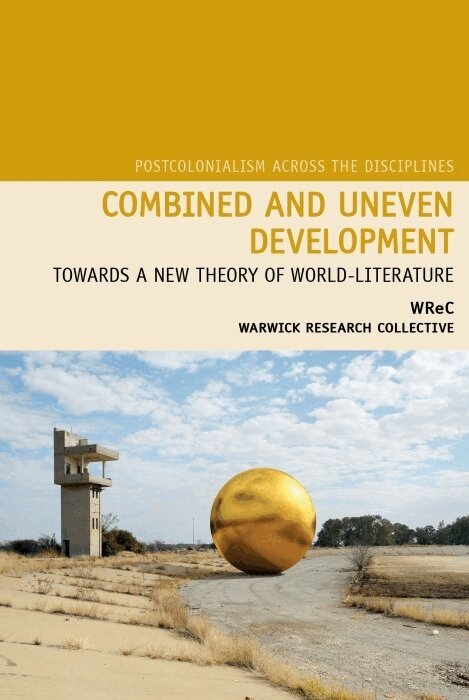
Combined and Uneven Development
Towards a New Theory of World-Literature
Häftad, Engelska, 2015
498 kr
Skickas inom 7-10 vardagar
The ambition of this book is to resituate the problem of ‘world literature’, considered as a revived category of theoretical enquiry, by pursuing the literary-cultural implications of the theory of combined and uneven development. This theory has a long pedigree in the social sciences, where it continues to stimulate debate. But its implications for cultural analysis have received less attention, even though the theory might be said to draw attention to a central – perhaps the central – arc or trajectory of modern(ist) production in literature and the other arts worldwide. It is in the conjuncture of combined and uneven development, on the one hand, and the recently interrogated and expanded categories of ‘world literature’ and ‘modernism’, on the other, that this book looks for its specific contours. In the two theoretical chapters that frame the book, the authors argue for a single, but radically uneven world-system; a singular modernity, combined and uneven; and a literature that variously registers this combined unevenness in both its form and content to reveal itself as, properly speaking, world-literature. In the four substantive chapters that then follow, the authors explore a selection of modern-era fictions in which the potential of their method of comparativism seems to be most dramatically highlighted. They treat the novel paradigmatically, not exemplarily, as a literary form in which combined and uneven development is manifested with particular salience, due in no small part to its fundamental association with the rise of capitalism and its status in peripheral and semi-peripheral societies as a ‘modernising’ import. The peculiar plasticity and hybridity of the novel form enables it to incorporate not only multiple literary levels, genres and modes, but also other non-literary and archaic cultural forms – so that, for example, realist elements might be mixed with more experimental modes of narration, or older literary devices might be reactivated in juxtaposition with more contemporary frames.
Del 61 - Liverpool Science Fiction Texts & Studies
Final Frontiers
Science Fiction and Techno-Science in Non-Aligned India
Inbunden, Engelska, 2020
2 783 kr
Skickas inom 3-6 vardagar
Winner of the Science Fiction Research Association Book Award 2021.This is the first book-length study of the relationship between science fiction, the techno-scientific policies of independent India, and the global non-aligned movement that emerged as a response to the Cold War and decolonization. Today, we see the trend of science fiction writers being used by governments as advisors on techno-scientific policies and defence industries. But such relationships between literature, policy and geo-politics have a long and complex history. Glimpses of this history can be seen in the case of the first generation of post-colonial Indian science fiction writers, the policies of scientific and technological development in independent India, and the political strategy of non-alignment advocated by India’s first prime minister, Jawaharlal Nehru, who proposed that Third World nations should maintain an equal distance between Washington and Moscow. Such a perspective reveals the surprisingly long and relatively unknown life of Indian science fiction, as well as the critical role played by the genre in imagining alternative pathways for scientific and geo-political developments to those that dominate our lives now.
Del 61 - Liverpool Science Fiction Texts & Studies
Final Frontiers
Science Fiction and Techno-Science in Non-Aligned India
Häftad, Engelska, 2022
498 kr
Skickas inom 7-10 vardagar
Winner of the Science Fiction Research Association Book Award 2021.This is the first book-length study of the relationship between science fiction, the techno-scientific policies of independent India, and the global non-aligned movement that emerged as a response to the Cold War and decolonization. Today, we see the trend of science fiction writers being used by governments as advisors on techno-scientific policies and defence industries. But such relationships between literature, policy and geo-politics have a long and complex history. Glimpses of this history can be seen in the case of the first generation of post-colonial Indian science fiction writers, the policies of scientific and technological development in independent India, and the political strategy of non-alignment advocated by India’s first prime minister, Jawaharlal Nehru, who proposed that Third World nations should maintain an equal distance between Washington and Moscow. Such a perspective reveals the surprisingly long and relatively unknown life of Indian science fiction, as well as the critical role played by the genre in imagining alternative pathways for scientific and geo-political developments to those that dominate our lives now.