Ursula-F. Habenicht – författare
Visar alla böcker från författaren Ursula-F. Habenicht. Handla med fri frakt och snabb leverans.
5 produkter
Fertility Control
Av Ursula-F. Habenicht, Robert John Aitken
Inbunden, 2010
3377 kr
Lägg i varukorg
The world’s population is growing at an unsustainable rate. From a baseline ?gure of one billion in 1800, global population is predicted to exceed nine billion by 2050 and 87. 8% of this growth will be localized in less developed countries. Such uneven population growth will yield a harvest of …
Fertility Control
Av Robert John Aitken, Ursula-F. Habenicht
E-bok, 2010
4187 kr
Lägg i varukorg
The world’s population is growing at an unsustainable rate. From a baseline ?gure of one billion in 1800, global population is predicted to exceed nine billion by 2050 and 87. 8% of this growth will be localized in less developed countries. Such uneven population growth will yield a harvest of …
Fertility Control
Av Ursula-F. Habenicht, Robert John Aitken
Häftad, 2014
3386 kr
Lägg i varukorg
The world’s population is growing at an unsustainable rate. From a baseline ?gure of one billion in 1800, global population is predicted to exceed nine billion by 2050 and 87. 8% of this growth will be localized in less developed countries. Such uneven population growth will yield a harvest of …
Spermatogenesis - Fertilization - Contraception
Molecular, Cellular and Endocrine Events in Male Reproduction
Av Ursula-F. Habenicht, E. Nieschlag
E-bok, 2013
1502 kr
Lägg i varukorg
Investigations into the mechanisms of spennatogenesis, sperm matura tion and fertilization provide the basis of our understanding of male re productive physiology. Since in recent years molecular and cellular en docrinology has provided particularly important contributions to our knowledge, the …
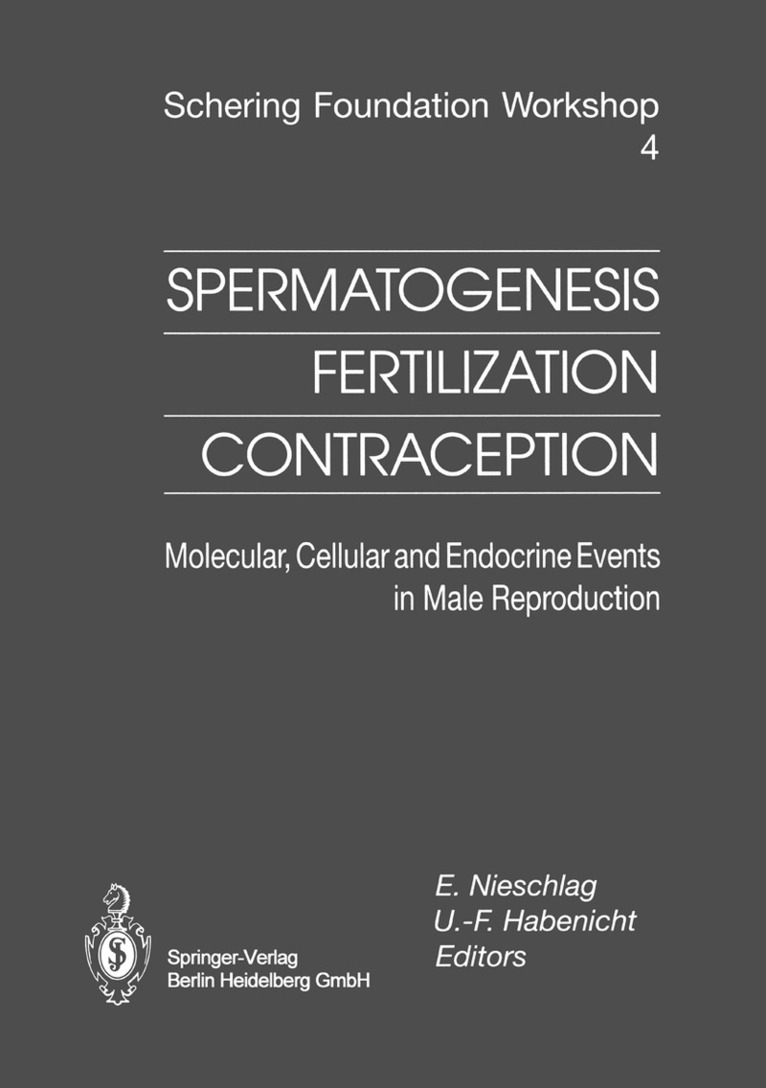
Spermatogenesis — Fertilization — Contraception
Molecular, Cellular and Endocrine Events in Male Reproduction
Av E. Nieschlag, Ursula-F. Habenicht
Häftad, 2013
1130 kr
Lägg i varukorg
Investigations into the mechanisms of spennatogenesis, sperm matura tion and fertilization provide the basis of our understanding of male re productive physiology. Since in recent years molecular and cellular en docrinology has provided particularly important contributions to our knowledge, the …