V. Fidler – författare
Visar alla böcker från författaren V. Fidler. Handla med fri frakt och snabb leverans.
5 produkter
5 produkter
Inbunden, Engelska, 2004
1 619 kr
Skickas inom 10-15 vardagar
Take any combination of the following features: supramolecular structures with a specific fluorescent probe localized as you would like; nanoscale spatial reso- tion; tailor-made molecular and/or solid-state fluorescing nanostructures; us- friendly and/or high- throughput fluorescence techniques; the ability to do wh- ever you wish with just one single (supra)molecule; utilization of non-linear optical processes; and,last but not least,physical understanding of the processes resu- ing in a (biological) functionality at the single molecule level. What you will then have is some recent progress in physics,chemistry,and the life sciences leading to the development of a new tool for research and application. This was amply demonstrated at the 8th Conference on Methods and Applications of Fluorescence: Probes,Imaging,and Spectroscopy held in Prague,the Czech Republic on August 24th-28th, 2003. This formed a crossroad of ideas from a variety of natural science and technical research fields and biomedical applications in particular.This volume - the third book in the Springer-Verlag Series on Fluorescence - reviews some of the most characteristic topics of the multidisciplinary area of fluorescence applications in life sciences either presendted directly at th 8th MAF Conference or considered to be a cruical development in the field. In the initial contribution in Part 1 - Basics and Advanced Approaches,the - itors explain the basics of fluorescence and illustrate the relationship between some modern fluorescence techniques and classical approaches. The second contrigution by B.
E-bok
PDF, Engelska, 20062 036 kr
Läs direkt efter köp
Häftad, Engelska, 2010
1 667 kr
Skickas inom 10-15 vardagar
Take any combination of the following features: supramolecular structures with a specific fluorescent probe localized as you would like; nanoscale spatial reso- tion; tailor-made molecular and/or solid-state fluorescing nanostructures; us- friendly and/or high- throughput fluorescence techniques; the ability to do wh- ever you wish with just one single (supra)molecule; utilization of non-linear optical processes; and,last but not least,physical understanding of the processes resu- ing in a (biological) functionality at the single molecule level. What you will then have is some recent progress in physics,chemistry,and the life sciences leading to the development of a new tool for research and application. This was amply demonstrated at the 8th Conference on Methods and Applications of Fluorescence: Probes,Imaging,and Spectroscopy held in Prague,the Czech Republic on August 24th-28th, 2003. This formed a crossroad of ideas from a variety of natural science and technical research fields and biomedical applications in particular.This volume - the third book in the Springer-Verlag Series on Fluorescence - reviews some of the most characteristic topics of the multidisciplinary area of fluorescence applications in life sciences either presendted directly at th 8th MAF Conference or considered to be a cruical development in the field. In the initial contribution in Part 1 - Basics and Advanced Approaches,the - itors explain the basics of fluorescence and illustrate the relationship between some modern fluorescence techniques and classical approaches. The second contrigution by B.
E-bok
PDF, Engelska, 20121 408 kr
Läs direkt efter köp
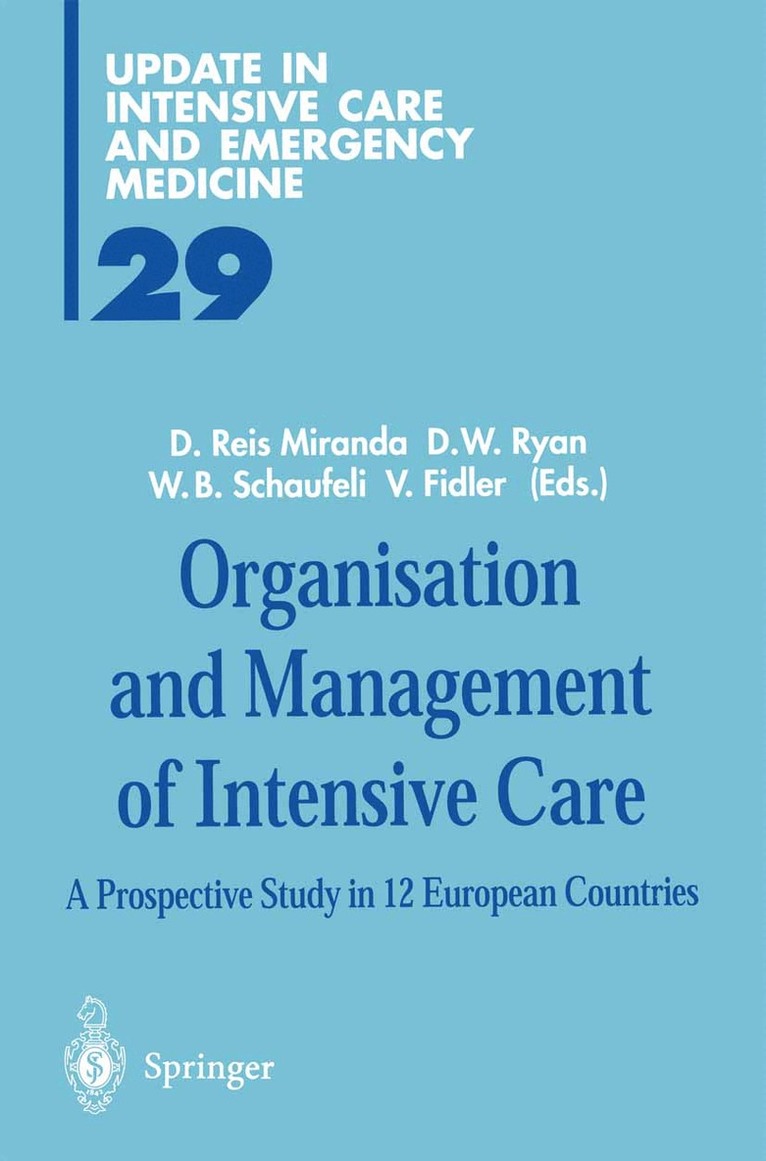
From the viewpoint of a health economist, the intensive care unit (leU) is a particularly fascinating phenomenon. It is the epitome of "high-tech" medicine and frequently portrayed as the place where life-saving miracles are routinely wrought. But the popular imagina tion is also caught up in the darker side, when agonizing decisions have to be made to avoid futile and inhuman continuation of expen sive treatments. My analytical interests led me to approach these issues by asking what the evidence tells us about which leu activities are very bene ficial in relationship to their costs and which are not. This quickly translates into a slightly different question, namely, which patients are most appropriately treated in an leu and which not. Unfor tunately, it is very hard to answer these questions because it has pro ved very difficult to investigate these issues in the manner which is now regarded as the "gold standard:'' namely by conducting rando mized clinical trials or alternative courses of action. I think this is a pity, and I am not at all convinced that it would be unethical to do so in many cases, because there is wide variation in practice and ge nuine doubt as to which practices are best -the two conditions that need to be fulfilled before such a trial is justifiable.
Häftad, Engelska, 2011
1 114 kr
Skickas inom 10-15 vardagar
From the viewpoint of a health economist, the intensive care unit (leU) is a particularly fascinating phenomenon. It is the epitome of "high-tech" medicine and frequently portrayed as the place where life-saving miracles are routinely wrought. But the popular imagina tion is also caught up in the darker side, when agonizing decisions have to be made to avoid futile and inhuman continuation of expen sive treatments. My analytical interests led me to approach these issues by asking what the evidence tells us about which leu activities are very bene ficial in relationship to their costs and which are not. This quickly translates into a slightly different question, namely, which patients are most appropriately treated in an leu and which not. Unfor tunately, it is very hard to answer these questions because it has pro ved very difficult to investigate these issues in the manner which is now regarded as the "gold standard:' namely by conducting rando mized clinical trials or alternative courses of action. I think this is a pity, and I am not at all convinced that it would be unethical to do so in many cases, because there is wide variation in practice and ge nuine doubt as to which practices are best -the two conditions that need to be fulfilled before such a trial is justifiable.