V. Tanaev - Böcker
Visar alla böcker från författaren V. Tanaev. Handla med fri frakt och snabb leverans.
5 produkter
5 produkter
535 kr
Skickas inom 10-15 vardagar
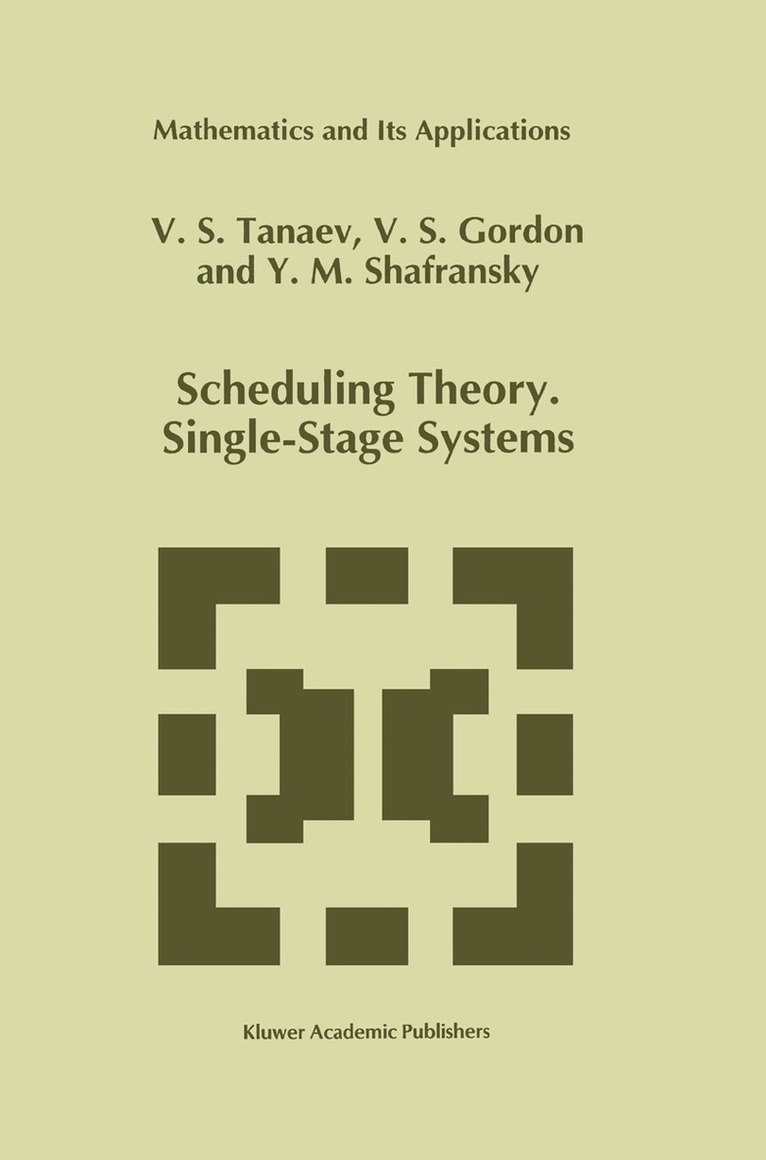
This is one of two volumes devoted to single and multistage systems in scheduling theory respectively. The main emphasis throughout is on the analysis of the computational complexity of scheduling problems. This volume is devoted to the problems of determining optimal schedules for systems consisting of either a single machine or several parallel machines. The most important statements and algorithms which relate to scheduling are described and discussed in detail. The book has an introduction followed by four chapters dealing with the elements of graph theory and the computational complexity of algorithms, polynomially solvable problems, priority-generating functions, and NP-Hard problems, respectively. Each chapter concludes with a comprehensive biobliography and review. The volume also includes an appendix devoted to approximation algorithms and extensive reference sections. The text is suitable for researchers and graduate students of management science and operations research interested in production planning and flexible manufacturing.
1 064 kr
Skickas inom 10-15 vardagar
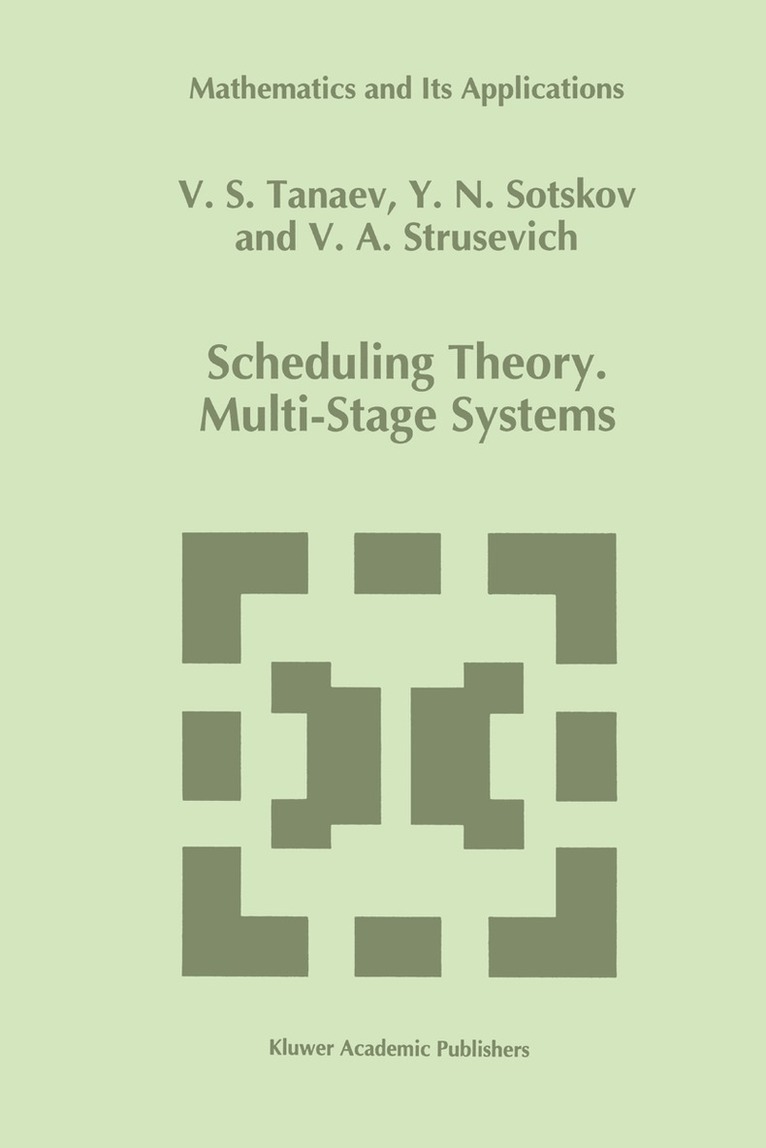
This volume is concerned with the problems of finding optimal schedules for systems comprising several sequential machines. More specifically, attention is largely given in separate chapters to three classical processing systems: the flow shop, the job shop and the open shop. A final chapter deals with mixed graph problems. Each of the four chapters concludes with a comprehensive bibliography and review. The volume also has an introduction and finishes with an extensive reference section. This volume is suitable for researchers and graduate students of management science and operations research interested in production planning and flexible manufacturing.
4 591 kr
Skickas inom 10-15 vardagar
This two-volume set is devoted to single and multistage systems in scheduling theory. The main emphasis throughout is on the analysis of the computational complexity of scheduling problems. The first volume is devoted to the problems of determining optimal schedules for systems consisting of either a single machine or several parallel machines. The most important statements and algorithms which relate to scheduling are described and discussed in detail. It has an introduction followed by four chapters dealing with the elements of graph theory and the computational complexity of algorithms, polynomially solvable problems, priority-generating functions, and NP-Hard problems, respectively. Each chapter concludes with a comprehensive biobliography and review. The volume also includes an appendix devoted to approximation algorithms and extensive reference sections. The second volume is concerned with the problems of finding optimal schedules for systems comprising several sequential machines. More specifically, attention is largely given in separate chapters to three classical processing systems: the flow shop, the job shop, and the open shop.A final chapter deals with mixed graph problems. Each of the four chapters concludes with a comprehensive bibliography and review. The volume also has an introduction and finishes with an extensive reference section. These volumes are suitable for researchers and graduate students of management science and operations research interested in production planning and flexible manufacturing.
535 kr
Skickas inom 10-15 vardagar
Scheduling theory is an important branch of operations research. Problems studied within the framework of that theory have numerous applications in various fields of human activity. As an independent discipline scheduling theory appeared in the middle of the fifties, and has attracted the attention of researchers in many countries. In the Soviet Union, research in this direction has been mainly related to production scheduling, especially to the development of automated systems for production control. In 1975 Nauka ("Science") Publishers, Moscow, issued two books providing systematic descriptions of scheduling theory. The first one was the Russian translation of the classical book Theory of Scheduling by American mathematicians R. W. Conway, W. L. Maxwell and L. W. Miller. The other one was the book Introduction to Scheduling Theory by Soviet mathematicians V. S. Tanaev and V. V. Shkurba. These books well complement each other. Both. books well represent major results known by that time, contain an exhaustive bibliography on the subject. Thus, the books, as well as the Russian translation of Computer and Job-Shop Scheduling Theory edited by E. G. Coffman, Jr., (Nauka, 1984) have contributed to the development of scheduling theory in the Soviet Union. Many different models, the large number of new results make it difficult for the researchers who work in related fields to follow the fast development of scheduling theory and to master new methods and approaches quickly.
1 064 kr
Skickas inom 10-15 vardagar
An increasing interest to scheduling theory can be attributed to the high level of automation of all branches of human activity. The quality of modern production essentially depends on the planning decisions taken at different stages of a production process. Moreover, while the quality of these decisions is improving, the time and flexibility requirements for decision-making are becoming more important. All this stimulates scheduling research. Started as an independent discipline in the early fifties, it now has become an important branch of operations research. In the eighties, the largest Russian publishing house for scientific literature Nauka Publishers, Moscow, issued two books by a group of Byelorussian mathematicians: Scheduling Theory. Single-Stage Systems by V. S. Tanaev, V. S. Gordon and Y. M. Shafransky (1984) and Scheduling Theory. Multi-Stage Systems by V. S. Tanaev, Y. N. Sotskov and V. A. Strusevich (1989). Originally published in Russian, these two books cover two different major problem areas of scheduling theory and can be considered as a two-volume monograph that provides a systematic and comprehensive exposition of the subject. The authors are grateful to Kluwer Academic Publishers for creating the opportunity to publish the English translations of these two books. We are indebted to M. Hazewinkel, J. K. Lenstra, A. H. G. Rinnooy Kan, D. B. Shmoys and W. Szwarc for their supporting the idea of translating the books into English.