Valeria Bello - Böcker
Visar alla böcker från författaren Valeria Bello. Handla med fri frakt och snabb leverans.
8 produkter
8 produkter
1 954 kr
Skickas inom 10-15 vardagar
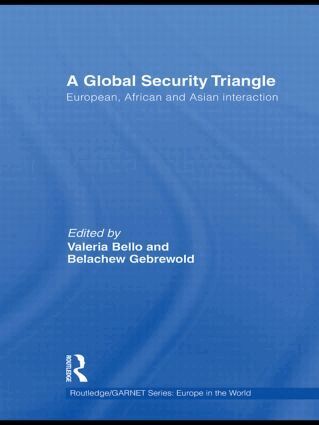
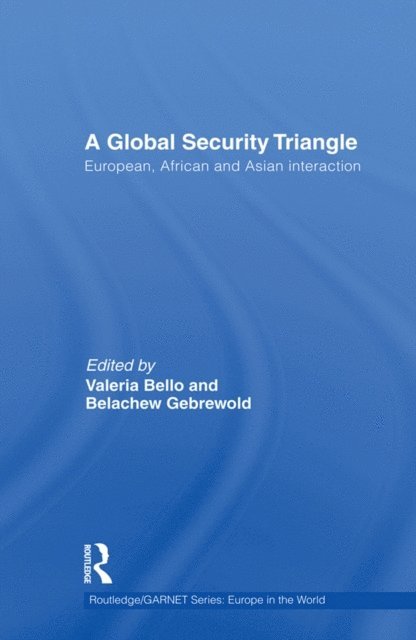
This book considers the interactions between Africa, Asia and Europe, analysing the short and long term strategies various states have adopted to external relations.The urgency attached to the agenda of international terrorism and human and drugs- trafficking has forced the European Union into new cooperation with Africa and Asia. These inter-regional relations have taken on new dimensions in the context of contemporary international politics framed by new security challenges, and new competitive forces particularly from Asia. This book provides both conceptual and empirical arguments to offer an innovative perspective on the EU as a global actor. It demonstrates how these three regions interact politically and economically to address global challenges as well as global opportunities, and thus provides an assessment of the multilateralism which the EU clearly stated in its Security Strategy paper. Addressing a broad range of topical issues, the book features chapters on European Security; European Migration Policy; African Union and its peace and security policy; Terrorism and international security; China and its fast growing global role; India, the biggest democracy in the world; and the impact of the Asian economic growth on the global economy. Further it compares the different backgrounds, forms and priorities of regional integrations.A Global Security Triangle will be of interest to all scholars of European politics, security studies, African and Asian studies, and International Relations.
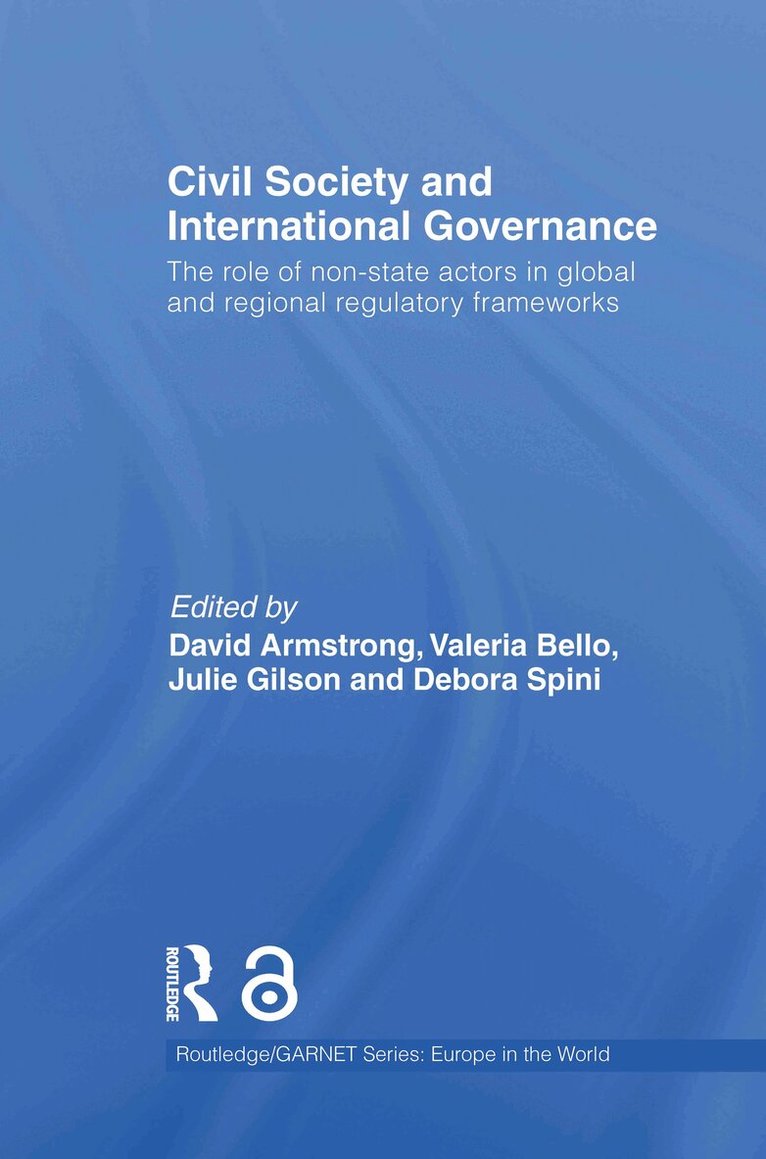
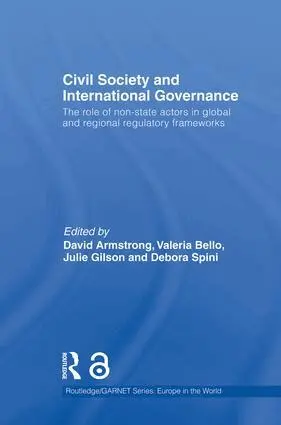
Civil Society and International Governance
The role of non-state actors in global and regional regulatory frameworks
Inbunden, Engelska, 2010
2 088 kr
Skickas inom 10-15 vardagar
A PDF version of this book is available for free in open access via www.tandfebooks.com as well as the OAPEN Library platform, www.oapen.org. It has been made available under a Creative Commons Attribution-Non Commercial-No Derivatives 3.0 license and is part of the OAPEN-UK research project.Structures and processes occurring within and between states are no longer the only – or even the most important - determinants of those political, economic and social developments and dynamics that shape the modern world. Many issues, including the environment, health, crime, drugs, migration and terrorism, can no longer be contained within national boundaries. As a result, it is not always possible to identify the loci for authority and legitimacy, and the role of governments has been called into question.Civil Society anf International Governance critically analyses the increasing impact of nongovernmental organisations and civil society on global and regional governance. Written from the standpoint of advocates of civil society and addressing the role of civil society in relation to the UN, the IMF, the G8 and the WTO, this volume assess the role of various non-state actors from three perspectives: theoretical aspects, civil society interaction with the European Union and civil society and regional governance outside Europe, specifically Africa, East Asia and the Middle East. It demonstrates that civil society’s role has been more complex than one defined in terms, essentially, of resistance and includes actual participation in governance as well as multi-facetted contributions to legitimising and democratising global and regional governance.This book will be of interest to students and scholars of political science, international relations, civil society, sociology, European politics and global governance.
617 kr
Skickas inom 10-15 vardagar
This book considers the interactions between Africa, Asia and Europe, analysing the short and long term strategies various states have adopted to external relations.The urgency attached to the agenda of international terrorism and human and drugs- trafficking has forced the European Union into new cooperation with Africa and Asia. These inter-regional relations have taken on new dimensions in the context of contemporary international politics framed by new security challenges, and new competitive forces particularly from Asia. This book provides both conceptual and empirical arguments to offer an innovative perspective on the EU as a global actor. It demonstrates how these three regions interact politically and economically to address global challenges as well as global opportunities, and thus provides an assessment of the multilateralism which the EU clearly stated in its Security Strategy paper. Addressing a broad range of topical issues, the book features chapters on European Security; European Migration Policy; African Union and its peace and security policy; Terrorism and international security; China and its fast growing global role; India, the biggest democracy in the world; and the impact of the Asian economic growth on the global economy. Further it compares the different backgrounds, forms and priorities of regional integrations.A Global Security Triangle will be of interest to all scholars of European politics, security studies, African and Asian studies, and International Relations.
1 736 kr
Skickas inom 10-15 vardagar
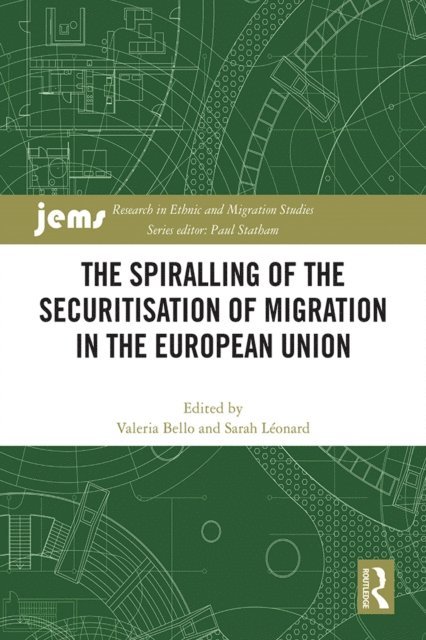
This book investigates how migration has been transformed into a security threat in Europe. It argues that this process has taken place through a self-fulfilling spiralling process, which involves different actors and their specific narratives, practices and policies. The book examines how situations stemming from the so-called ‘migration crisis’ in the European Union (EU) have been dealt with by governments and non-governmental organisations. It also considers how actors treating migration as an ordinary phenomenon rather than a threat and sharing inclusive narratives can create the conditions for decelerating and eventually stopping securitisation processes. Some chapters examine the spiralling of the securitisation of migration in depth, by analysing increases in securitisation, as well as cases characterised by resistance. Others focus on examining the consequences of socially constructing migration as a crisis for the EU’s relations with third countries. In sum, this book shows that there is a wide range of motives for which states and societies would benefit from a change in migration politics and move from the current management of a ‘crisis’ to a more positive governance of human mobility. It will be of interest to researchers and advanced students of sociology, politics, international relations, social and cultural anthropology, human geography, and social work. This book was originally published as a special issue of the Journal of Ethnic and Migration Studies.
530 kr
Skickas inom 10-15 vardagar
This book investigates how migration has been transformed into a security threat in Europe. It argues that this process has taken place through a self-fulfilling spiralling process, which involves different actors and their specific narratives, practices and policies. The book examines how situations stemming from the so-called ‘migration crisis’ in the European Union (EU) have been dealt with by governments and non-governmental organisations. It also considers how actors treating migration as an ordinary phenomenon rather than a threat and sharing inclusive narratives can create the conditions for decelerating and eventually stopping securitisation processes. Some chapters examine the spiralling of the securitisation of migration in depth, by analysing increases in securitisation, as well as cases characterised by resistance. Others focus on examining the consequences of socially constructing migration as a crisis for the EU’s relations with third countries. In sum, this book shows that there is a wide range of motives for which states and societies would benefit from a change in migration politics and move from the current management of a ‘crisis’ to a more positive governance of human mobility. It will be of interest to researchers and advanced students of sociology, politics, international relations, social and cultural anthropology, human geography, and social work. This book was originally published as a special issue of the Journal of Ethnic and Migration Studies.
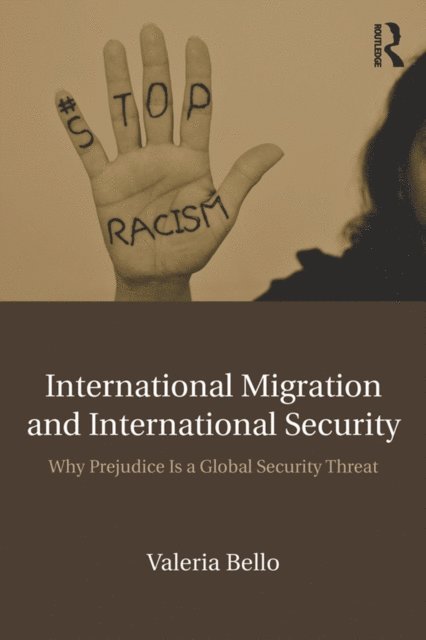
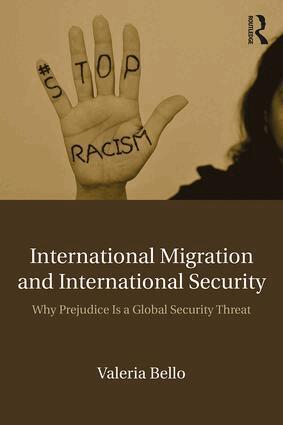
International Migration and International Security
Why Prejudice Is a Global Security Threat
Inbunden, Engelska, 2017
2 088 kr
Skickas inom 10-15 vardagar
Through an interdisciplinary analytic lens that combines debates emerged in the fields of international relations, political science and sociology, Valeria Bello reveals how transnational dynamics have increased extremism, prejudiced attitudes towards others and international xenophobia.Bello begins her analysis by tracing similarities between Europe today and Europe before World War II to explain why prejudice is a global security threat and why it is arising as a current global concern within International Organizations. In such a light, Bello shows how changes in the International System and the attack on the UN practice of Intercultural Dialogue have become sources of new perceived threats and the reasons for which new exclusionary patterns have arisen. She argues that both those outcomes have been exacerbating the perceived clash of civilizations and the root causes of different fashions of extremisms. Bello concludes by portraying alternative ways to deal with these instabilities through a partnership of the different stakeholders involved, including both state and non-state actors at global, regional, national and local levels.International Migration and International Security provides a unique crosscutting angle from which to analyze the current socio-political crisis connected to the theme of international migration that the world is currently witnessing. Bello expertly shows that different paths for the world are possible and suggest ways to further promote Global Human Security through local, national, regional and global practices of Intercultural Dialogue.
International Migration and International Security
Why Prejudice Is a Global Security Threat
Häftad, Engelska, 2017
631 kr
Skickas inom 10-15 vardagar
Through an interdisciplinary analytic lens that combines debates emerged in the fields of international relations, political science and sociology, Valeria Bello reveals how transnational dynamics have increased extremism, prejudiced attitudes towards others and international xenophobia.Bello begins her analysis by tracing similarities between Europe today and Europe before World War II to explain why prejudice is a global security threat and why it is arising as a current global concern within International Organizations. In such a light, Bello shows how changes in the International System and the attack on the UN practice of Intercultural Dialogue have become sources of new perceived threats and the reasons for which new exclusionary patterns have arisen. She argues that both those outcomes have been exacerbating the perceived clash of civilizations and the root causes of different fashions of extremisms. Bello concludes by portraying alternative ways to deal with these instabilities through a partnership of the different stakeholders involved, including both state and non-state actors at global, regional, national and local levels.International Migration and International Security provides a unique crosscutting angle from which to analyze the current socio-political crisis connected to the theme of international migration that the world is currently witnessing. Bello expertly shows that different paths for the world are possible and suggest ways to further promote Global Human Security through local, national, regional and global practices of Intercultural Dialogue.
Civil Society and International Governance
The role of non-state actors in global and regional regulatory frameworks
Häftad, Engelska, 2015
671 kr
Skickas inom 10-15 vardagar
A PDF version of this book is available for free in open access via www.tandfebooks.com as well as the OAPEN Library platform, www.oapen.org. It has been made available under a Creative Commons Attribution-Non Commercial-No Derivatives 3.0 license and is part of the OAPEN-UK research project.Structures and processes occurring within and between states are no longer the only – or even the most important - determinants of those political, economic and social developments and dynamics that shape the modern world. Many issues, including the environment, health, crime, drugs, migration and terrorism, can no longer be contained within national boundaries. As a result, it is not always possible to identify the loci for authority and legitimacy, and the role of governments has been called into question.Civil Society anf International Governance critically analyses the increasing impact of nongovernmental organisations and civil society on global and regional governance. Written from the standpoint of advocates of civil society and addressing the role of civil society in relation to the UN, the IMF, the G8 and the WTO, this volume assess the role of various non-state actors from three perspectives: theoretical aspects, civil society interaction with the European Union and civil society and regional governance outside Europe, specifically Africa, East Asia and the Middle East. It demonstrates that civil society’s role has been more complex than one defined in terms, essentially, of resistance and includes actual participation in governance as well as multi-facetted contributions to legitimising and democratising global and regional governance.This book will be of interest to students and scholars of political science, international relations, civil society, sociology, European politics and global governance.