Vanda Broughton – författare
Visar alla böcker från författaren Vanda Broughton. Handla med fri frakt och snabb leverans.
15 produkter
15 produkter
E-bok
PDF, Engelska, 2016779 kr
Läs direkt efter köp
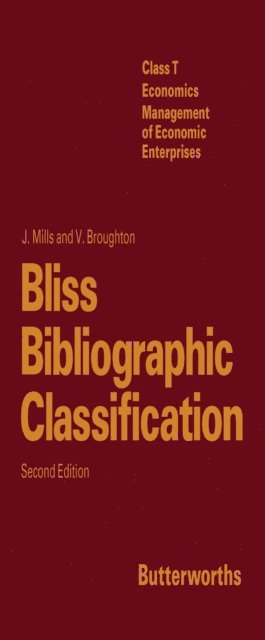
Bliss Bibliographic Classification, Second Edition is an outline composed of thorough and detailed analysis of the vocabulary of economics and management. The book is divided into two chapters. Chapter 1 includes concepts related to the subject, such as the schools of thought in economics, economic history and processes, supply and demand, the price and market system, and economic resources. Chapter 2, on the other hand, is an outline of different concepts related to management, such as the management of economic enterprises, management processes and functions, and management techniques. The text is recommended for economists and financial analysts, especially those who are making studies and are in need of a reference material.
Häftad, Engelska, 2015
1 269 kr
Skickas inom 11-20 vardagar
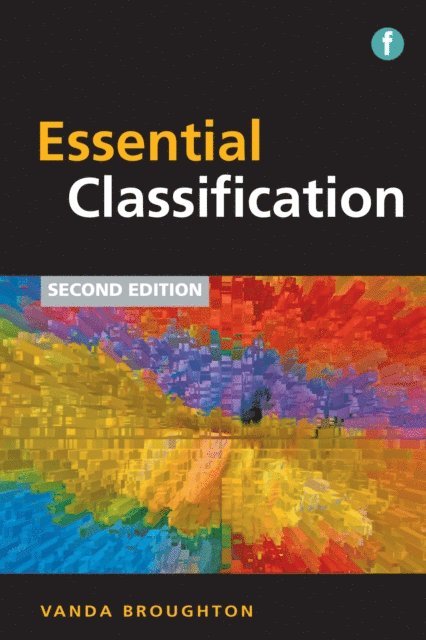
Classification is a crucial skill for all information workers involved in organizing collections. This new edition offers fully revised and updated guidance on how to go about classifying a document from scratch. Essential Classification leads the novice classifier step by step through the basics of subject cataloguing, with an emphasis on practical document analysis and classification. It deals with fundamental questions of the purpose of classification in different situations, and the needs and expectations of end users. The reader is introduced to the ways in which document content can be assessed, and how this can best be expressed for translation into the language of specific indexing and classification systems. Fully updated to reflect changes to the major general schemes (Library of Congress, LCSH, Dewey and UDC) since the first edition, and with new chapters on working with informal classification, from folksonomies to tagging and social media, this new edition will set cataloguers on the right path. Key areas covered are:The need for classificationThe variety of classificationThe structure of classificationWorking with informal classificatioManagement aspects of classificationClassification in digital space. This guide is essential reading for library school students, novice cataloguers and all information workers who need to classify but have not formally been taught how. It also offers practical guidance to computer scientists, internet and intranet managers, and all others concerned with the design and maintenance of subject tools.
E-bok
PDF, Engelska, 2017959 kr
Läs direkt efter köp
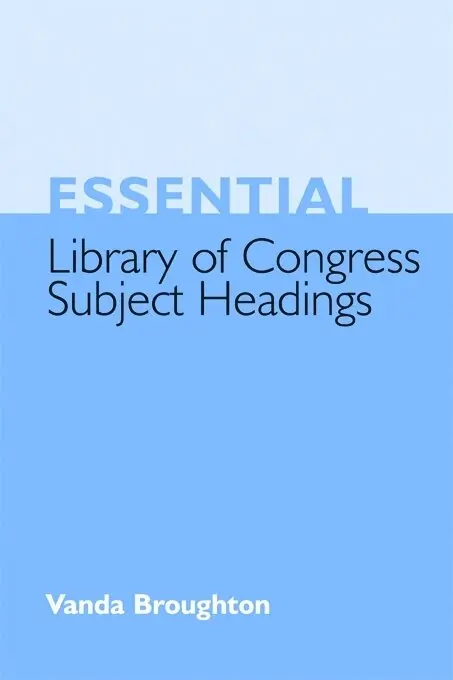
Library of Congress Subject Headings (LCSH) are increasingly seen as ''the'' English language controlled vocabulary, despite their lack of a theoretical foundation, and their evident US bias. In mapping exercises between national subject heading lists, and in exercises in digital resource organization and management, LCSH are often chosen because of the lack of any other widely accepted English language standard for subject cataloguing. It is therefore important that the basic nature of LCSH, their advantages, and their limitations, are well understood both by LIS practitioners and those in the wider information community. Information professionals who attended library school before 1995 - and many more recent library school graduates - are unlikely to have had a formal introduction to Library of Congress Subject Headings (LCSH). Paraprofessionals who undertake cataloguing are similarly unlikely to have enjoyed an induction to the broad principles of LCSH. This is the first compact guide to LCSH written from a UK viewpoint. Key topics include: • background and history of LCSH • subject heading lists • structure and display in LCSH • form of entry • application of LCSH • document analysis • main headings • topical, geographical and free-floating sub-divisions • building compound headings • name headings • headings for literature, art, music, history and law • LCSH in the online environment. Readership: There is a strong emphasis throughout on worked examples and practical exercises in the application of the scheme, and a full glossary of terms is supplied. No prior knowledge or experience of subject cataloguing is assumed. This is an indispensable guide to LCSH for practitioners and students alike.
Häftad, Engelska, 2027
1 407 kr
Skickas inom 11-20 vardagar
Facet analysis is an important theory in the fields of knowledge organization and information retrieval. It has been stated that ‘it has dominated what has been termed “modern classification theory”’, and the Classification Research Group of the UK aimed to make it ‘the basis of all information retrieval’. Yet the philosophical and methodological bases of facet analysis are poorly understood by the wider information community and the theory is not well documented. Facet Analysis provides a general overview of facet analysis as a formal methodology for building knowledge organization and search tools and as a general knowledge organization theory. The functions of faceted systems can be broadly categorized as: organizing content; building tools; designing interfaces; and empowering search, and examples of all of these are discussed. Coverage includes:a full statement of the principles and theory of faceted systems as developed by Ranganathan and the UK Classification Research Group, and that theory as it is understood todaydiscussion of the origin and development of analytico-synthetic classification and indexing tools, and of the use of facet analytical theory to underpin design and constructiondiscussion of different applications of facet analysis, not only in conventional information managements contexts (classification schemes and thesauri), but also in e-environments, both academic and commercial, and on the Weba survey of the work of a number of current writers and researchers in the facet analytical tradition, including those who work in the digital environment, for which a distinctive parallel strand of facet theory can be observed.This book will be useful reading for LIS students enrolled on classification, knowledge organisation and information retrieval modules. It will also be of immediate use to practitioners concerned with information organisation, management and retrieval, as well as software engineers, web designers, semantic web researchers and developers.
Inbunden, Engelska, 2027
2 807 kr
Skickas inom 11-20 vardagar
Facet analysis is an important theory in the fields of knowledge organization and information retrieval. It has been stated that ‘it has dominated what has been termed “modern classification theory”’, and the Classification Research Group of the UK aimed to make it ‘the basis of all information retrieval’. Yet the philosophical and methodological bases of facet analysis are poorly understood by the wider information community and the theory is not well documented. Facet Analysis provides a general overview of facet analysis as a formal methodology for building knowledge organization and search tools and as a general knowledge organization theory. The functions of faceted systems can be broadly categorized as: organizing content; building tools; designing interfaces; and empowering search, and examples of all of these are discussed. Coverage includes:a full statement of the principles and theory of faceted systems as developed by Ranganathan and the UK Classification Research Group, and that theory as it is understood todaydiscussion of the origin and development of analytico-synthetic classification and indexing tools, and of the use of facet analytical theory to underpin design and constructiondiscussion of different applications of facet analysis, not only in conventional information managements contexts (classification schemes and thesauri), but also in e-environments, both academic and commercial, and on the Weba survey of the work of a number of current writers and researchers in the facet analytical tradition, including those who work in the digital environment, for which a distinctive parallel strand of facet theory can be observed.This book will be useful reading for LIS students enrolled on classification, knowledge organisation and information retrieval modules. It will also be of immediate use to practitioners concerned with information organisation, management and retrieval, as well as software engineers, web designers, semantic web researchers and developers.
E-bok
PDF, Engelska, 2017959 kr
Läs direkt efter köp
Classification is a crucial skill for all information workers involved in organizing collections. This new edition offers fully revised and updated guidance on how to go about classifying a document from scratch. Essential Classification leads the novice classifier step by step through the basics of subject cataloguing, with an emphasis on practical document analysis and classification. It deals with fundamental questions of the purpose of classification in different situations, and the needs and expectations of end users. The reader is introduced to the ways in which document content can be assessed, and how this can best be expressed for translation into the language of specific indexing and classification systems. Fully updated to reflect changes to the major general schemes (Library of Congress, LCSH, Dewey and UDC) since the first edition, and with new chapters on working with informal classification, from folksonomies to tagging and social media, this new edition will set cataloguers on the right path. Key areas covered are: the need for classification, the variety of classification, the structure of classification, working with informal classification, management aspects of classification, and classification in digital space. This guide is essential reading for library school students, novice cataloguers and all information workers who need to classify but have not formally been taught how. It also offers practical guidance to computer scientists, internet and intranet managers, and all others concerned with the design and maintenance of subject tools.
Häftad, Engelska, 2011
1 258 kr
Skickas inom 11-20 vardagar
Library of Congress Subject Headings (LCSH) are increasingly seen as 'the' English language controlled vocabulary, despite their lack of a theoretical foundation, and their evident US bias. In mapping exercises between national subject heading lists, and in exercises in digital resource organization and management, LCSH are often chosen because of the lack of any other widely accepted English language standard for subject cataloguing. It is therefore important that the basic nature of LCSH, their advantages, and their limitations, are well understood both by LIS practitioners and those in the wider information community. Information professionals who attended library school before 1995 - and many more recent library school graduates - are unlikely to have had a formal introduction to Library of Congress Subject Headings (LCSH). Paraprofessionals who undertake cataloguing are similarly unlikely to have enjoyed an induction to the broad principles of LCSH. This is the first compact guide to LCSH written from a UK viewpoint. Key topics include: • background and history of LCSH • subject heading lists • structure and display in LCSH • form of entry • application of LCSH • document analysis • main headings • topical, geographical and free-floating sub-divisions • building compound headings • name headings • headings for literature, art, music, history and law • LCSH in the online environment. Readership: There is a strong emphasis throughout on worked examples and practical exercises in the application of the scheme, and a full glossary of terms is supplied. No prior knowledge or experience of subject cataloguing is assumed. This is an indispensable guide to LCSH for practitioners and students alike.
E-bok
PDF, Engelska, 2013967 kr
Läs direkt efter köp
Many information professionals working in small units today fail to find the published tools for subject-based organization that are appropriate to their local needs, whether they are archivists, special librarians, information officers, or knowledge or content managers. Large established standards for document description and organization are too unwieldy, unnecessarily detailed, or too expensive to install and maintain. In other cases the available systems are insufficient for a specialist environment, or don''t bring things together in a helpful way. A purpose built, in-house system would seem to be the answer, but too often the skills necessary to create one are lacking. This practical text examines the criteria relevant to the selection of a subject-management system, describes the characteristics of some common types of subject tool, and takes the novice step by step through the process of creating a system for a specialist environment. The methodology employed is a standard technique for the building of a thesaurus that incidentally creates a compatible classification or taxonomy, both of which may be used in a variety of ways for document or information management. Key areas covered are: What is a thesaurus? Tools for subject access and retrieval; what a thesaurus is used for? Why use a thesaurus? Examples of thesauri; the structure of a thesaurus; thesaural relationships; practical thesaurus construction; the vocabulary of the thesaurus; building the systematic structure; conversion to alphabetic format; forms of entry in the thesaurus; maintaining the thesaurus; thesaurus software; and; the wider environment. Essential for the practising information professional, this guide is also valuable for students of library and information science.
E-bok
PDF, Engelska, 20181 917 kr
Läs direkt efter köp
No detailed description available for "e;General Science. Physics"e;.
Inbunden, Engelska, 1999
1 656 kr
Skickas inom 5-8 vardagar
No detailed description available for "General Science. Physics".
Inbunden, Engelska, 2012
2 164 kr
Skickas inom 5-8 vardagar
The Bliss Bibliographic Classification Association is an association of users and supporters of the Bibliographic Classification. The association promotes the development and use of classification, publishes official amendments, enables users to keep in touch and exchange experience, and gives them a say in the future of the scheme. It is a nonprofit organization, founded in 1969, with members all over the world. Each of the following schedules is the result of a rigorous and detailed analysis of the terminology of the field in question, using the techniques of facet analysis.
Inbunden, Engelska, 1996
1 122 kr
Skickas inom 5-8 vardagar
No detailed description available for "Law".
Inbunden, Engelska, 2017
2 358 kr
Tillfälligt slut
Classification is a crucial skill for all information workers involved in organizing collections. This new edition offers fully revised and updated guidance on how to go about classifying a document from scratch. Essential Classification leads the novice classifier step by step through the basics of subject cataloguing, with an emphasis on practical document analysis and classification. It deals with fundamental questions of the purpose of classification in different situations, and the needs and expectations of end users. The reader is introduced to the ways in which document content can be assessed, and how this can best be expressed for translation into the language of specific indexing and classification systems. Fully updated to reflect changes to the major general schemes (Library of Congress, LCSH, Dewey and UDC) since the first edition, and with new chapters on working with informal classification, from folksonomies to tagging and social media, this new edition will set cataloguers on the right path. Key areas covered are:The need for classificationThe variety of classificationThe structure of classificationWorking with informal classificatioManagement aspects of classificationClassification in digital space. This guide is essential reading for library school students, novice cataloguers and all information workers who need to classify but have not formally been taught how. It also offers practical guidance to computer scientists, internet and intranet managers, and all others concerned with the design and maintenance of subject tools.
Häftad, Engelska, 2006
1 027 kr
Tillfälligt slut
Many information professionals working in small units today fail to find the published tools for subject based organization that are appropriate to their local needs, whether they are archivists, special librarians, information officers, or knowledge or content managers. Large established standards for document description and organization are too unwieldy, unnecessarily detailed, or too expensive to install and maintain. In other cases the available systems are insufficient for a specialist environment, or don't bring things together in a helpful way. A purpose built, in-house system would seem to be the answer, but too often the skills necessary to create one are lacking. This practical text examines the criteria relevant to the selection of a subject management system, describes the characteristics of some common types of subject tool, and takes the novice step-by-step through the process of creating a system for a specialist environment. The methodology employed is a standard technique for the building of a thesaurus that incidentally creates a compatible classification or taxonomy, both of which may be used in a variety of ways for document or information management. Key areas covered are: • What is a thesaurus? • Tools for subject access and retrieval • What a thesaurus is used for • Why use a thesaurus? • Examples of thesauri • The structure of a thesaurus • Thesaural relations • Practical thesaurus construction • The vocabulary of the thesaurus • Building the systematic structure • Conversion to alphabetic format • Forms of entry in the thesaurus • Maintaining the thesaurus • Thesaurus software • The wider environment. Readership: Although primarily aimed at the practising information professional, the book is also suitable for students of library and information science.
Inbunden, Engelska, 1992
998 kr
Tillfälligt slut
No detailed description available for "Philosophy and Logic".