Vandana Mohindru Sood - Böcker
Visar alla böcker från författaren Vandana Mohindru Sood. Handla med fri frakt och snabb leverans.
3 produkter
3 produkter
1 957 kr
Skickas inom 10-15 vardagar
A cyber-physical system (CPS) is a computer system in which a mechanism is controlled or monitored by computer-based algorithms and involves transdisciplinary approaches, merging theories of cybernetics, mechatronics, design, and process science. This text mainly concentrates on offering a foundational theoretical underpinning, and a comprehensive and coherent review of intelligent security solutions for cyber-physical systems.Features: Provides an overview of cyber-physical systems (CPSs) along with security concepts like attack detection methods, cyber-physical systems failures, and risk identification and managementShowcases cyber-physical systems (CPSs) security solutions, lightweight cryptographic solutions, and CPS forensics, etcEmphasizes machine learning methods for behavior-based intrusion detection in cyber-physical systems (CPSs), resilient machine learning for networked CPS, fog computing industrial CPS, etcElaborates classification of network abnormalities in Internet of Things-based cyber-physical systems (CPSs) using deep learningIncludes case studies and applications in the domain of smart grid systems, industrial control systems, smart manufacturing, social network and gaming, electric power grid and energy systems, etc
745 kr
Skickas inom 10-15 vardagar
A cyber-physical system (CPS) is a computer system in which a mechanism is controlled or monitored by computer-based algorithms and involves transdisciplinary approaches, merging theories of cybernetics, mechatronics, design, and process science. This text mainly concentrates on offering a foundational theoretical underpinning, and a comprehensive and coherent review of intelligent security solutions for cyber-physical systems.Features: Provides an overview of cyber-physical systems (CPSs) along with security concepts like attack detection methods, cyber-physical systems failures, and risk identification and managementShowcases cyber-physical systems (CPSs) security solutions, lightweight cryptographic solutions, and CPS forensics, etcEmphasizes machine learning methods for behavior-based intrusion detection in cyber-physical systems (CPSs), resilient machine learning for networked CPS, fog computing industrial CPS, etcElaborates classification of network abnormalities in Internet of Things-based cyber-physical systems (CPSs) using deep learningIncludes case studies and applications in the domain of smart grid systems, industrial control systems, smart manufacturing, social network and gaming, electric power grid and energy systems, etc
1 904 kr
Skickas inom 7-10 vardagar
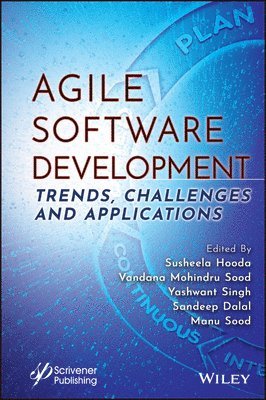
AGILE SOFTWARE DEVELOPMENT A unique title that introduces the whole range of agile software development processes from the fundamental concepts to the highest levels of applications such as requirement analysis, software testing, quality assurance, and risk management. Agile Software Development (ASD) has become a popular technology because its methods apply to any programming paradigm. It is important in the software development process because it emphasizes incremental delivery, team collaboration, continuous planning, and learning over delivering everything at once near the end. Agile has gained popularity as a result of its use of various frameworks, methods, and techniques to improve software quality. Scrum is a major agile framework that has been widely adopted by the software development community. Metaheuristic techniques have been used in the agile software development process to improve software quality and reliability. These techniques not only improve quality and reliability but also test cases, resulting in cost-effective and time-effective software. However, many significant research challenges must be addressed to put such ASD capabilities into practice. With the use of diverse techniques, guiding principles, artificial intelligence, soft computing, and machine learning, this book seeks to study theoretical and technological research findings on all facets of ASD. Also, it sheds light on the latest trends, challenges, and applications in the area of ASD. This book explores the theoretical as well as the technical research outcomes on all the aspects of Agile Software Development by using various methods, principles, artificial intelligence, soft computing, and machine learning. Audience The book is designed for computer scientists and software engineers both in research and industry. Graduate and postgraduate students will find the book accessible as well.