Venkatraman Atti – författare
Visar alla böcker från författaren Venkatraman Atti. Handla med fri frakt och snabb leverans.
4 produkter
4 produkter
E-bok
PDF, Engelska, 20071 954 kr
Läs direkt efter köp
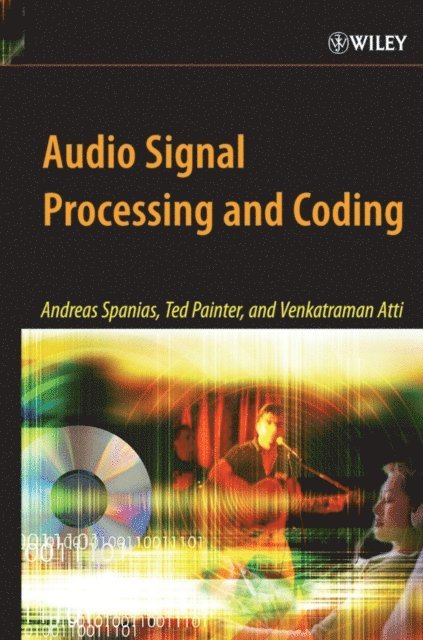
An in-depth treatment of algorithms and standards for perceptual coding of high-fidelity audio, this self-contained reference surveys and addresses all aspects of the field. Coverage includes signal processing and perceptual (psychoacoustic) fundamentals, details on relevant research and signal models, details on standardization and applications, and details on performance measures and perceptual measurement systems. It includes a comprehensive bibliography with over 600 references, computer exercises, and MATLAB-based projects for use in EE multimedia, computer science, and DSP courses. An ftp site containing supplementary material such as wave files, MATLAB programs and workspaces for the students to solve some of the numerical problems and computer exercises in the book can be found at ftp://ftp.wiley.com/public/sci_tech_med/audio_signal
Inbunden, Engelska, 2007
1 724 kr
Skickas inom 5-8 vardagar
An in-depth treatment of algorithms and standards for perceptual coding of high-fidelity audio, this self-contained reference surveys and addresses all aspects of the field. Coverage includes signal processing and perceptual (psychoacoustic) fundamentals, details on relevant research and signal models, details on standardization and applications, and details on performance measures and perceptual measurement systems. It includes a comprehensive bibliography with over 600 references, computer exercises, and MATLAB-based projects for use in EE multimedia, computer science, and DSP courses. An ftp site containing supplementary material such as wave files, MATLAB programs and workspaces for the students to solve some of the numerical problems and computer exercises in the book can be found at ftp://ftp.wiley.com/public/sci_tech_med/audio_signal
Häftad, Engelska, 2011
362 kr
Skickas inom 10-15 vardagar
From the early pulse code modulation-based coders to some of the recent multi-rate wideband speech coding standards, the area of speech coding made several significant strides with an objective to attain high quality of speech at the lowest possible bit rate.
E-bok
PDF, Engelska, 2022428 kr
Läs direkt efter köp
From the early pulse code modulation-based coders to some of the recent multi-rate wideband speech coding standards, the area of speech coding made several significant strides with an objective to attain high quality of speech at the lowest possible bit rate. This book presents some of the recent advances in linear prediction (LP)-based speech analysis that employ perceptual models for narrow- and wide-band speech coding. The LP analysis-synthesis framework has been successful for speech coding because it fits well the source-system paradigm for speech synthesis. Limitations associated with the conventional LP have been studied extensively, and several extensions to LP-based analysis-synthesis have been proposed, e.g., the discrete all-pole modeling, the perceptual LP, the warped LP, the LP with modified filter structures, the IIR-based pure LP, all-pole modeling using the weighted-sum of LSP polynomials, the LP for low frequency emphasis, and the cascade-form LP. These extensions canbe classified as algorithms that either attempt to improve the LP spectral envelope fitting performance or embed perceptual models in the LP. The first half of the book reviews some of the recent developments in predictive modeling of speech with the help of Matlab™ Simulation examples. Advantages of integrating perceptual models in low bit rate speech coding depend on the accuracy of these models to mimic the human performance and, more importantly, on the achievable "coding gains" and "computational overhead" associated with these physiological models. Methods that exploit the masking properties of the human ear in speech coding standards, even today, are largely based on concepts introduced by Schroeder and Atal in 1979. For example, a simple approach employed in speech coding standards is to use a perceptual weighting filter to shape the quantization noise according to the masking properties of the human ear. The second half of the book reviews some of the recent developments in perceptual modeling of speech (e.g., masking threshold, psychoacoustic models, auditory excitation pattern, and loudness) with the help of Matlab™ simulations. Supplementary material including Matlab™ programs and simulation examples presented in this book can also be accessed here. Table of Contents: Introduction / Predictive Modeling of Speech / Perceptual Modeling of Speech