Vicente M. Lechuga – författare
Visar alla böcker från författaren Vicente M. Lechuga. Handla med fri frakt och snabb leverans.
9 produkter
Changing Landscape of the Academic Profession
Faculty Culture at For-Profit Colleges and Universities
Häftad, 2013
867 kr
Lägg i varukorg
The rapid success of for-profit colleges and universities (FPCUs) only recently has caught the attention of scholars in academe. The continuing expansion of the proprietary higher education sector has lead to fundamental questions regarding the purpose and function of FPCUs. As new technologies …
Changing Landscape of the Academic Profession
Faculty Culture at For-Profit Colleges and Universities
Inbunden, 2005
2433 kr
Lägg i varukorg
The rapid success of for-profit colleges and universities (FPCUs) only recently has caught the attention of scholars in academe. The continuing expansion of the proprietary higher education sector has lead to fundamental questions regarding the purpose and function of FPCUs. As new technologies …
For-Profit Colleges and Universities
Their Markets, Regulation, Performance, and Place in Higher Education
Av William G. Tierney, Vicente M. Lechuga m. fl.
E-bok, 2023
556 kr
Lägg i varukorg
Do for-profit colleges and universities (FPCUs) pose a threat to traditional providers of higher education, or do they play a vital role at a time when the capacity of public and private non-profits to meet demand is constrained? With the US no longer the leader in developing a college-educated …
For-Profit Colleges and Universities
Their Markets, Regulation, Performance, and Place in Higher Education
Av William G. Tierney, Vicente M. Lechuga m. fl.
E-bok, 2023
556 kr
Lägg i varukorg
Do for-profit colleges and universities (FPCUs) pose a threat to traditional providers of higher education, or do they play a vital role at a time when the capacity of public and private non-profits to meet demand is constrained? With the US no longer the leader in developing a college-educated …
Qualitative Inquiry in Higher Education Organization and Policy Research
Av Penny A. Pasque, Vicente M. Lechuga
Inbunden, 2016
2433 kr
Lägg i varukorg
Qualitative Inquiry in Higher Education Organization and Policy Research provides readers with the theoretical foundations and innovative perspectives for undertaking qualitative research to influence policy and practice discussions. Well-known chapter authors discuss innovative strategies for …
Qualitative Inquiry in Higher Education Organization and Policy Research
Av Penny A. Pasque, Vicente M. Lechuga
Häftad, 2016
712 kr
Lägg i varukorg
Qualitative Inquiry in Higher Education Organization and Policy Research provides readers with the theoretical foundations and innovative perspectives for undertaking qualitative research to influence policy and practice discussions. Well-known chapter authors discuss innovative strategies for …
Qualitative Inquiry in Higher Education Organization and Policy Research
Av Vicente M. Lechuga, Penny A. Pasque
E-bok, 2016
815 kr
Lägg i varukorg
Qualitative Inquiry in Higher Education Organization and Policy Research provides readers with the theoretical foundations and innovative perspectives for undertaking qualitative research to influence policy and practice discussions. Well-known chapter authors discuss innovative strategies for …
Qualitative Inquiry in Higher Education Organization and Policy Research
Av Vicente M. Lechuga, Penny A. Pasque
E-bok, 2016
842 kr
Lägg i varukorg
Qualitative Inquiry in Higher Education Organization and Policy Research provides readers with the theoretical foundations and innovative perspectives for undertaking qualitative research to influence policy and practice discussions. Well-known chapter authors discuss innovative strategies for …
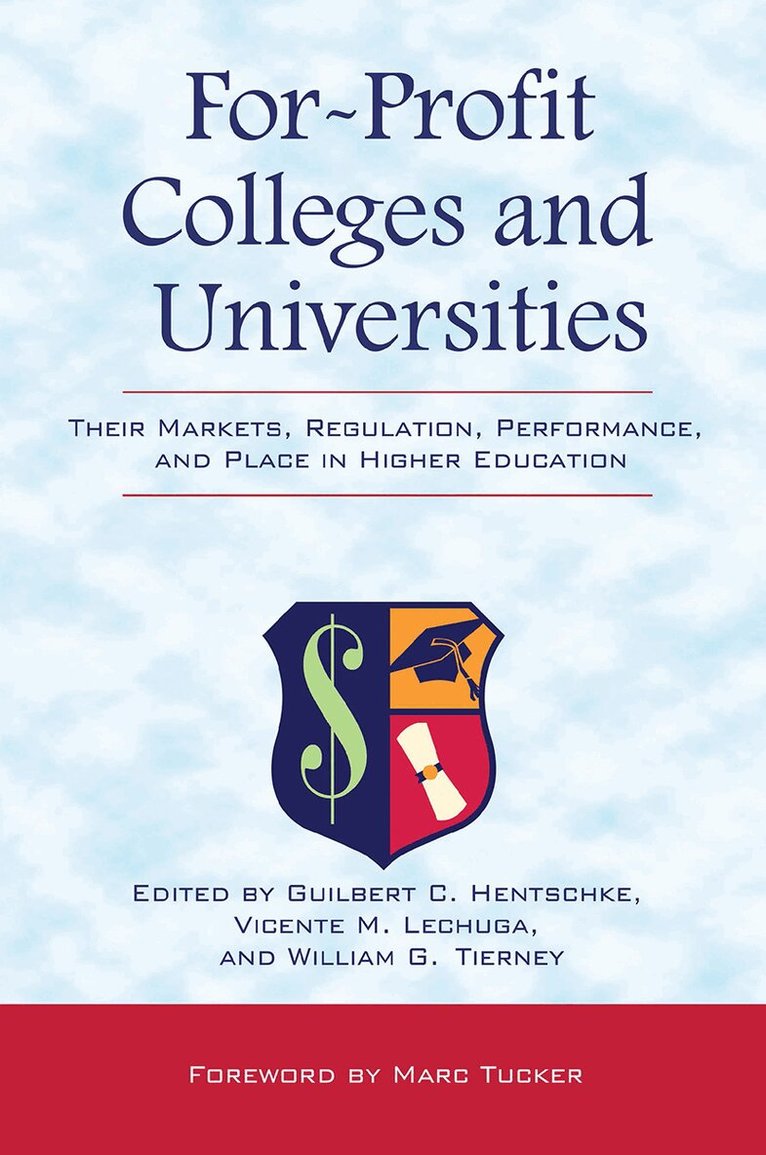
For-Profit Colleges and Universities
Their Markets, Regulation, Performance, and Place in Higher Education
Av Guilbert C. Hentschke, Vicente M. Lechuga m. fl.
Häftad, 2010
472 kr
Lägg i varukorg
Do for-profit colleges and universities (FPCUs) pose a threat to traditional providers of higher education, or do they play a vital role at a time when the capacity of public and private non-profits to meet demand is constrained? With the US no longer the leader in developing a college-educated …