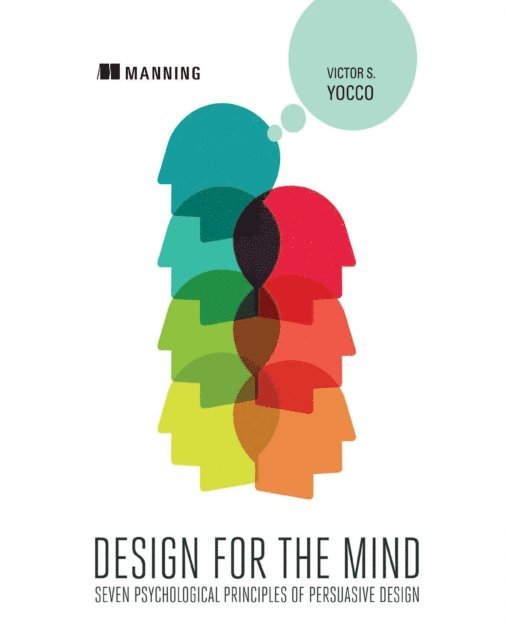
SummaryDesign for the Mind: Seven Psychological Principles of Persuasive Design teaches web designers and developers how to create sites and applications that appeal to our innate natural responses as humans. Author Victor Yocco, a researcher on psychology and communication, introduces the most immediately relevant and applicable psychological concepts, breaks down each theory into easily-digested principles, then shows how they can be used to inform better design.Purchase of the print book includes a free eBook in PDF, Kindle, and ePub formats from Manning Publications.About the TechnologyDesigners and design team members need to think about more than just aesthetics. How do you handle short attention spans. How does your design encourage users to engage, browse, or buy? Fortunately, there are psychological principles that you can use in your design to anticipate and benefit from how humans think, behave, and react.About the BookDesign for the Mind: Seven Psychological Principles of Persuasive Design teaches you to recognize how websites and applications can benefit from an awareness of our innate, natural responses as humans, and to apply the same principles to your own designs. This approachable book introduces the psychological principles, deconstructs each into easily digestible concepts, and then shows how you can apply them. The idea is to deepen your understanding of why people react in the ways they do. After reading the book, you''ll be ready to make your work more psychologically friendly, engaging, and persuasive.What''s InsideMaking design persuasiveEncouraging visitors to take actionCreating enduring messagesMeeting the needs of both engaged and disengaged visitorsBecoming a strategic influencerApplying theory, with case studies and real-world examplesAbout the ReaderThis book is for web and UX designers and developers as well as anyone involved in customer-facing digital products.About the AuthorVictor Yocco, PhD, is a research director at a Philadelphia-based digital design firm. He received his PhD from The Ohio State University, where his research focused on psychology and communication in informal learning settings. Victor regularly writes and speaks on topics related to the application of psychology to design and addressing the culture of alcohol use in design and technology. He can be found at www.victoryocco.com or @victoryocco on Twitter.Table of Contents
PART 1 INTRODUCING THE APPLICATION OF PSYCHOLOGY TO DESIGN
Meeting users'' needs: including psychology in design
PART 2 WHY DO FOLKS ACT LIKE THAT? PRINCIPLES OF BEHAVIOR
Designing for regular use: addressing planned behaviorRisky decisions and mental shortcutsMotivation, ability, and trigger-boom!
PART 3 PRINCIPLES OF INFLUENCE AND PERSUASION: NOT AS EVIL AS YOU''D THINK
Influence: getting people to like and use your designUsing family, friends, and social networks to influence usersIt''s not what you say; it''s how you say it!Persuasion: the deadliest art
PART 4 USER EXPERIENCE DESIGN: PUTTING IT ALL TOGETHER
Case study: KidTech Design Co.''s Good Choice appThe next step: getting up and running