Vida Panitch - Böcker
Visar alla böcker från författaren Vida Panitch. Handla med fri frakt och snabb leverans.
4 produkter
4 produkter
3 265 kr
Skickas inom 10-15 vardagar
Some goods are freely traded as commodities without question or controversy. For other goods, their commodification – their being made available in exchange for money, or their being subject to market valuation and exchange – is hotly contested. “Contested” commodities range from labour and land, to votes, healthcare, and education, to human organs, gametes, and intimate services, to parks and emissions. But in the context of a market economy, what distinguishes these goods as non-commodifiable, or what defines them as contestable commodities? And why should their status as such justify restricting the market choices of rationally consenting parties to otherwise voluntary exchanges?This volume draws together wide-ranging, interdisciplinary research on the legitimate scope of markets and the kinds of goods that should be exempt therefrom. In bringing diverse answers to this question together for the first time, it finally identifies commodification studies as a unique field of scholarly research in its own right. In so doing, it fosters interdisciplinary dialogue, advances scholarship, and enhances education in this controversial, important, and growing field of research. Contemporary theorists who examine this question do so from across the disciplinary spectrum and ground their answers in diverse scholarly literature and divergent methodological approaches. Their arguments will be of interest to scholars and students of philosophy, economics, law, political science, sociology, policy, feminist theory, and ecology, among others.The contributors to this volume take diverse and divergent positions on the benefits of markets in general and on the possible harms of specific contested markets in particular. While some favour free markets and others regulation or prohibition, and while some engage in more normative and others in more empirical analysis, the contributors all advance nuanced and thoughtful arguments that engage deeply with the complex set of moral and empirical questions at the heart of commodification studies. This volume collects their new and provocative work together for the first time.
698 kr
Skickas inom 10-15 vardagar
Some goods are freely traded as commodities without question or controversy. For other goods, their commodification – their being made available in exchange for money, or their being subject to market valuation and exchange – is hotly contested. “Contested” commodities range from labour and land, to votes, healthcare, and education, to human organs, gametes, and intimate services, to parks and emissions. But in the context of a market economy, what distinguishes these goods as non-commodifiable, or what defines them as contestable commodities? And why should their status as such justify restricting the market choices of rationally consenting parties to otherwise voluntary exchanges?This volume draws together wide-ranging, interdisciplinary research on the legitimate scope of markets and the kinds of goods that should be exempt therefrom. In bringing diverse answers to this question together for the first time, it finally identifies commodification studies as a unique field of scholarly research in its own right. In so doing, it fosters interdisciplinary dialogue, advances scholarship, and enhances education in this controversial, important, and growing field of research. Contemporary theorists who examine this question do so from across the disciplinary spectrum and ground their answers in diverse scholarly literature and divergent methodological approaches. Their arguments will be of interest to scholars and students of philosophy, economics, law, political science, sociology, policy, feminist theory, and ecology, among others.The contributors to this volume take diverse and divergent positions on the benefits of markets in general and on the possible harms of specific contested markets in particular. While some favour free markets and others regulation or prohibition, and while some engage in more normative and others in more empirical analysis, the contributors all advance nuanced and thoughtful arguments that engage deeply with the complex set of moral and empirical questions at the heart of commodification studies. This volume collects their new and provocative work together for the first time.
1 833 kr
Skickas inom 10-15 vardagar
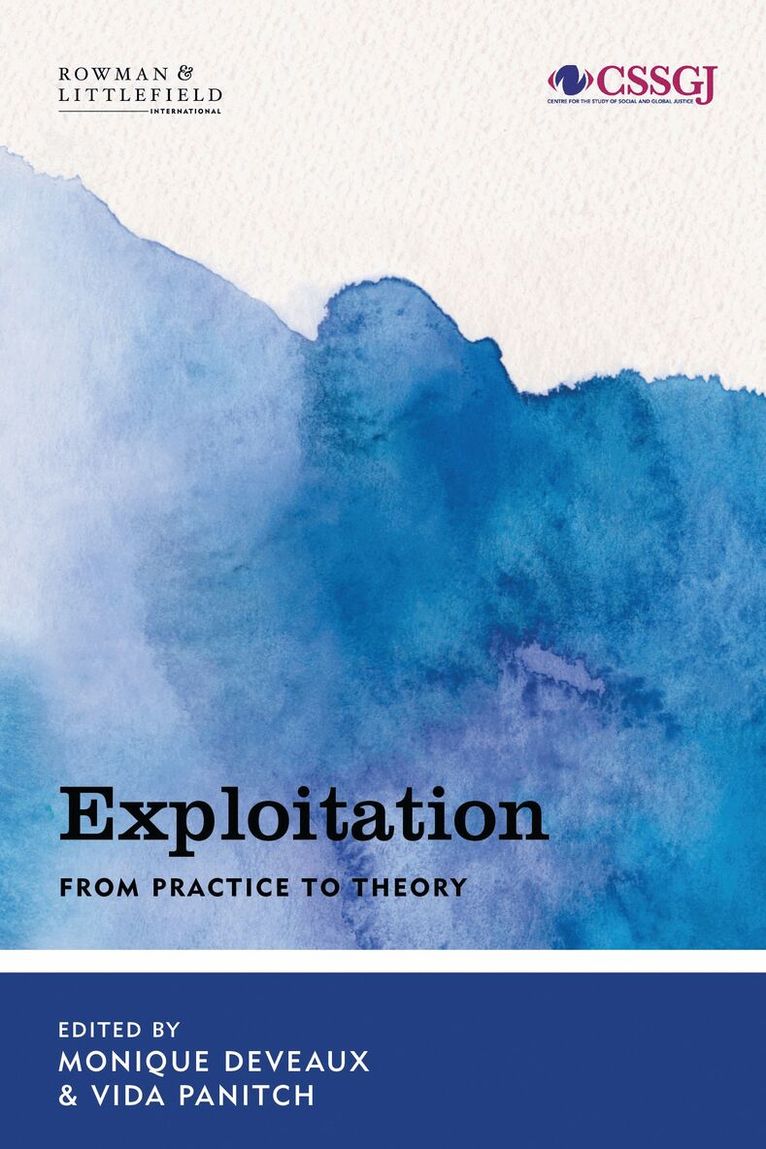
Contemporary theoretical discussions of exploitation are dominated by thinkers in the liberal and Marxian traditions. Exploitation: From Practice to Theory, pushes past these traditional and binary explanations, to focus on unjust practises that both depend on and perpetuate inequalities central to exploitation. Using real-world examples, the chapters in this collection address key questions, including, in what ways are exploitation practices globalised, racialized and gendered? How do cases of organ selling, price gouging and commercial gestational surrogacy change our understandings of exploitation? What possible social and economic remedies do these new conceptions prescribe? Case studies in this volume span the globe, dealing with developed and developing countries alike and in a variety of national and transnational contexts.
675 kr
Skickas inom 10-15 vardagar
Contemporary theoretical discussions of exploitation are dominated by thinkers in the liberal and Marxian traditions. Exploitation: From Practice to Theory, pushes past these traditional and binary explanations, to focus on unjust practises that both depend on and perpetuate inequalities central to exploitation. Using real-world examples, the chapters in this collection address key questions, including, in what ways are exploitation practices globalised, racialized and gendered? How do cases of organ selling, price gouging and commercial gestational surrogacy change our understandings of exploitation? What possible social and economic remedies do these new conceptions prescribe? Case studies in this volume span the globe, dealing with developed and developing countries alike and in a variety of national and transnational contexts.