
Vijay Madisetti – författare
Visar alla böcker från författaren Vijay Madisetti. Handla med fri frakt och snabb leverans.
11 produkter
11 produkter
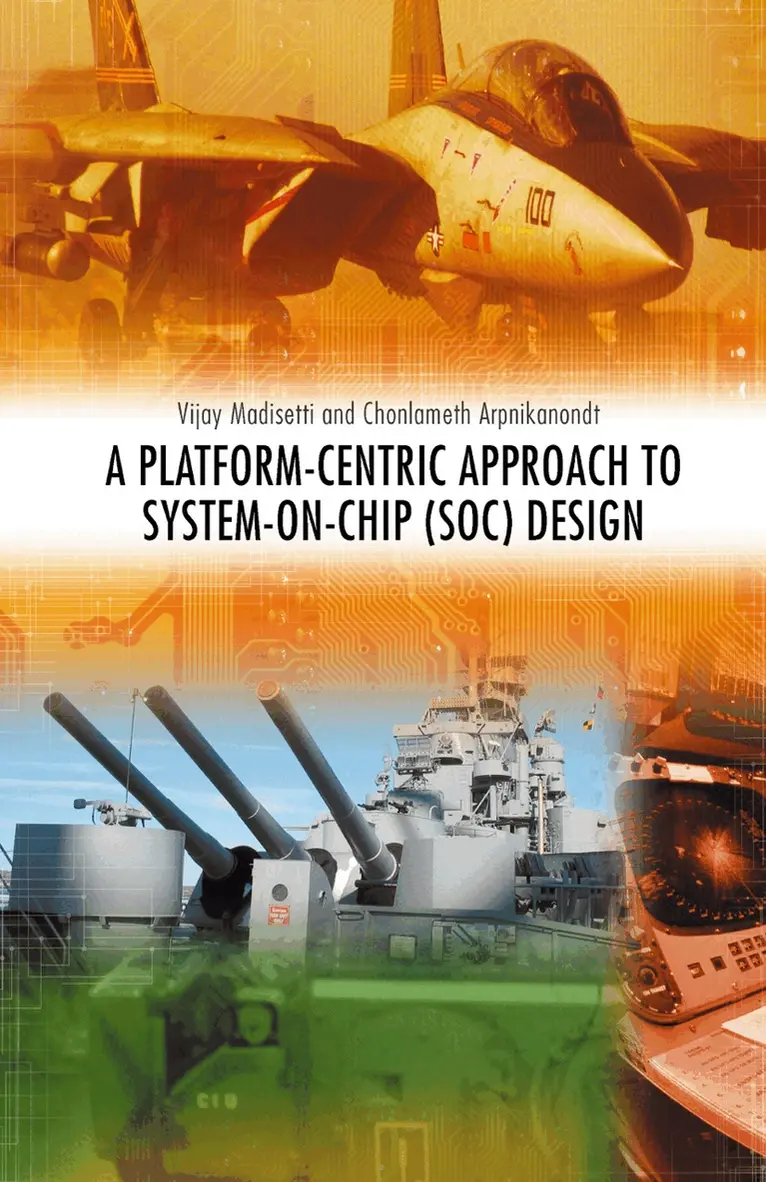
Inbunden, Engelska, 2004
1 619 kr
Skickas inom 10-15 vardagar
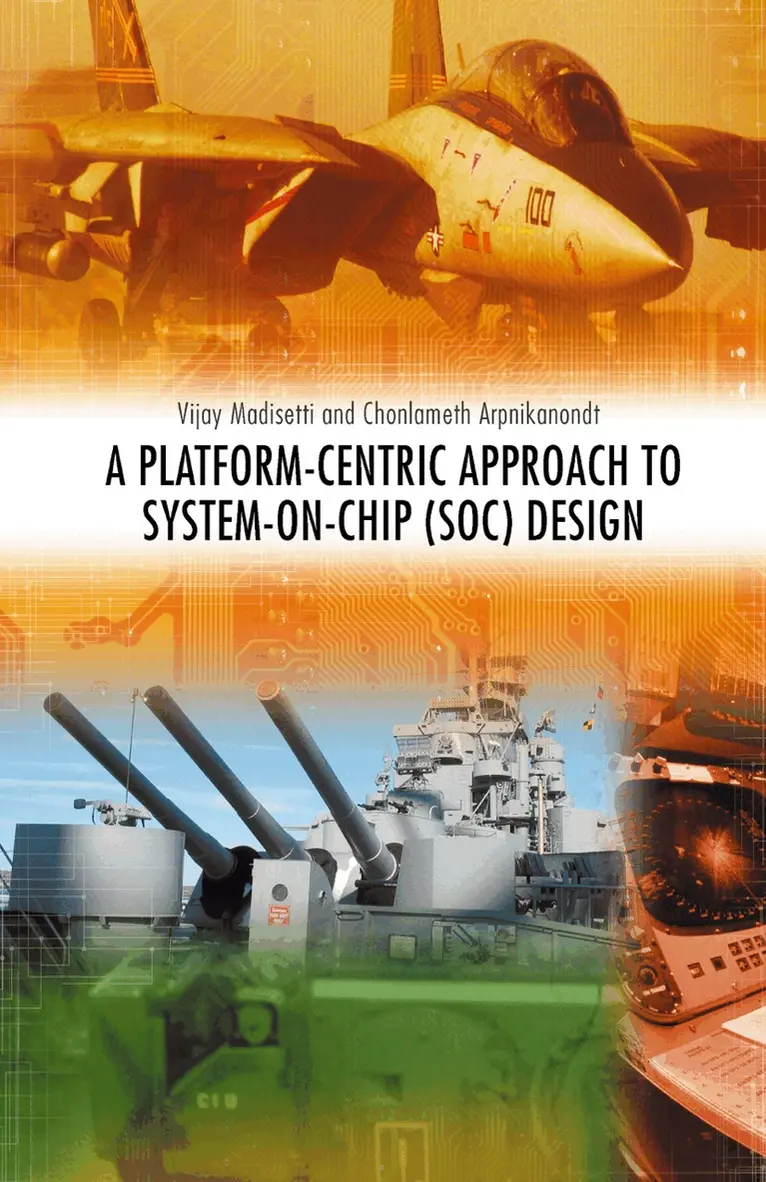
The platform-centric SoC method is aimed at the design of today's SoC systems with emphasis on real-time, embedded systems. The approach provides a guideline and a SoC design environment that promotes an integration of state-of-the-art tools and techniques necessary for the development of the systems. It renders a new and better perspective toward co-design approaches, while also raising a level of design abstraction. Because the configurable platform objects are designed off-cycle, they contribute to the general improvement in development time. By incorporating their usage, the overall method strikes a balance between total design flexibility and minimal time-to-market.
Inbunden, Engelska, 1996
1 605 kr
Skickas inom 10-15 vardagar
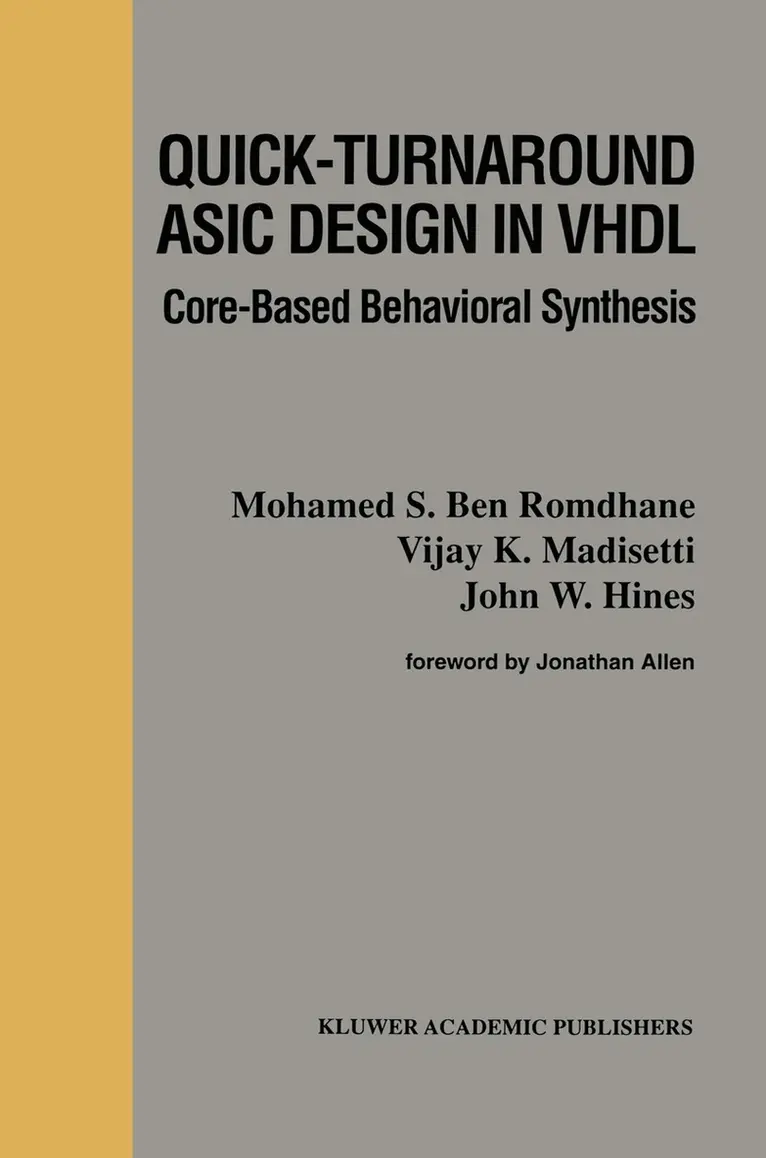
In order to organize the design process, there have been two major approaches. The top-down approach starts with an abstract, concise, functional description which can be quickly generated. On the other hand, the bottom-up approach starts from a detailed low-level design where performance can be directly assessed, but where the requisite design and interface detail take a long time to generate. In this book, the authors show a way to effectively resolve this tension by retaining the high-level conciseness of VHDL while parameterizing it to get good fit to specific applications through reuse of core library components. Since they build on a pre-designed set of core elements, accurate area, speed and power estimates can be percolated to high- level design routines which explore the design space. Results are impressive, and the cost model provided should prove to be very useful. The methodology provided makes use of extant design tools, and is realistic in terms of the industrial design process. The approach is interesting in its own right, but is also of direct utility, and it will give the existing DSP CAD tools a highly competitive alternative.The techniques described have been developed within ARPAs RASSP (Rapid Prototyping of Application Specific Signal Processors) project, and should be of great interest there, as well as to many industrial designers.

Inbunden, Engelska, 2014
463 kr
Skickas inom 5-8 vardagar

Inbunden, Engelska, 2014
463 kr
Skickas inom 5-8 vardagar

Inbunden, Engelska, 2016
687 kr
Skickas inom 5-8 vardagar
Inbunden, Engelska, 2009
3 355 kr
Skickas inom 10-15 vardagar
Now available in a three-volume set, this updated and expanded edition of the bestselling The Digital Signal Processing Handbook continues to provide the engineering community with authoritative coverage of the fundamental and specialized aspects of information-bearing signals in digital form. Encompassing essential background material, technical details, standards, and software, the second edition reflects cutting-edge information on signal processing algorithms and protocols related to speech, audio, multimedia, and video processing technology associated with standards ranging from WiMax to MP3 audio, low-power/high-performance DSPs, color image processing, and chips on video. Drawing on the experience of leading engineers, researchers, and scholars, the three-volume set contains 29 new chapters that address multimedia and Internet technologies, tomography, radar systems, architecture, standards, and future applications in speech, acoustics, video, radar, and telecommunications.This volume, Wireless, Networking, Radar, Sensor Array Processing, and Nonlinear Signal Processing, provides complete coverage of the foundations of signal processing related to wireless, radar, space–time coding, and mobile communications, together with associated applications to networking, storage, and communications.
Inbunden, Engelska, 2009
2 429 kr
Skickas inom 10-15 vardagar
Now available in a three-volume set, this updated and expanded edition of the bestselling The Digital Signal Processing Handbook continues to provide the engineering community with authoritative coverage of the fundamental and specialized aspects of information-bearing signals in digital form. Encompassing essential background material, technical details, standards, and software, the second edition reflects cutting-edge information on signal processing algorithms and protocols related to speech, audio, multimedia, and video processing technology associated with standards ranging from WiMax to MP3 audio, low-power/high-performance DSPs, color image processing, and chips on video. Drawing on the experience of leading engineers, researchers, and scholars, the three-volume set contains 29 new chapters that address multimedia and Internet technologies, tomography, radar systems, architecture, standards, and future applications in speech, acoustics, video, radar, and telecommunications.This volume, Video, Speech, and Audio Signal Processing and Associated Standards, provides thorough coverage of the basic foundations of speech, audio, image, and video processing and associated applications to broadcast, storage, search and retrieval, and communications.
Häftad, Engelska, 2010
1 541 kr
Skickas inom 5-8 vardagar
The platform-centric SoC method is aimed at the design of today's SoC systems with emphasis on real-time, embedded systems. The approach provides a guideline and an SoC design environment that promotes an integration of state-of-the-art tools and techniques necessary for the development of the systems. It renders a new and better perspective towards co-design approaches, while also raising a level of design abstraction. Because the configurable platform objects are designed off-cycle, they contribute to a general improvement in development time. By incorporating their usage, the overall method strikes a balance between total design flexibility and minimal time-to-market. In Chapter 1, challenges in the co-design of SoCs are introduced. The chapter briefly describes the technical challenges facing system developers and introduces a proposed solution to the problem. The remainder of this book presents a more thorough examination on the problem and the proposed approach. Chapter 2 describes the proposed platform-centric SoC design method in detail. It illustrates the design flow and discusses each main step in the design process.Definition of a platform as originally defined by Sabbagh [96], as well as the platform-based and platform-centric design approaches, are presented. The chapter concludes by comparing the proposed approach with previous related work. Chapter 3 lays out the technological background for the proposed SoC design method. Whereas the platform technology is discussed in Chapter 2, this chapter gives an overview of the other two fundamental technologies: the Unified Modeling Language (UML) and the Extensible Markup Language (XML). The chapter begins with an introduction to UML as a modeling tool very well perceived within the software engineering community. It is followed by a discussion on an attempt by the Object Management Group (OMG) to empower UML for the development of real-time embedded software -- an effort which will eventually culminate in a design framework known as the UML Profile for Schedulability, Performance, and Time Specification [29]. Thereafter, an overview of XML and a few other related internet technologies ensue.Chapter 4 outlines the structure of the library of platform objects (LPO), as well as furnishes a comprehensive guideline and requirements specification that a platform object must possess in order to be scalable and compatible with the proposed approach. Essential elements for each platform object, e.g. architecture blueprint, XML-based self-described modules, platform managing tool, etc., are also discussed in detail. Chapter 5 provides a detailed treatment of UML extensions for the development of real-time embedded systems. The chapter starts with a layout of the Co-design Modeling Framework (CMF) hierarchy that encompasses five other sub-profiles -- the generic utility profile (PCUprofile), the Exception Modeling profile (EMprofile), the Interrupt Modeling profile (IMprofile), the Synthesizable Hardware Description Language profile (SHDLprofile), and the Architecture Blueprint profile (ABprofile). Each of these profiles furnishes a design framework that is specifically tailored for the proposed approach, and may be able to meet with the challenges posed by the design and test of real-time embedded SoC-based systems.The chapter, then, proceeds to discuss the domain concept for each sub-profile, followed by the description of the corresponding stereotypes. Chapter 6 applies the platform-centric SoC design method, using the CMF profile in UML, to the development of a simplified digital camera system so as to demonstrate the use and the robustness of the proposed approach. Specifically, the NiOS development board is used to mimic the digital camera system where raw image data are read from a charge-coupled device (CCD), and then JPEG encoded and stored into memory. The chapter begins with an overview of the Altera's NiOS system, followed by the actual system development process that explicitly demonstrates the use of the proposed approach. A quantitative evaluation is then presented that compares the development cost of the proposed platform-centric SoC design method against some alternative approaches using cost estimation models and tools. Chapter 7 concludes the book with a summary and a discussion of future directions for this effort on platform-based design.
Häftad, Engelska, 2011
1 619 kr
Skickas inom 10-15 vardagar
From the Foreword..... Modern digital signal processing applications provide a large challenge to the system designer. Algorithms are becoming increasingly complex, and yet they must be realized with tight performance constraints. Nevertheless, these DSP algorithms are often built from many constituent canonical subtasks (e.g., IIR and FIR filters, FFTs) that can be reused in other subtasks. Design is then a problem of composing these core entities into a cohesive whole to provide both the intended functionality and the required performance. In order to organize the design process, there have been two major approaches. The top-down approach starts with an abstract, concise, functional description which can be quickly generated. On the other hand, the bottom-up approach starts from a detailed low-level design where performance can be directly assessed, but where the requisite design and interface detail take a long time to generate. In this book, the authors show a way to effectively resolve this tension by retaining the high-level conciseness of VHDL while parameterizing it to get good fit to specific applications through reuse of core library components. Since they build on a pre-designed set of core elements, accurate area, speed and power estimates can be percolated to high- level design routines which explore the design space. Results are impressive, and the cost model provided will prove to be very useful. Overall, the authors have provided an up-to-date approach, doing a good job at getting performance out of high-level design. The methodology provided makes good use of extant design tools, and is realistic in terms of the industrial design process. The approach is interesting in its own right, but is also of direct utility, and it will give the existing DSP CAD tools a highly competitive alternative. The techniques described have been developed within ARPAs RASSP (Rapid Prototyping of Application Specific SignalProcessors) project, and should be of great interest there, as well as to many industrial designers. Professor Jonathan Allen, Massachusetts Institute of Technology
Inbunden, Engelska, 2019
1 116 kr
Skickas inom 5-8 vardagar
Inbunden, Engelska, 2024
1 092 kr
Skickas inom 5-8 vardagar