Vincent C. Müller - Böcker
Visar alla böcker från författaren Vincent C. Müller. Handla med fri frakt och snabb leverans.
15 produkter
15 produkter
657 kr
Skickas inom 10-15 vardagar
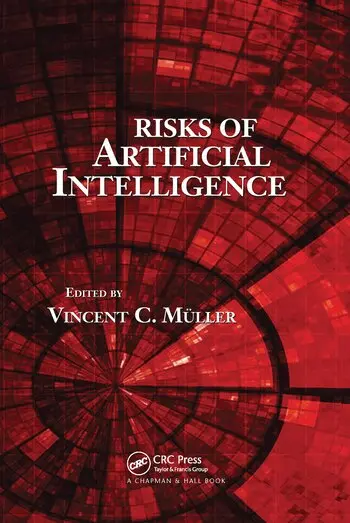
If the intelligence of artificial systems were to surpass that of humans, humanity would face significant risks. The time has come to consider these issues, and this consideration must include progress in artificial intelligence (AI) as much as insights from AI theory.Featuring contributions from leading experts and thinkers in artificial intelligence, Risks of Artificial Intelligence is the first volume of collected chapters dedicated to examining the risks of AI. The book evaluates predictions of the future of AI, proposes ways to ensure that AI systems will be beneficial to humans, and then critically evaluates such proposals.The book covers the latest research on the risks and future impacts of AI. It starts with an introduction to the problem of risk and the future of artificial intelligence, followed by a discussion (Armstrong/Sokala/ÓhÉigeartaigh) on how predictions of its future have fared to date.Omohundro makes the point that even an innocuous artificial agent can easily turn into a serious threat for humans. T. Goertzel explains how to succeed in the design of artificial agents. But will these be a threat for humanity, or a useful tool? Ways to assure beneficial outcomes through ‘machine ethics’ and ‘utility functions’ are discussed by Brundage and Yampolskiy.B. Goertzel and Potapov/Rodionov propose ‘learning’ and ‘empathy’ as paths towards safer AI while Kornai explains how the impact of AI may be bounded. Sandberg explains the implications of human-like AI via the technique of brain emulation. Dewey discusses strategies to deal with the ‘fast takeoff’ of artificial intelligence and, finally, Bishop explains why there is no need to worry because computers will remain in a state of ‘artificial stupidity’.Sharing insights from leading thinkers in artificial intelligence, this book provides you with an expert-level perspective of what is on the horizon for AI, whether it will be a threat for humanity, and how we might counteract this threat.
1 873 kr
Skickas inom 10-15 vardagar
If the intelligence of artificial systems were to surpass that of humans, humanity would face significant risks. The time has come to consider these issues, and this consideration must include progress in artificial intelligence (AI) as much as insights from AI theory.Featuring contributions from leading experts and thinkers in artificial intelligence, Risks of Artificial Intelligence is the first volume of collected chapters dedicated to examining the risks of AI. The book evaluates predictions of the future of AI, proposes ways to ensure that AI systems will be beneficial to humans, and then critically evaluates such proposals.The book covers the latest research on the risks and future impacts of AI. It starts with an introduction to the problem of risk and the future of artificial intelligence, followed by a discussion (Armstrong/Sokala/ÓhÉigeartaigh) on how predictions of its future have fared to date.Omohundro makes the point that even an innocuous artificial agent can easily turn into a serious threat for humans. T. Goertzel explains how to succeed in the design of artificial agents. But will these be a threat for humanity, or a useful tool? Ways to assure beneficial outcomes through ‘machine ethics’ and ‘utility functions’ are discussed by Brundage and Yampolskiy.B. Goertzel and Potapov/Rodionov propose ‘learning’ and ‘empathy’ as paths towards safer AI while Kornai explains how the impact of AI may be bounded. Sandberg explains the implications of human-like AI via the technique of brain emulation. Dewey discusses strategies to deal with the ‘fast takeoff’ of artificial intelligence and, finally, Bishop explains why there is no need to worry because computers will remain in a state of ‘artificial stupidity’.Sharing insights from leading thinkers in artificial intelligence, this book provides you with an expert-level perspective of what is on the horizon for AI, whether it will be a threat for humanity, and how we might counteract this threat.
1 578 kr
Skickas inom 10-15 vardagar
This edited volume is about how unprejudiced approaches to real human cognition can improve the design of AI. It covers many aspects of human cognition and across 12 chapters the reader can explore multiple approaches about the complexities of human cognitive skills and reasoning, always guided by experts from different but complimentary academic fields.A central concept is explained: blended cognition, the natural skill of human beings for combining constantly different heuristics during their several task-solving activities. Something that was sometimes observed like a problem as “bad reasoning”, is now the central key for the understanding of the richness, adaptability and creativity of human cognition. The topic of this book connects in a significant way with the disciplines of psychology, neurology, anthropology, philosophy, logics, engineering, logics, and AI. In a nutshell: understanding better humans for designing better machines.Any person with interests on natural and artificial reasoning should read this book as a primary source of inspiration and a way to achieve a critical thinking on these topics.
Del 44 - Studies in Applied Philosophy, Epistemology and Rational Ethics
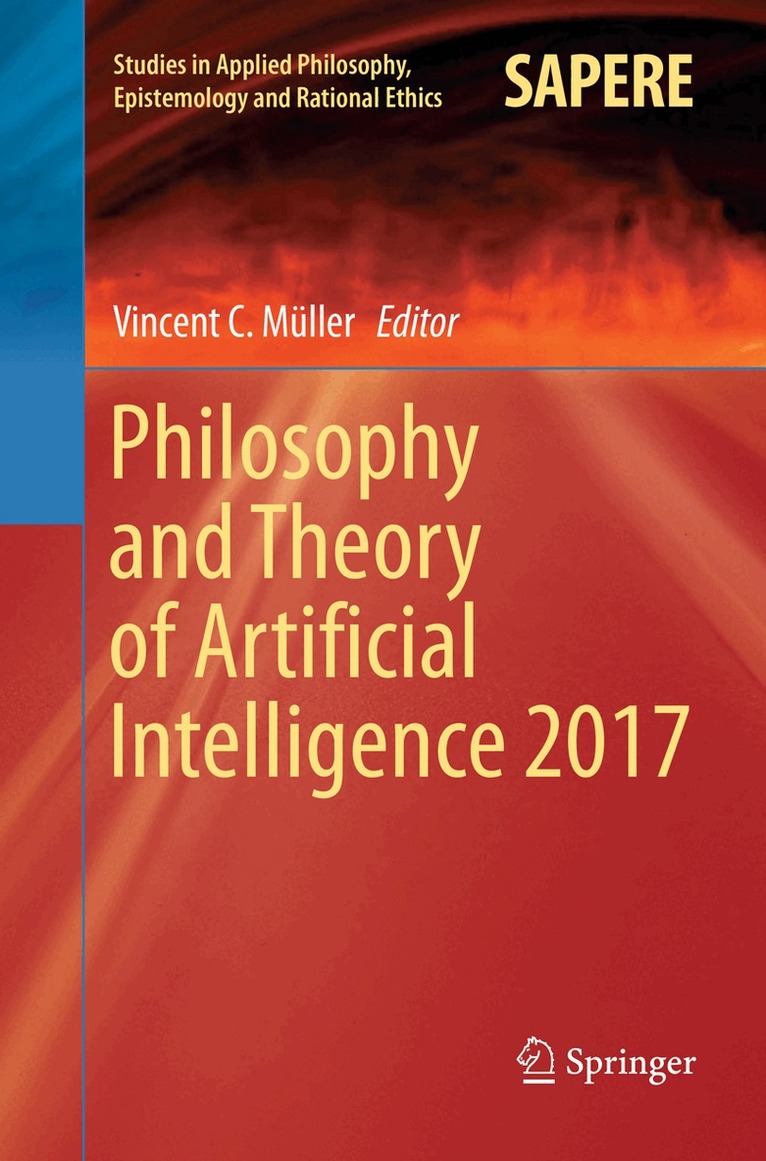
Philosophy and Theory of Artificial Intelligence 2017
Häftad, Engelska, 2019
959 kr
Skickas inom 10-15 vardagar
cutting-edge ethical issues, such as the AI impact on human dignity and society, responsibilities and rights of machines, as well as AI threats to humanity and AI safety;
Del 63 - Studies in Applied Philosophy, Epistemology and Rational Ethics
Philosophy and Theory of Artificial Intelligence 2021
Inbunden, Engelska, 2022
1 682 kr
Skickas inom 10-15 vardagar
This book gathers contributions from the fourth edition of the Conference on "Philosophy and Theory of Artificial Intelligence" (PT-AI), held on 27-28th of September 2021 at Chalmers University of Technology, in Gothenburg, Sweden.
Del 63 - Studies in Applied Philosophy, Epistemology and Rational Ethics
Philosophy and Theory of Artificial Intelligence 2021
Häftad, Engelska, 2023
1 682 kr
Skickas inom 10-15 vardagar
This book gathers contributions from the fourth edition of the Conference on "Philosophy and Theory of Artificial Intelligence" (PT-AI), held on 27-28th of September 2021 at Chalmers University of Technology, in Gothenburg, Sweden. It covers topics at the interface between philosophy, cognitive science, ethics and computing. It discusses advanced theories fostering the understanding of human cognition, human autonomy, dignity and morality, and the development of corresponding artificial cognitive structures, analyzing important aspects of the relationship between humans and AI systems, including the ethics of AI. This book offers a thought-provoking snapshot of what is currently going on, and what are the main challenges, in the multidisciplinary field of the philosophy of artificial intelligence.
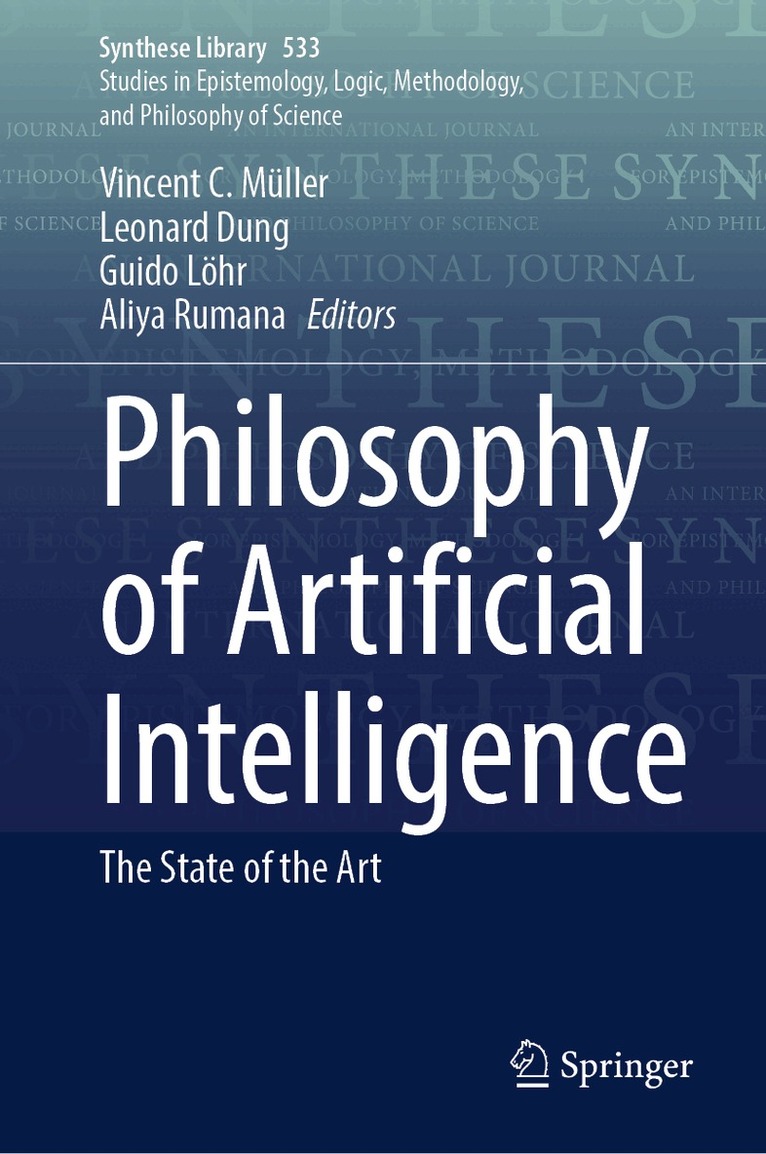
Del 533 - Synthese Library
Philosophy of Artificial Intelligence
The State of the Art
Inbunden, Engelska, 2026
1 510 kr
Kommande
This book contains a selection of the very best papers from the Philosophy of AI (PhAI, formerly PT-AI), one of the leading regular conferences in the field of Philosophy of AI. The field finds itself in a moment of massive growth and change, and this book presents highly innovative, cutting-edge research by top scholars. The philosophy of AI is more and more intertwined with the ethics of AI and it now has both a deep impact on society, and on philosophy itself. Containing chapters on classic issues such as machine agency, regulation or bias, as well as new ones like large language models (LLMs), machine agency, creativity and the general ability to have mental states, this volume is of great interest to those interested in philosophy of AI and its impact on society.
1 064 kr
Skickas inom 10-15 vardagar
The chapters cover: 1) philosophy of computing, 2) philosophy of computer science & discovery, 3) philosophy of cognition & intelligence, 4) computing & society, and 5) ethics of computation.
2 625 kr
Skickas inom 10-15 vardagar
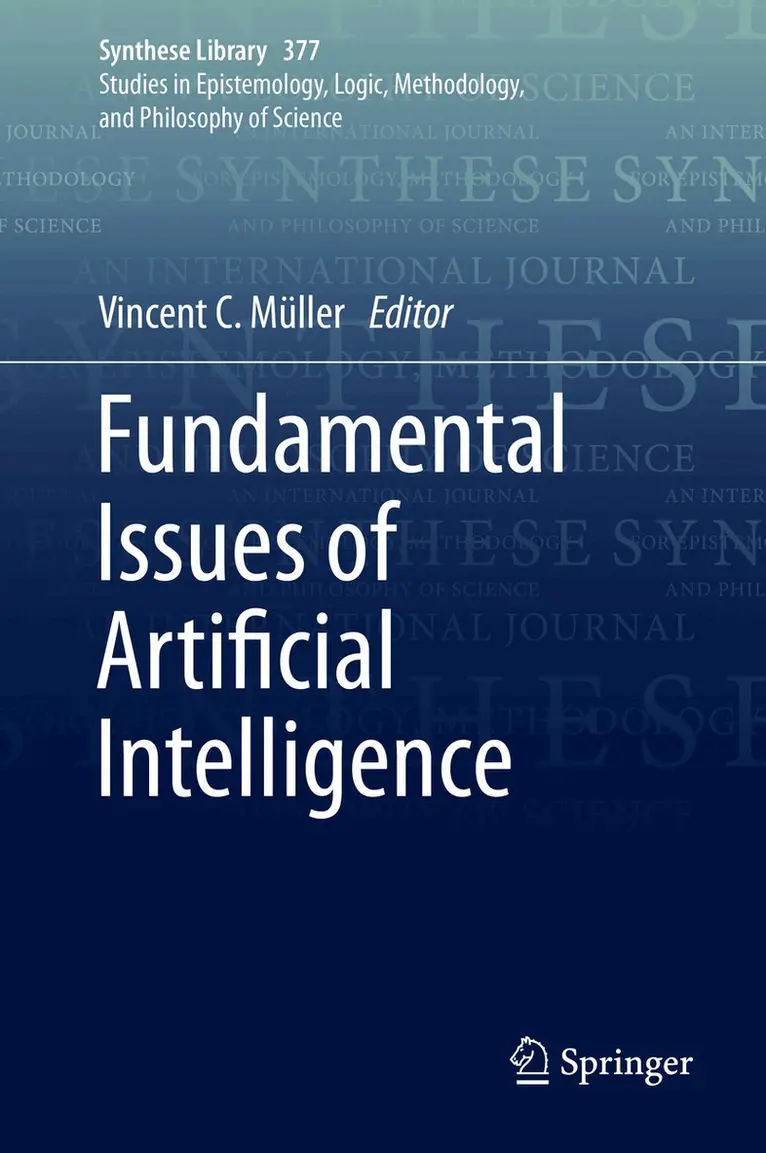
This volume offers a look at the fundamental issues of present and future AI, especially from cognitive science, computer science, neuroscience and philosophy. This work examines the conditions for artificial intelligence, how these relate to the conditions for intelligence in humans and other natural agents, as well as ethical and societal problems that artificial intelligence raises or will raise.The key issues this volume investigates include the relation of AI and cognitive science, ethics of AI and robotics, brain emulation and simulation, hybrid systems and cyborgs, intelligence and intelligence testing, interactive systems, multi-agent systems, and super intelligence.Based on the 2nd conference on “Theory and Philosophy of Artificial Intelligence” held in Oxford, the volume includes prominent researchers within the field from around the world.
1 064 kr
Skickas inom 10-15 vardagar
The chapters cover: 1) philosophy of computing, 2) philosophy of computer science & discovery, 3) philosophy of cognition & intelligence, 4) computing & society, and 5) ethics of computation.
2 625 kr
Skickas inom 10-15 vardagar
This volume offers a look at the fundamental issues of present and future AI, especially from cognitive science, computer science, neuroscience and philosophy. This work examines the conditions for artificial intelligence, how these relate to the conditions for intelligence in humans and other natural agents, as well as ethical and societal problems that artificial intelligence raises or will raise.The key issues this volume investigates include the relation of AI and cognitive science, ethics of AI and robotics, brain emulation and simulation, hybrid systems and cyborgs, intelligence and intelligence testing, interactive systems, multi-agent systems, and super intelligence.Based on the 2nd conference on “Theory and Philosophy of Artificial Intelligence” held in Oxford, the volume includes prominent researchers within the field from around the world.
Del 44 - Studies in Applied Philosophy, Epistemology and Rational Ethics
Philosophy and Theory of Artificial Intelligence 2017
Inbunden, Engelska, 2018
1 381 kr
Skickas inom 10-15 vardagar
This book reports on the results of the third edition of the premier conference in the field of philosophy of artificial intelligence, PT-AI 2017, held on November 4 - 5, 2017 at the University of Leeds, UK. It covers: advanced knowledge on key AI concepts, including complexity, computation, creativity, embodiment, representation and superintelligence; cutting-edge ethical issues, such as the AI impact on human dignity and society, responsibilities and rights of machines, as well as AI threats to humanity and AI safety; and cutting-edge developments in techniques to achieve AI, including machine learning, neural networks, dynamical systems. The book also discusses important applications of AI, including big data analytics, expert systems, cognitive architectures, and robotics. It offers a timely, yet very comprehensive snapshot of what is going on in the field of AI, especially at the interfaces between philosophy, cognitive science, ethics and computing.
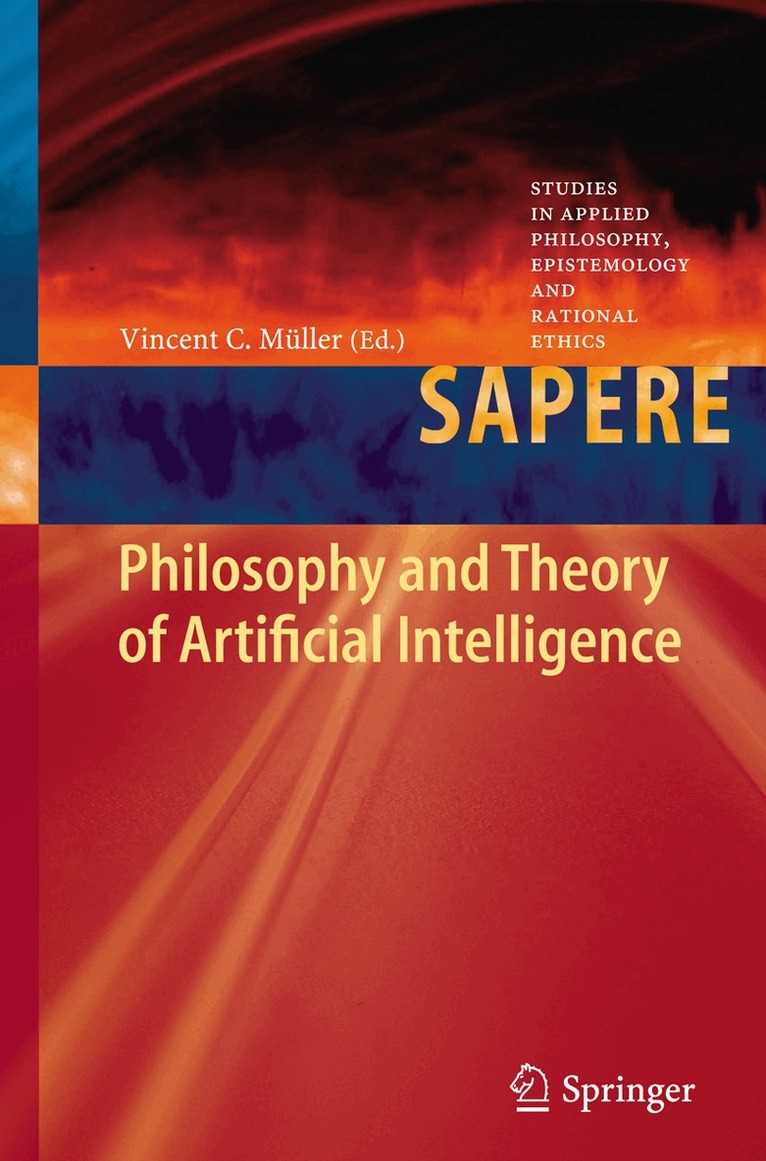
Del 5 - Studies in Applied Philosophy, Epistemology and Rational Ethics
Philosophy and Theory of Artificial Intelligence
Inbunden, Engelska, 2012
1 578 kr
Skickas inom 10-15 vardagar
Can we make machines that think and act like humans or other natural intelligent agents? The answer to this question depends on how we see ourselves and how we see the machines in question. Classical AI and cognitive science had claimed that cognition is computation, and can thus be reproduced on other computing machines, possibly surpassing the abilities of human intelligence. This consensus has now come under threat and the agenda for the philosophy and theory of AI must be set anew, re-defining the relation between AI and Cognitive Science. We can re-claim the original vision of general AI from the technical AI disciplines; we can reject classical cognitive science and replace it with a new theory (e.g. embodied); or we can try to find new ways to approach AI, for example from neuroscience or from systems theory. To do this, we must go back to the basic questions on computing, cognition and ethics for AI. The 30 papers in this volume provide cutting-edge work from leading researchers that define where we stand and where we should go from here.
Del 5 - Studies in Applied Philosophy, Epistemology and Rational Ethics
Philosophy and Theory of Artificial Intelligence
Häftad, Engelska, 2014
1 578 kr
Skickas inom 10-15 vardagar
Can we make machines that think and act like humans or other natural intelligent agents? The answer to this question depends on how we see ourselves and how we see the machines in question. Classical AI and cognitive science had claimed that cognition is computation, and can thus be reproduced on other computing machines, possibly surpassing the abilities of human intelligence. This consensus has now come under threat and the agenda for the philosophy and theory of AI must be set anew, re-defining the relation between AI and Cognitive Science. We can re-claim the original vision of general AI from the technical AI disciplines; we can reject classical cognitive science and replace it with a new theory (e.g. embodied); or we can try to find new ways to approach AI, for example from neuroscience or from systems theory. To do this, we must go back to the basic questions on computing, cognition and ethics for AI. The 30 papers in this volume provide cutting-edge work from leading researchers that define where we stand and where we should go from here.
200 kr
Skickas inom 3-6 vardagar