Vincent J. Giannetti - Böcker
Visar alla böcker från författaren Vincent J. Giannetti. Handla med fri frakt och snabb leverans.
4 produkter
4 produkter
2 042 kr
Skickas inom 10-15 vardagar
The last two decades have seen unprecedented increases in health care costs and, at the same time, encouraging progress in psychotherapy research. On the one hand, accountability, cost-effectiveness, and efficiency have now become commonplace terms for providers of mental health services whereas, on the other hand, an increasingly voluminous literature has emerged supporting the effectiveness of a number of types of psychotherapies. There now exists the possibility for the design and delivery of mental health services that-drawing upon this literature-more closely approximate empirically established data concerning the appropriateness and effectiveness of psychotherapy. The Handbook of the Brief Psychotherapies is intended to capture one major thrust of this movement: the development of a group of empirically grounded, time-limited therapies all sharing a common interest in the clinical utilization of a structured focus and an emphasis on time and action. For many years, professional self-interest, competing theoretical para digms, and the vagaries of practice, wisdom, and clinical myth have influenced the practice of psychotherapy. A critical questioning of the resulting, predomi nantly nondirective, open-ended, and global therapies has led to a growing emphasis on action-oriented, problem-focused, time-limited therapies. Yet, ironically, this interest in the brief psychotherapies has not so much involved a radical departure from traditional therapeutic modalities as it has emphasized a new pragmatism about how time, action, and structure operate in life as well as in therapy.
878 kr
Skickas inom 10-15 vardagar
552 kr
Skickas inom 10-15 vardagar
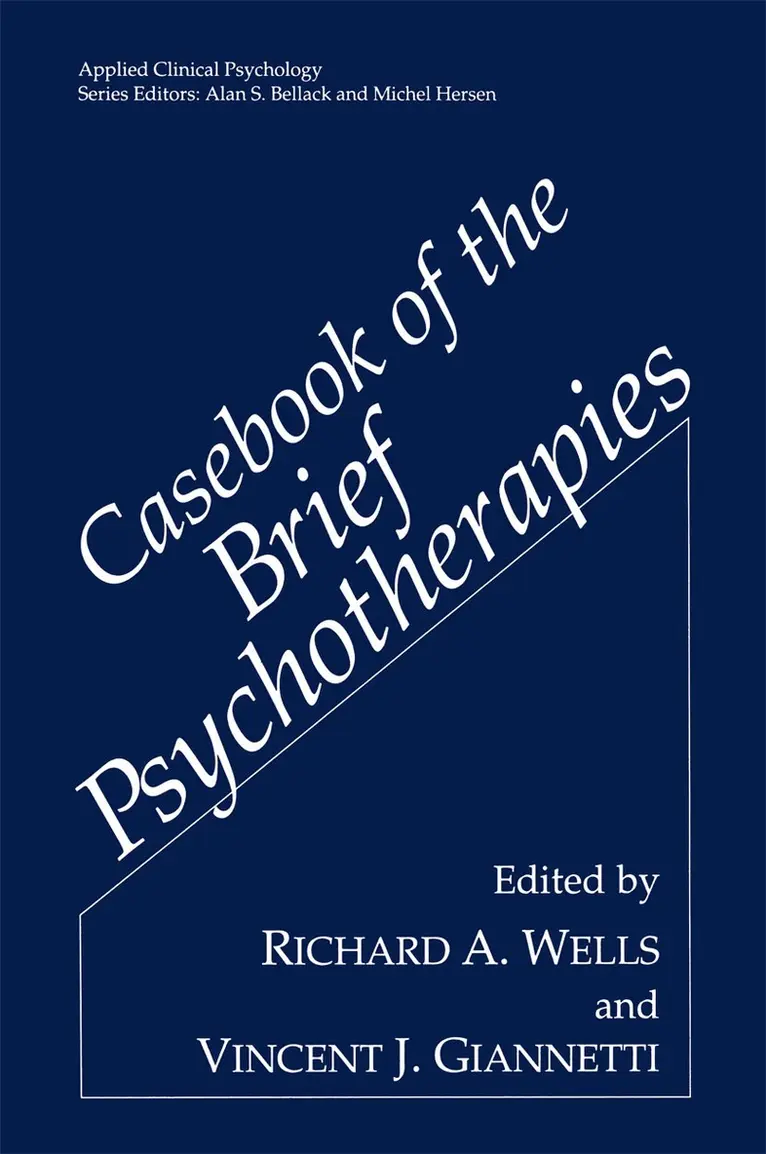
Following the publication of the Handbook of the Brief Psychotherapies (Wells & Giannetti, 1990), the editors began to conceptualize the idea of a collection of case studies encompassing a number of the commonly en countered clinical problems that have been treated with such ap proaches. The Casebook of the Brief Psychotherapies is the result. The Case book details clinical interventions with client populations as diverse as substance abusers, torture victims, the physically handicapped and other exceptional groups, and the economically disadvantaged with emotional and behavioral problems, as well as individuals experiencing sexual dysfunction or eating disorders. In addition, topics such as be reavement, depression, anger, and many crucial aspects of marital and family therapy are discussed by eminent clinical practitioners. Although the cases draw heavily upon cognitive behavioral and strategic structural formulations, psychodynamic, interpersonal, and experiential ap proaches are also included. The Casebook is clinically oriented, with a minimum of theory. Am ple case material and commentary allow the reader to experience direct ly the application of brief therapy to specific client problems. What emerges from this compendium of approaches and problems is a tap estry of action-oriented, problem-solving, skill-building, rational ap proaches to therapy that balance the client's ability to change with the demands and limits of time.
2 164 kr
Skickas inom 10-15 vardagar
The last two decades have seen unprecedented increases in health care costs and, at the same time, encouraging progress in psychotherapy research. On the one hand, accountability, cost-effectiveness, and efficiency have now become commonplace terms for providers of mental health services whereas, on the other hand, an increasingly voluminous literature has emerged supporting the effectiveness of a number of types of psychotherapies. There now exists the possibility for the design and delivery of mental health services that-drawing upon this literature-more closely approximate empirically established data concerning the appropriateness and effectiveness of psychotherapy. The Handbook of the Brief Psychotherapies is intended to capture one major thrust of this movement: the development of a group of empirically grounded, time-limited therapies all sharing a common interest in the clinical utilization of a structured focus and an emphasis on time and action. For many years, professional self-interest, competing theoretical para digms, and the vagaries of practice, wisdom, and clinical myth have influenced the practice of psychotherapy. A critical questioning of the resulting, predomi nantly nondirective, open-ended, and global therapies has led to a growing emphasis on action-oriented, problem-focused, time-limited therapies. Yet, ironically, this interest in the brief psychotherapies has not so much involved a radical departure from traditional therapeutic modalities as it has emphasized a new pragmatism about how time, action, and structure operate in life as well as in therapy.