Vincenzo Barone - Böcker
Visar alla böcker från författaren Vincenzo Barone. Handla med fri frakt och snabb leverans.
7 produkter
7 produkter
2 410 kr
Skickas inom 7-10 vardagar
Handbook of Electronic Structure Theory: Methods and Applications provides a much-needed learning resource that collects and demonstrates the various key methods involved in electronic structure theory, the feasibility and reliability of electronic structure calculations, and their applications using computational chemistry. With a particular focus on the most modern and recent problems that are typically poorly covered in existing, largely outdated book literature, this handbook is designed with early career researchers in mind. It is written primarily for masters, PhD, and postdoctoral students in theoretical and computational chemistry as well as experimental researchers wishing to apply quantum chemical methods in a critical way. Elements like summary boxes, worked examples, and downloadable datasets make this a holistic guide to the topic for learners from different backgrounds who require a deeper understanding of electronic structure theory. Sections focus on critical core theories, the most important recent developments, and future directions, including key topics such as the electronic excited states and the harnessing of machine learning. Finally, the book collects a range of key case study examples of applications, such as in biomolecules, in spectroscopy, and for use in catalysis, amongst others.Provides comprehensive coverage of electronic structure theory and its application using computational chemistryWritten with consistent structure and pedagogical elements to maximize learning and understandingFocuses on modern and the most recent problems and challenges in electronic structure theory (which have been poorly covered in existing books and literature)
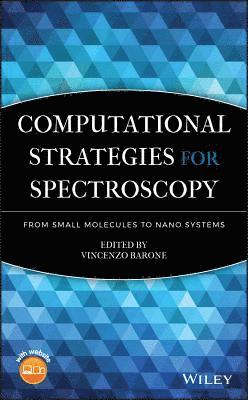
Computational Strategies for Spectroscopy
from Small Molecules to Nano Systems
Inbunden, Engelska, 2011
1 577 kr
Skickas inom 7-10 vardagar
Computational spectroscopy is a rapidly evolving field that is becoming a versatile and widespread tool for the assignment of experimental spectra and their interpretation as related to chemical physical effects. This book is devoted to the most significant methodological contributions in the field, and to the computation of IR, UV-VIS, NMR and EPR spectral parameters with reference to the underlying vibronic and environmental effects. Each section starts with a chapter written by an experimental spectroscopist dealing with present challenges in the different fields; comprehensive coverage of conventional and advanced spectroscopic techniques is provided by means of dedicated chapters written by experts. Computational chemists, analytical chemists and spectroscopists, physicists, materials scientists, and graduate students will benefit from this thorough resource.
1 064 kr
Skickas inom 10-15 vardagar
This monograph gives a comprehensive and up-to-date overview of soft and hard diffraction processes in strong interaction physics. The first part covers the general formalism (the optical analogy, the eikonal picture, high-energy kinematics, S-matrix theory) and soft hadron--hadron scattering (including the Regge theory) in a complete and mature presentation. It can be used as a textbook in particle physics classes. The remainder of the book is devoted to the "new diffraction": the pomeron in QCD, low-x physics, diffractive deep inelastic scattering and related processes, jet production etc. It presents recent results and experimental findings and their phenomenological interpretations. This part addresses graduate students as well as researchers.
1 064 kr
Skickas inom 10-15 vardagar
High-energy diffraction has become a hot and fashionable subject in recent years due to the great interest triggered by the HERA and Tevatron data. These data have helped to show the field from a different perspective paving the road to a hopefully more complete understanding than hitherto achieved. The forthcoming data in the next few years from even higher energies (LHC) promise to sustain this interest for a long time. We believe that it is therefore necessary to summarize the main devel opments which have marked the growth of high-energy diffractive physics in recent decades, and to assess the present state of the art. This is the purpose of the present book, which is especially aimed at the young researchers who are entering the field and want to get acquainted with the relevant results and the main theoretical techniques. The "new" diffraction has started to bridge the gap between the hard and soft regimes of strong interactions. A modern account of the subject, in our opinion, should reflect this situation, covering both the traditional approaches to soft processes which are still alive and useful, and the modern treatment of hard dynamics in the framework of perturbative QCD. The book is divided into three parts. The first part (Chaps. 1-3) contains some introductory material: the systematics of diffractive processes, some historical remarks, the optical analogy, the eikonal approximation of quantum mechanics, and high-energy kinematics. In the second part (Chaps.
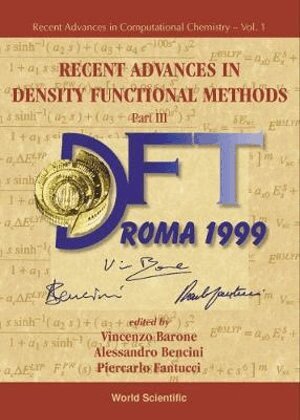
Del 1 - Recent Advances In Computational Chemistry
Recent Advances In Density Functional Methods, Part Iii
Inbunden, Engelska, 2002
2 255 kr
Tillfälligt slut
In the last few years, much attention has been given by theoretical chemists to the development of more accurate model functionals and faster computational techniques including excited electronic states. The 8th International Conference on the Applications of Density Functional Theory to Chemistry and Physics, held in Rome, Italy, on 6-10 September 1999, gathered chemists and physicists to present and discuss state-of-the-art methodological developments and applications of density functional theory (DFT) to increasingly complex systems. The scientists shared their knowledge and experience in DFT, enabling them to face the challenges posed by the needs of high level modeling and simulation in their disciplines. The meeting was opened with an exciting lecture delivered by Nobel laureate W Kohn.The growing use of DFT in studying organic, inorganic and organometallic molecules, clusters and solids provided the basis for the success of the conference, whose main contributions are collected in this invaluable book.
1 841 kr
Tillfälligt slut
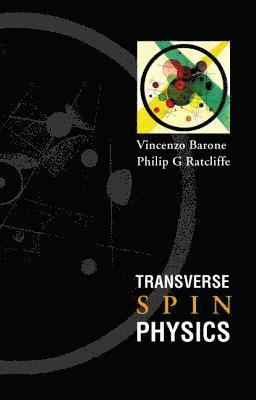
This book is devoted to the theory and phenomenology of transverse-spin effects in high-energy hadronic physics. Contrary to common past belief, it is now rather clear that such effects are far from irrelevant. A decade or so of intense theoretical work has shed much light on the subject and brought to surface an entire class of new phenomena, which now await thorough experimental investigation. Over the next few years a number of experiments world-wide (at BNL, CERN, DESY and JLAB) will run with transversely polarised beams and targets, providing data that will enrich our knowledge of the transverse-spin structure of hadrons. It is therefore timely to assess the state of the art, and this is the principal aim of the volume.An outline of the book is as follows. After a few introductory remarks (Chapter 1), attention is directed in Chapter 2 to transversely polarised deeply-inelastic scattering (DIS), which probes the transverse spin structure function g2. This existing data are reviewed and discussed (for completeness, a brief presentation of longitudinally polarised DIS is also provided). In Chapter 3 the transverse-spin structure of the proton is illustrated in detail, with emphasis on the transversity distribution and the twist-three parton distribution contributing to g2. Model calculations of these quantities are also presented. In Chapter 4, the QCD evolution of transversity is studied at leading and next-to-leading order. Chapter 5 illustrates the g2 structure function and its related sum rules within the framework of perturbative QCD. The last three chapters are devoted to the phenomenology of transversity, in the context of Drell-Yan processes (Chapter 6), inclusive leptoproduction (Chapter 7) and inclusive hadroproduction (Chapter 8). The interpretation of some recent single-spin asymmetry data is discussed and the prospects for future measurements are reviewed.
1 972 kr
Tillfälligt slut
The notion of transversity in hadronic physics has been with us for over 25 years. Intriguing though it might have been, for much of that time transversity remained an intangible and remote object, of interest principally to a few theoreticians. In recent years transversity and transverse-spin effects in general have grown as both theoretical and experimental areas of active research. This increasing attention has now matured into a thriving field with a driving force of its own. The ever-growing bulk of data on asymmetries in collisions involving transversely polarised hadrons demands a more solid and coherent theoretical basis for its description. Indeed, it now appears rather clear that transversity and other closely related properties play a significant role in such phenomena.As part of a Ministry-funded inter-university Research Project, this workshop was organised to gather together experimentalists and theoreticians engaged in investigating the nature of transverse spin in hadronic physics, with the intent of favouring the exchange of up-to-date theoretical and experimental ideas and news on the subject. Over 70 physicists took part and very nearly all the major experiments involved in transverse-spin studies were officially represented, as too were the main theory groups working in the field. New results and new analyses sparked many interesting and lively discussions.