Vincenzo Vullo - Böcker
Visar alla böcker från författaren Vincenzo Vullo. Handla med fri frakt och snabb leverans.
10 produkter
10 produkter
789 kr
Skickas inom 5-8 vardagar
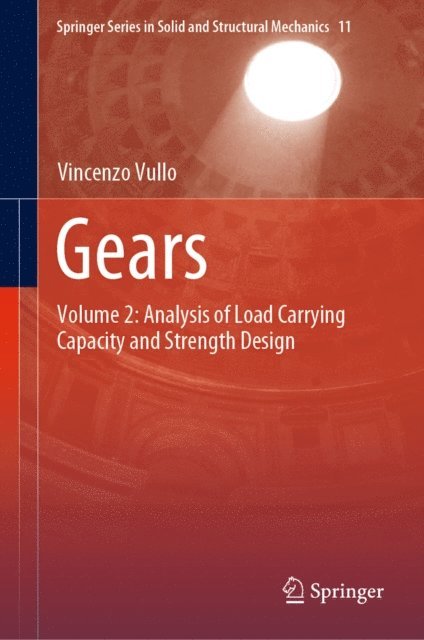
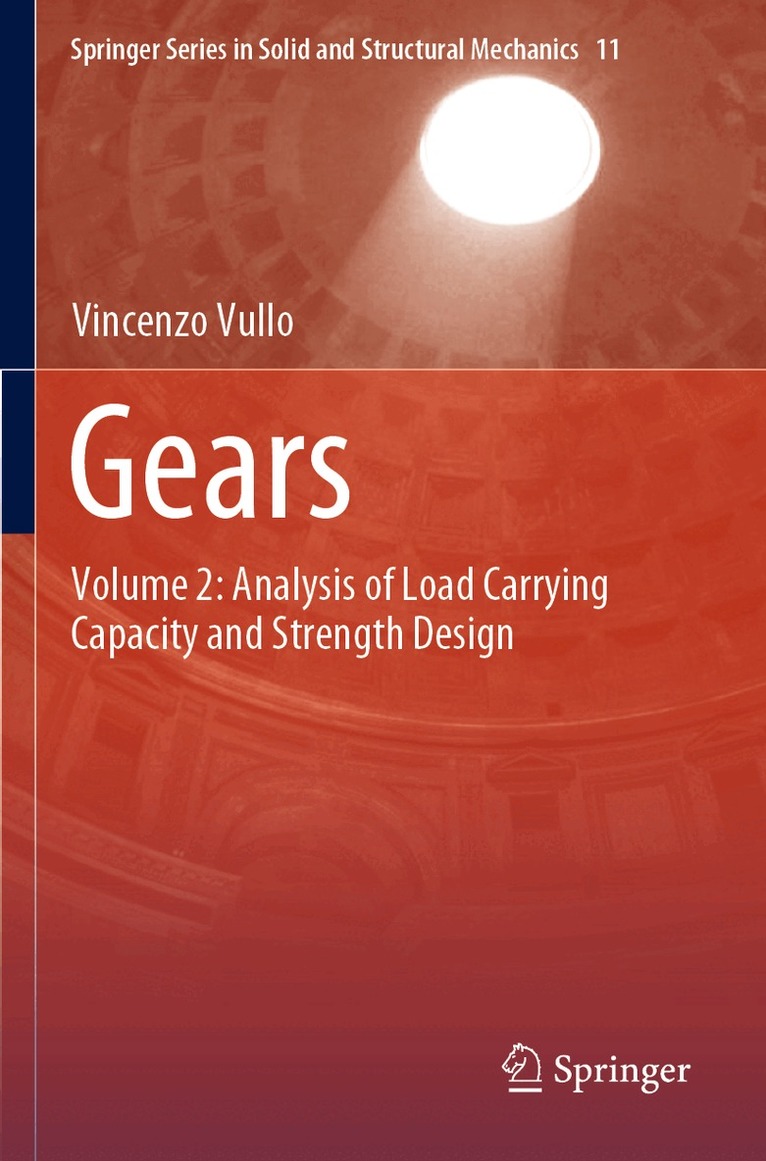
The book explores the geometric and kinematic design of the various types of gears most commonly used in practical applications, also considering the problems concerning their cutting processes. The cylindrical spur and helical gears are first considered, determining their main geometric quantities in the light of interference and undercut problems, as well as the related kinematic parameters. Particular attention is paid to the profile shift of these types of gears either generated by rack-type cutter or by pinion-rack cutter. Among other things, profile-shifted toothing allows to obtain teeth shapes capable of greater strength and more balanced specific sliding, as well as to reduce the number of teeth below the minimum one to avoid the operating interference or undercut. These very important aspects of geometric-kinematic design of cylindrical spur and helical gears are then generalized and extended to the other examined types of gears most commonly used in practical applications, such as: straight bevel gears; crossed helical gears; worm gears; spiral bevel and hypoid gears. Finally, ordinary gear trains, planetary gear trains and face gear drives are discussed.Includes fully-developed exercises to draw the reader's attention to the problems that are of interest to the designer, as well as to clarify the calculation procedureTopics are addressed from a theoretical standpoint, but in such a way as not to lose sight of the physical phenomena that characterize the various types of gears which are examinedThe analytical and numerical solutions are formulated so as to be of interest not only to academics, but also to designers who deal with actual engineering problems concerning the gears
634 kr
Skickas inom 5-8 vardagar
This book explores the geometric and kinematic design of the various types of gears most commonly used in practical applications, also considering the problems concerning their cutting processes. The cylindrical spur and helical gears are first considered, determining their main geometric quantities in the light of interference and undercut problems, as well as the related kinematic parameters. Particular attention is paid to the profile shift of these types of gears either generated by rack-type cutter or by pinion-rack cutter. Among other things, profile-shifted toothing allows to obtain teeth shapes capable of greater strength and more balanced specific sliding, as well as to reduce the number of teeth below the minimum one to avoid the operating interference or undercut. These very important aspects of geometric-kinematic design of cylindrical spur and helical gears are then generalized and extended to the other examined types of gears most commonly used in practical applications, such as straight bevel gears; crossed helical gears; worm gears; spiral bevel and hypoid gears. Finally, ordinary gear trains, planetary gear trains and face gear drives are discussed.This is the most advanced reference guide to the state of the art in gear engineering.Topics are addressed from a theoretical standpoint, but in such a way as not to lose sight of the physical phenomena that characterize the various types of gears which are examined.The analytical and numerical solutions are formulated so as to be of interest not only to academics, but also to designers who deal with actual engineering problems concerning the gears
557 kr
Skickas inom 5-8 vardagar
The book explores the geometric and kinematic design of the various types of gears most commonly used in practical applications, also considering the problems concerning their cutting processes. The cylindrical spur and helical gears are first considered, determining their main geometric quantities in the light of interference and undercut problems, as well as the related kinematic parameters. Particular attention is paid to the profile shift of these types of gears either generated by rack-type cutter or by pinion-rack cutter. Among other things, profile-shifted toothing allows to obtain teeth shapes capable of greater strength and more balanced specific sliding, as well as to reduce the number of teeth below the minimum one to avoid the operating interference or undercut. These very important aspects of geometric-kinematic design of cylindrical spur and helical gears are then generalized and extended to the other examined types of gears most commonly used in practical applications, such as: straight bevel gears; crossed helical gears; worm gears; spiral bevel and hypoid gears. Finally, ordinary gear trains, planetary gear trains and face gear drives are discussed.Includes fully-developed exercises to draw the reader's attention to the problems that are of interest to the designer, as well as to clarify the calculation procedureTopics are addressed from a theoretical standpoint, but in such a way as not to lose sight of the physical phenomena that characterize the various types of gears which are examinedThe analytical and numerical solutions are formulated so as to be of interest not only to academics, but also to designers who deal with actual engineering problems concerning the gears
448 kr
Skickas inom 5-8 vardagar
This book explores the geometric and kinematic design of the various types of gears most commonly used in practical applications, also considering the problems concerning their cutting processes. The cylindrical spur and helical gears are first considered, determining their main geometric quantities in the light of interference and undercut problems, as well as the related kinematic parameters. Particular attention is paid to the profile shift of these types of gears either generated by rack-type cutter or by pinion-rack cutter. Among other things, profile-shifted toothing allows to obtain teeth shapes capable of greater strength and more balanced specific sliding, as well as to reduce the number of teeth below the minimum one to avoid the operating interference or undercut. These very important aspects of geometric-kinematic design of cylindrical spur and helical gears are then generalized and extended to the other examined types of gears most commonly used in practical applications, such as straight bevel gears; crossed helical gears; worm gears; spiral bevel and hypoid gears. Finally, ordinary gear trains, planetary gear trains and face gear drives are discussed.This is the most advanced reference guide to the state of the art in gear engineering.Topics are addressed from a theoretical standpoint, but in such a way as not to lose sight of the physical phenomena that characterize the various types of gears which are examined.The analytical and numerical solutions are formulated so as to be of interest not only to academics, but also to designers who deal with actual engineering problems concerning the gears
1 387 kr
Skickas inom 10-15 vardagar
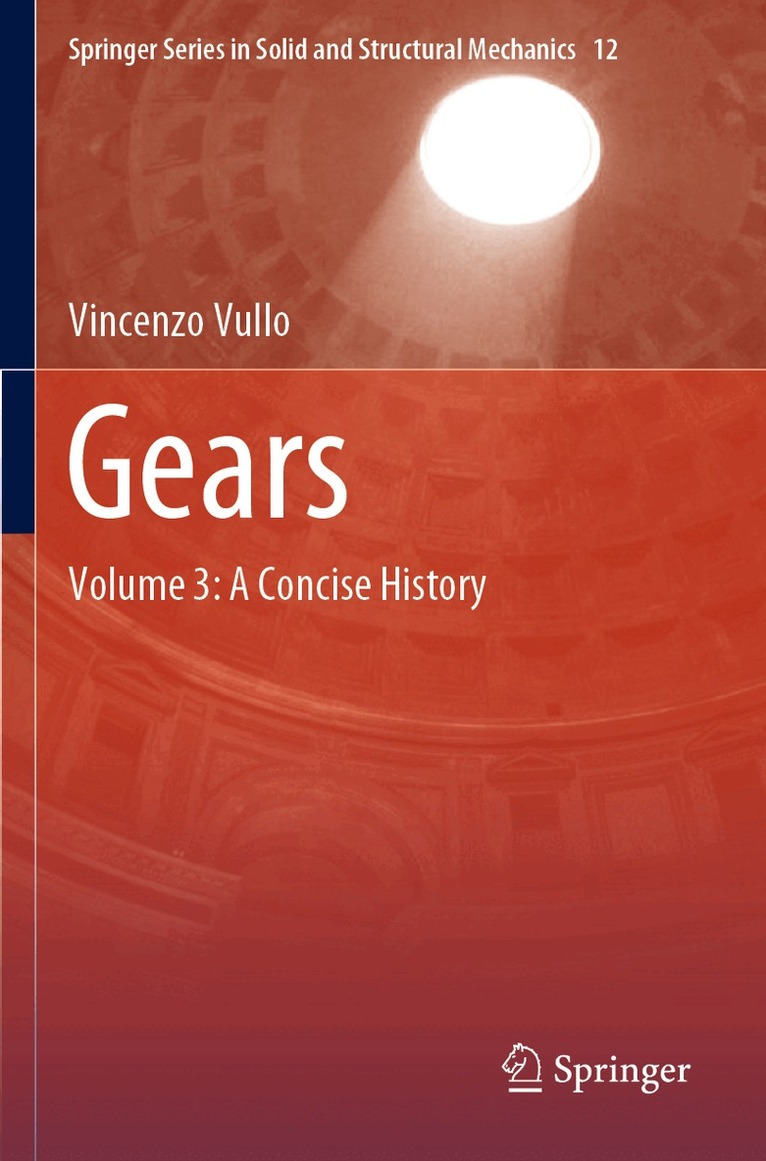
This book provides a compact history of gears, by summarizing the main stages of their development and the corresponding gradual acquisition of engineering expertise, from the antiquity to the Renaissance and the twentieth century.
1 387 kr
Skickas inom 10-15 vardagar
This book provides a compact history of gears, by summarizing the main stages of their development and the corresponding gradual acquisition of engineering expertise, from the antiquity to the Renaissance and the twentieth century.
1 900 kr
Skickas inom 10-15 vardagar
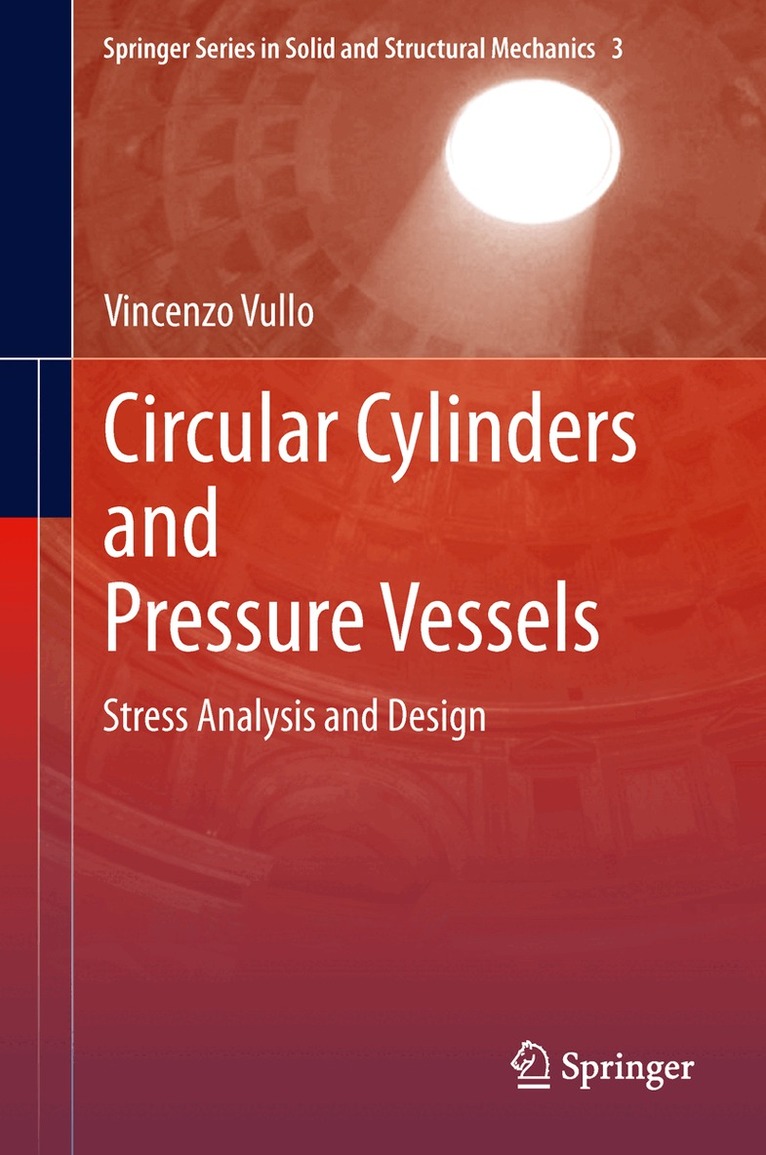
This book provides comprehensive coverage of stress and strain analysis of circular cylinders and pressure vessels, one of the classic topics of machine design theory and methodology. Whereas other books offer only a partial treatment of the subject and frequently consider stress analysis solely in the elastic field, Circular Cylinders and Pressure Vessels broadens the design horizons, analyzing theoretically what happens at pressures that stress the material beyond its yield point and at thermal loads that give rise to creep. The consideration of both traditional and advanced topics ensures that the book will be of value for a broad spectrum of readers, including students in postgraduate, and doctoral programs and established researchers and design engineers. The relations provided will serve as a sound basis for the design of products that are safe, technologically sophisticated, and compliant with standards and codes and for the development of innovative applications.
1 900 kr
Skickas inom 10-15 vardagar
This book provides comprehensive coverage of stress and strain analysis of circular cylinders and pressure vessels, one of the classic topics of machine design theory and methodology. Whereas other books offer only a partial treatment of the subject and frequently consider stress analysis solely in the elastic field, Circular Cylinders and Pressure Vessels broadens the design horizons, analyzing theoretically what happens at pressures that stress the material beyond its yield point and at thermal loads that give rise to creep. The consideration of both traditional and advanced topics ensures that the book will be of value for a broad spectrum of readers, including students in postgraduate, and doctoral programs and established researchers and design engineers. The relations provided will serve as a sound basis for the design of products that are safe, technologically sophisticated, and compliant with standards and codes and for the development of innovative applications.
1 577 kr
Skickas inom 10-15 vardagar
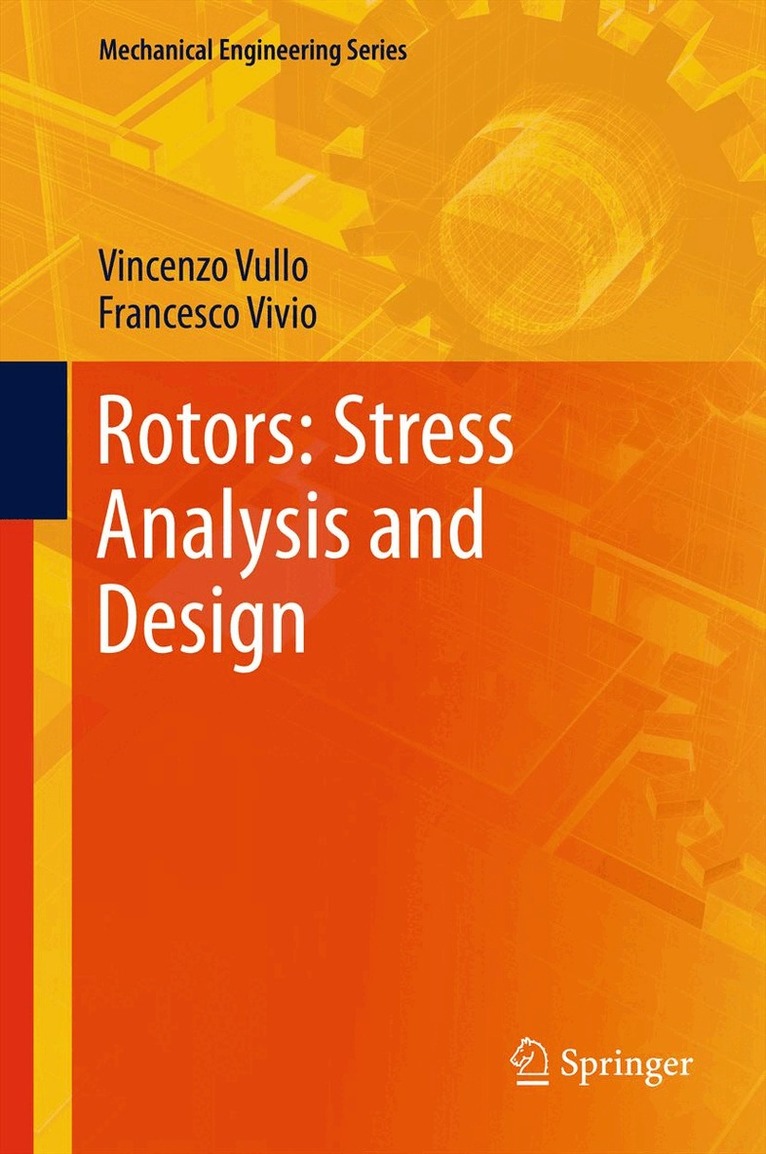
Stress and strain analysis of rotors subjected to surface and body loads, as well as to thermal loads deriving from temperature variation along the radius, constitutes a classic subject of machine design. Nevertheless attention is limited to rotor profiles for which governing equations are solvable in closed form. Furthermore very few actual engineering issues may relate to structures for which stress and strain analysis in the linear elastic field and, even more, under non-linear conditions (i.e. plastic or viscoelastic conditions) produces equations to be solved in closed form. Moreover, when a product is still in its design stage, an analytical formulation with closed-form solution is of course simpler and more versatile than numerical methods, and it allows to quickly define a general configuration, which may then be fine-tuned using such numerical methods. In this view, all subjects are based on analytical-methodological approach, and some new solutions in closed form are presented. The analytical formulation of problems is always carried out considering actual engineering applications. Moreover, in order to make the use of analytical models even more friendly at the product design stage, a function is introduced whereby it is possible to define a fourfold infinity of disk profiles, solid or annular, concave or convex, converging or diverging. Such subjects, even derived from scientific authors’ contributions, are always aimed at designing rotors at the concept stage, i.e. in what precedes detailed design. Among the many contributions, a special mention is due for the following: linear elastic analysis of conical disks and disks with variable profile along its radius according to a power of a linear function, also subjected to thermal load and with variable density; analysis of a variable-profile disk subjected to centrifugal load beyond the material's yield point, introducing the completely general law expressed by a an n-gradepolynomial; linear elastic analysis of hyperbolic disk, subjected to thermal load along its radius; linear elastic analysis of a variable-thickness disk according to a power of a linear function, subjected to angular acceleration; etc.
1 577 kr
Skickas inom 10-15 vardagar
Stress and strain analysis of rotors subjected to surface and body loads, as well as to thermal loads deriving from temperature variation along the radius, constitutes a classic subject of machine design. Nevertheless attention is limited to rotor profiles for which governing equations are solvable in closed form. Furthermore very few actual engineering issues may relate to structures for which stress and strain analysis in the linear elastic field and, even more, under non-linear conditions (i.e. plastic or viscoelastic conditions) produces equations to be solved in closed form. Moreover, when a product is still in its design stage, an analytical formulation with closed-form solution is of course simpler and more versatile than numerical methods, and it allows to quickly define a general configuration, which may then be fine-tuned using such numerical methods. In this view, all subjects are based on analytical-methodological approach, and some new solutions in closed form are presented. The analytical formulation of problems is always carried out considering actual engineering applications. Moreover, in order to make the use of analytical models even more friendly at the product design stage, a function is introduced whereby it is possible to define a fourfold infinity of disk profiles, solid or annular, concave or convex, converging or diverging. Such subjects, even derived from scientific authors’ contributions, are always aimed at designing rotors at the concept stage, i.e. in what precedes detailed design. Among the many contributions, a special mention is due for the following: linear elastic analysis of conical disks and disks with variable profile along its radius according to a power of a linear function, also subjected to thermal load and with variable density; analysis of a variable-profile disk subjected to centrifugal load beyond the material's yield point, introducing the completely general law expressed by a an n-gradepolynomial; linear elastic analysis of hyperbolic disk, subjected to thermal load along its radius; linear elastic analysis of a variable-thickness disk according to a power of a linear function, subjected to angular acceleration; etc.