Vittorio Chiesa - Böcker
Visar alla böcker från författaren Vittorio Chiesa. Handla med fri frakt och snabb leverans.
3 produkter
3 produkter
Evaluation and Performance Measurement of Research and Development
Techniques and Perspectives for Multi-Level Analysis
Inbunden, Engelska, 2009
2 045 kr
Skickas inom 7-10 vardagar
This book develops and illustrates a comprehensive, multi-level framework for the evaluation of industrial research and development (R&D) activities and the measurement of their performance. The framework encompasses a set of hierarchical, interrelated levels at which R&D evaluation and performance measurement could be undertaken. This enlightening book focuses on the single industrial firm to study performance measurement of R&D functions, projects and individual researchers or engineers. It also addresses R&D evaluation from the point of view of financial markets, with a focus on the relationship between R&D investments and the value of the traded firm. The book broadens tin scope to study the role of technology platforms as R&D coordination mechanisms and also looks at the evaluation of R&D policies.This book will be warmly welcomed by researchers and postgraduate students in disciplines concerned with innovation management, technology policy, and finance who wish to gain an updated overview of R&D evaluation and performance measurement as well as exploring different units of analysis.

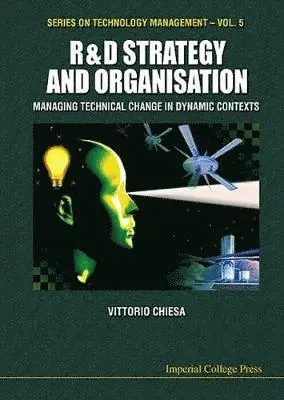
Del 5 - Series on Technology Management
R&d Strategy & Organisation: Managing Technical Change In Dynamic Contexts
Inbunden, Engelska, 2001
1 096 kr
Tillfälligt slut
This book deals with key issues and trade-offs in R&D strategy and organisation, paying attention especially to dynamic competitive contexts where technology plays a key role. These topics are treated from the perspective of the decision taker, i.e. the manager who makes decisions in terms of R&D strategy and organisation. The book addresses typical problems of large firms having structured R&D and operating businesses where R&D is a source of competitive advantages. Although it focuses strongly on R&D, it sees R&D as a part (a key part) of the process of technological innovation, and therefore as an activity to be strongly and appropriately integrated with other functions to make innovation successful.This book is primarily conceived as an academic review of research topics. Therefore the main audience is composed of scholars, researchers and PhD students. However, the book can be useful for postgraduate students taking MBA electives, or students attending courses on technology management. It is also relevant to R&D managers and, more generally, people responsible for units concerned with technological innovation.
Industrial Clusters In Biotechnology: Driving Forces, Development Processes And Management Practices
Inbunden, Engelska, 2004
1 120 kr
Tillfälligt slut
This book presents the results of Cleverbio, a project funded by the European Commission. The project examined the process of growth and development of clusters in the biotech industry, identifying and studying the main driving forces. The empirical work involved in-depth analysis of five clusters at different stages of development: Cambridge, the most important cluster in Europe; Heidelberg, one of the strongest in Germany; Aarhus in Denmark; Marseille in France; and Milano in Italy at an early stage of development. Other clusters were also analysed, such as Paris-Evry (France), Uppsala (Sweden), Biovalley (Switzerland), Bay Area and San Diego (US).The ultimate aim of Cleverbio has been to build a normative model that incorporates:• the preconditions for a cluster to grow (scientific base and/or industrial base, innovative financing, etc.);• the driving forces for cluster growth and development, i.e. the key factors of development (new company creation, IP rules, acceptance of biotech products, services and infrastructures, etc.);• best practices in cluster management (barrier removal, network creation, marketing, technology transfer, etc.).The book also identifies different forms of cluster creation. In some cases clusters were born and grew spontaneously as a consequence of the original co-presence of the key success factors (spontaneous clusters); in other cases they were born of the actions of public actors (industry restructuring and industry development policies). Finally, in a few cases, the process of clustering started as a result of a combination of different original conditions (hybrid clusters).