Vivian Schelling - Böcker
Visar alla böcker från författaren Vivian Schelling. Handla med fri frakt och snabb leverans.
2 produkter
2 produkter
314 kr
Skickas inom 3-6 vardagar
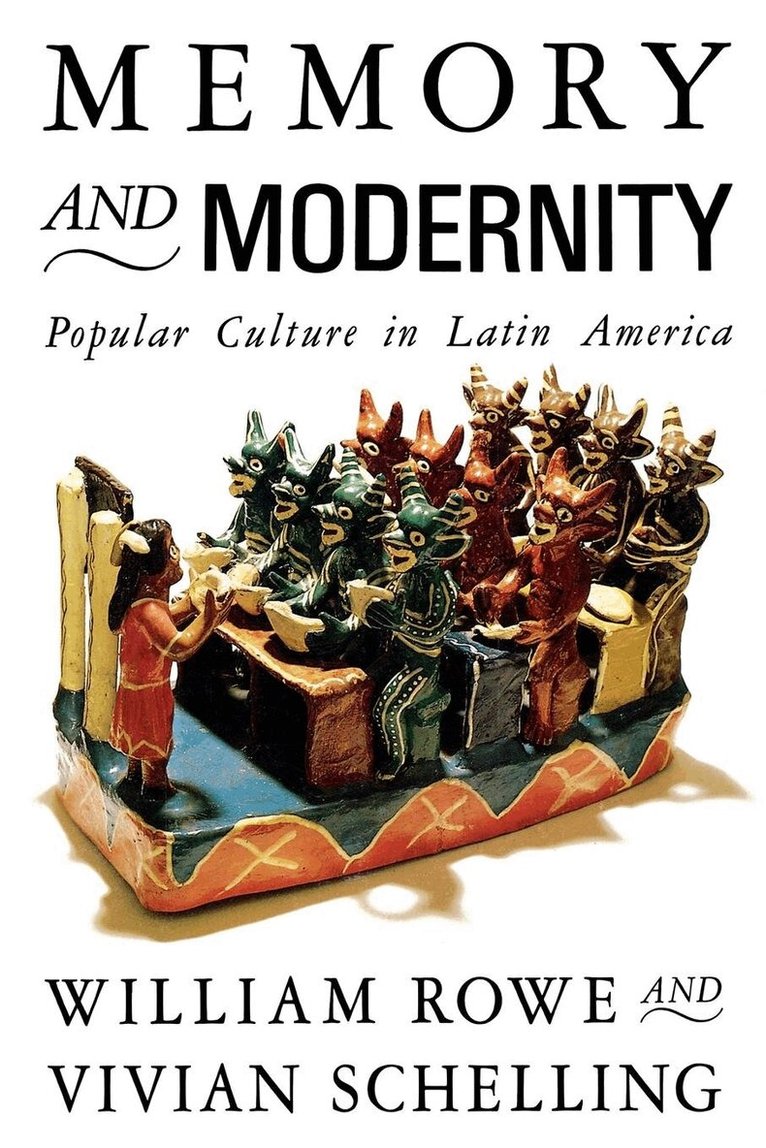
Samba and carnival, radio soaps and telenovelas, oral poetry, popular drama, Amerindian art. This illustrated overview of Latin America's popular culture considers the broad spectrum of cultural forms in the various countries of the subcontinent.Exploring the ways in which daily life and ritual have resisted and been influenced by Western mass culture, Memory and Modernity traces the main anthropological, sociological and political debates about the nature of popular culture. Rowe and Schelling use their analysis of the development of a culture industry in Latin America to engage with wider debates about modernity, drawing out the contrast between Latin America's cultural wealth and its widespread material poverty.In challenging the assumptions of much Western cultural criticism, this book will be essential reading for students of Latin American society, while offering the general reader a concise and accessible overview of an exciting and varied popular culture.
218 kr
Tillfälligt slut
Modernity in Latin America is defined above all by its multi-layered, kaleidoscopic quality. Reminiscent of Octavio Paz's labyrinth, it is a modernity which has accommodated a piling-on of new traditions to old, a blending of external cultures with local, and of high cultures with more popular ones-mixes which allowed a rich and celebratory avant-garde movement, for example, to emerge in the 1920s, and prompted the explosive growth of cities like Rio de Janeiro. Many such cultural (as well as technological) innovations have occurred without equivalent changes in social and political life, however, and so the region has also been at the mercy of what might be termed an uneven development in many of its civic institutions.In this prestigious volume of original essays, many of the best writers on the region are brought together to examine the nature and manifestations of a specifically Latin American modernity. Beatriz Sarlo and Nicolau Sevcenko write about Buenos Aires and Sao Paulo in an exploration of twentieth century urban experience and shifting patterns of migration and immigration; Renato Ortiz and Ana Lopez look at mass media and the ways in which radio, television and cinema have shaped modernity; Jose Jorge de Carvalho, Jose de Souza Martins and Nelson Manrique address questions of religion, politics, ideology and social movements; Gwen Kirkpatrick and Beatriz Rezende explore the intricacies of artistic and literary modernism; and Nestor Canclini and Ruben Oliven open the collection with essays which unravel the many forces - the legacy of slavery, the freedom from an unquestioning faith in development and 'progress', the impact of globalisation - that have given rise to a characteristically hybrid modernity.