Vladimir G. Chigrinov – författare
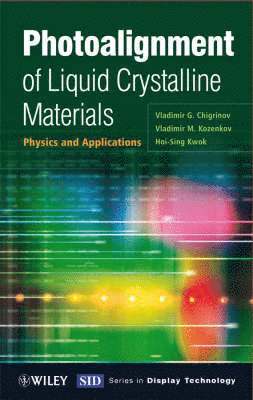
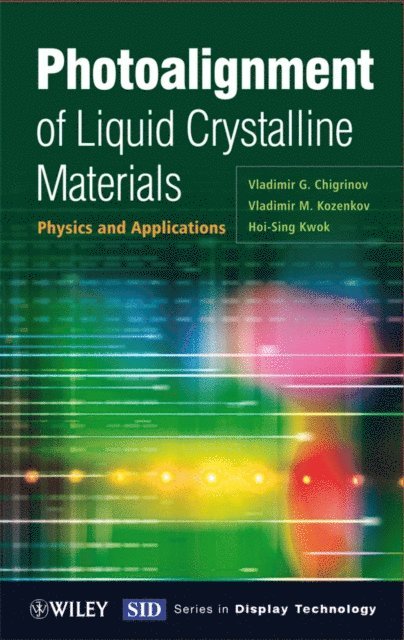
Photoalignment of Liquid Crystalline Materials
Physics and Applications
1 462 kr
Skickas inom 11-20 vardagar
1 297 kr
Skickas inom 5-8 vardagar
1 709 kr
Läs direkt efter köp
Photoalignment of Liquid Crystalline Materials covers state-of-the-art techniques and key applications, as well as the authors’ own diffusion model for photoalignment. The book aims to stimulate new research and development in the field of liquid crystalline photoalignment and in so doing, enable the technology to be used in large scale LCD production.
Key features:
Provides a full examination of the mechanisms of photoalignment. Examines the properties of liquid crystals during photoalignment, with particular reference made to the effect on their chemical structure and stability. Considers the most useful photosensitive materials and preparation procedures suitable for liquid crystalline photoalignment. Presents several methods for photoalignment of liquid crystals. Compares various applications of photoalignment technology for in-cell patterned polarizers and phase retarders, transflective and micro displays, security and other liquid crystal devices.Through its interdisciplinary approach, this book is aimed at a wide range of practising electrical engineers, optical engineers, display technologists, materials scientists, physicists and chemists working on the development of liquid crystal devices. It will also appeal to researchers and graduate students taking courses on liquid crystals or display technologies.
The Society for Information Display (SID) is an international society, which has the aim of encouraging the development of all aspects of the field of information display. Complementary to the aims of the society, the Wiley-SID series is intended to explain the latest developments in information display technology at a professional level. The broad scope of the series addresses all facets of information displays from technical aspects through systems and prototypes to standards and ergonomics
1 465 kr
Läs direkt efter köp
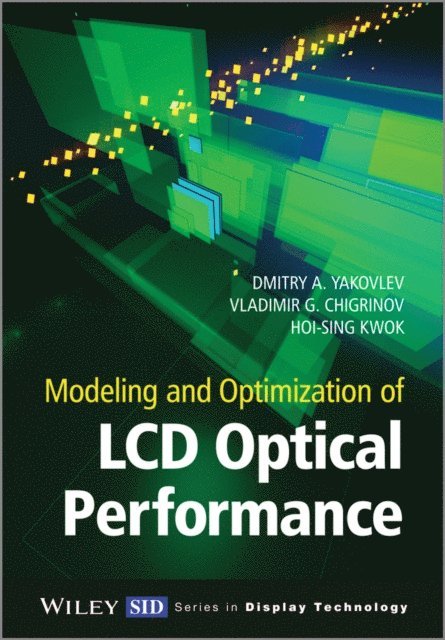
Focusing on polarization matrix optics in many forms, this book includes coverage of a wide range of methods which have been applied to LCD modeling, ranging from the simple Jones matrix method to elaborate and high accuracy algorithms suitable for off-axis optics. Researchers and scientists are constantly striving for improved performance, faster response times, wide viewing angles, improved colour in liquid crystal display development, and with this comes the need to model LCD devices effectively. The authors have significant experience in dealing with the problems related to the practical application of liquid crystals, in particular their optical performance.
Key features:
Explores analytical solutions and approximations to important cases in the matrix treatment of different LC layer configurations, and the application of these results to improve the computational method Provides the analysis of accuracies of the different approaches discussed in the book Explains the development of the Eigenwave Jones matrix method which offers a path to improved accuracy compared to Jones matrix and extended Jones matrix formalisms, while achieving significant improvement in computational speed and versatility compared to full 4x4 matrix methods Includes a companion website hosting the authors'' program library LMOPTICS (FORTRAN 90), a collection of routines for calculating the optical characteristics of stratified media, the use of which allows for the easy implementation of the methods described in this book. The website also contains a set of sample programs (source codes) using LMOPTICS, which exemplify the application of these methods in different situations1 465 kr
Läs direkt efter köp
Focusing on polarization matrix optics in many forms, this book includes coverage of a wide range of methods which have been applied to LCD modeling, ranging from the simple Jones matrix method to elaborate and high accuracy algorithms suitable for off-axis optics. Researchers and scientists are constantly striving for improved performance, faster response times, wide viewing angles, improved colour in liquid crystal display development, and with this comes the need to model LCD devices effectively. The authors have significant experience in dealing with the problems related to the practical application of liquid crystals, in particular their optical performance.
Key features:
Explores analytical solutions and approximations to important cases in the matrix treatment of different LC layer configurations, and the application of these results to improve the computational method Provides the analysis of accuracies of the different approaches discussed in the book Explains the development of the Eigenwave Jones matrix method which offers a path to improved accuracy compared to Jones matrix and extended Jones matrix formalisms, while achieving significant improvement in computational speed and versatility compared to full 4x4 matrix methods Includes a companion website hosting the authors'' program library LMOPTICS (FORTRAN 90), a collection of routines for calculating the optical characteristics of stratified media, the use of which allows for the easy implementation of the methods described in this book. The website also contains a set of sample programs (source codes) using LMOPTICS, which exemplify the application of these methods in different situations2 473 kr
Läs direkt efter köp