Vladimir Tumanov – författare
Visar alla böcker från författaren Vladimir Tumanov. Handla med fri frakt och snabb leverans.
2 produkter
2 produkter
Inbunden, Engelska, 2019
411 kr
Skickas inom 5-8 vardagar
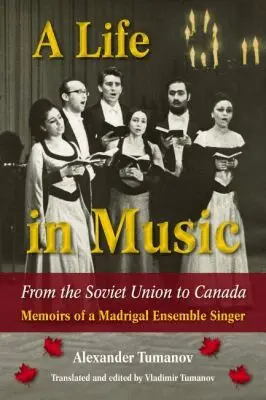
The musical career of Alexander Tumanov extends from Stalinist and Soviet Russia through contemporary Canada, and as such provides an inspiring portrait of one person's devotion to his art under trying circumstances. Tumanov was a founding member of Moscow's Madrigal Ensemble of early music, which introduced Renaissance and Baroque music to the Soviet Union. The Ensemble enjoyed tremendous popularity in the 1960s and 1970s, despite occasional official disapproval by the Soviet bureaucracy. At times the compositions of the group's founder, Andrei Volkonsky, were banned. Volkonsky eventually emigrated to escape the oppressive conditions, followed soon after, in 1974, by Tumanov, and the Madrigal Ensemble continued in a changed form under new leaders.The story of the author's subsequent life and career in Canada provides a poignant point of contrast with his Soviet period — at the musical, academic, and political levels. This book is a valuable resource for those interested in the history of music and intellectual life in Russia, Ukraine, and the Soviet Union in the twentieth century and is the first published book on the Madrigal Ensemble.
E-bok
PDF, Engelska, 20232 180 kr
Läs direkt efter köp
In this book literary interior monologue is considered in relation to extraliterary phenomena, as well as narrative theory. The central question posed by this study is: what makes a particular interior monologue believable, given the unobservable nature of human thought? The discussion revolves around the unobservable counterpart of literary interior monologue, i.e., what is known in psychology as inner speech. Taking various experimental findings and theories from Soviet and American research on inner speech, the author compares them with literary interior monologue and tries to account for similarities and differences. Examples of literary interior monologue are analyzed in comparison with data from the linguistic study of real oral spontaneous discourse (also known as face-to-face communication). In the context of this interdisciplinary framework four examples of literary interior monologue are considered: V.M. Garshin's Four Days (1877), E. Dujardin's Les Lauriers sont coupes (1887), A Schnitzler's Leutnant Gustl (1900) and V. Larbaud's Amants, heureux amants... (1921). The inclusion of data from psychology and research on face-to-face communication makes a unique contribution not only to narrative theory, but also to the understanding of the relationship between literary and extraliterary communication.