V.P. Vizgin - Böcker
Visar alla böcker från författaren V.P. Vizgin. Handla med fri frakt och snabb leverans.
2 produkter
2 produkter
852 kr
Skickas inom 10-15 vardagar
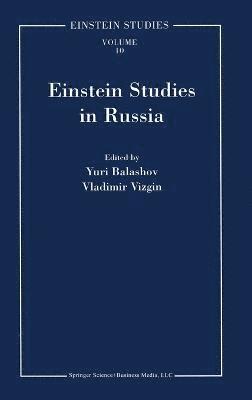
This volume presents a selection of contributions by Russian scholars - historians and philosophers to science - to the Einstein Studies industry, broadly construed. This work explores the historical and foundational issues in general relativity and relativistic cosmology, Einstein's contributions to early quantum mechanics and the rise of Dirac's quantum electrodynamics. It also includes a detailed description of the physics colloquium Einstein established and coordinated in 1912-1913 and comments on his brief interest in the construction of the plane wing in 1916. The contributors draw extensively on documentation previously unavailable to most scholars. Materials from various Russian archives shed new light on the famous exchange (regarding the first evolutionary cosmological models) between Einstein and Alexander Friedmann in the early 1920s and on the role of Boris Podolsky and Vladimir Fock in the emergence of quantum electrodynamics. The little-known correspondence between Einstein and a famous German pilot Paul Erhardt suggests that during World War I, the former was involved with aero- and hydrodynamics research and ways of improving airplane design.Other articles introduce new approaches to important foundational questions in general relativity and cosmology.
958 kr
Skickas inom 10-15 vardagar
Despite the rapidly expanding ambit of physical research and the continual appearance of new branches of physics, the main thrust in its development has been the attempt at a theoretical synthesis of the entire body of physical knowledge. Vladimir Vizgin's work presents perhaps the first systematic historico-scientific study of the formation and development of the unified field theories in the general context of 20th century physics. Concentrating on the first three decades of the century and drawing extensively on Russian sources, the author analyses the first successes, failures and paths of further development of the unified field theories. He presents the evolution of these theories as a process of interaction/competition between the geometric field and quantum research programs, and ascertains the relevance of these theories for fundamental concepts in modern field theory.