V.S. Alagar – författare
Visar alla böcker från författaren V.S. Alagar. Handla med fri frakt och snabb leverans.
10 produkter
10 produkter
Inbunden, Engelska, 2011
565 kr
Skickas inom 10-15 vardagar
This extensively revised and updated new edition of Specification of Software Systems builds upon the original focus on software specification with added emphasis on the practice of formal methods for specification and verification activities for different types of software systems and at different stages of developing software systems. Topics and features: provides a wide coverage of formal specification techniques and a clear writing style, supported by end-of-chapter bibliographic notes for further reading; presents a logical structure, with sections devoted to specification fundamentals, basics of formalism, logic, set theory and relations, property-oriented specification methods, and model-based specification techniques; contains end-of-chapter exercises and numerous case studies, with potential course outlines suggested in the Preface; covers Object-Z, B-Method, and Calculus of Communicating Systems; offers material that can be taught with tool-supported laboratory projects.
E-bok
PDF, Engelska, 2011708 kr
Läs direkt efter köp
This extensively revised and updated new edition of Specification of Software Systems builds upon the original focus on software specification with added emphasis on the practice of formal methods for specification and verification activities for different types of software systems and at different stages of developing software systems. Topics and features: provides a wide coverage of formal specification techniques and a clear writing style, supported by end-of-chapter bibliographic notes for further reading; presents a logical structure, with sections devoted to specification fundamentals, basics of formalism, logic, set theory and relations, property-oriented specification methods, and model-based specification techniques; contains end-of-chapter exercises and numerous case studies, with potential course outlines suggested in the Preface; covers Object-Z, B-Method, and Calculus of Communicating Systems; offers material that can be taught with tool-supported laboratory projects.
Häftad, Engelska, 2013
565 kr
Skickas inom 10-15 vardagar
This extensively revised and updated new edition of Specification of Software Systems builds upon the original focus on software specification with added emphasis on the practice of formal methods for specification and verification activities for different types of software systems and at different stages of developing software systems. Topics and features: provides a wide coverage of formal specification techniques and a clear writing style, supported by end-of-chapter bibliographic notes for further reading; presents a logical structure, with sections devoted to specification fundamentals, basics of formalism, logic, set theory and relations, property-oriented specification methods, and model-based specification techniques; contains end-of-chapter exercises and numerous case studies, with potential course outlines suggested in the Preface; covers Object-Z, B-Method, and Calculus of Communicating Systems; offers material that can be taught with tool-supported laboratory projects.
E-bok
PDF, Engelska, 2012708 kr
Läs direkt efter köp
Logic and object-orientation have come to be recognized as being among the most powerful paradigms for modeling information systems. The term "information systems" is used here in a very general context to denote database systems, software development systems, knowledge base systems, proof support systems, distributed systems and reactive systems. One of the most vigorously researched topics common to all information systems is "formal modeling". An elegant high-level abstraction applicable to both application domain and system domain concepts will always lead to a system design from "outside in"; that is, the aggregation of ideas is around real-life objects about which the system is to be designed. Formal methods \yhen applied with this view in mind, especially during early stages of system development, can lead to a formal reasoning on the intended properties, thus revealing system flaws that might otherwise be discovered much later. Logic in different styles and semantics is being used to model databases and their transactions; it is also used to specify concurrent, distributed, real-time, and reactive systems. ,The notion of "object" is central to the modeling of object oriented databases, as well as object-oriented design and programs in software engineering. Both database and software engineering communities have undoubtedly made important contributions to formalisms based on logic and objects. It is worthwhile bringing together the ideas developed by the two communities in isolation, and focusing on integrating their common strengths.
E-bok
PDF, Engelska, 2012708 kr
Läs direkt efter köp
The Software Engineering and Knowledgebase Systems (SOFfEKS) Research Group of the Department of Computer Science, Concordia University, Canada, organized a workshop on Incompleteness and Uncertainty in Information Systems from October 8-9, 1993 in Montreal. A major aim of the workshop was to bring together researchers who share a concern for issues of incompleteness and uncertainty. The workshop attracted people doing fundamental research and industry oriented research in databases, software engineering and AI from North America, Europe and Asia. The workshop program featured six invited talks and twenty other presentations. The invited speakers were: Martin Feather (University of Southern CalifornialInformation Systems Institute) Laks V. S. Lakshmanan (Concordia University) Ewa Orlowska (Polish Academy of Sciences) z. Pawlak (Warsaw Technical University and Academy of Sciences) F. Sadri (Concordia University) A. Skowron (Warsaw University) The papers can be classified into four groups: rough sets and logic, concept analysis, databases and information retrieval, and software engineering. The workshop opened with a warm welcome speech from Dr. Dan Taddeo, Dean, Faculty of Engineering and Computer Science. The first day''s presentations were in rough sets, databases and information retrieval. Papers given on the second day centered around software engineering and concept analysis. Sufficient time was given in between presentations to promote active interactions and numerous lively discussions. At the end of two days, the participants expressed their hope that this workshop would be continued.
E-bok
PDF, Engelska, 20131 174 kr
Läs direkt efter köp
This is a textbook on software specification emphasizing formal methods that are relevant to requirements and design stages of software development. The aim of the book is to teach the fundamental principles of formal methods in the construction of modular and verifiable formal specifications. The book introduces several formal specification techniques and illustrates the expressive power of each technique with a number of examples. General Characteristics Traditional textbooks on software engineering discuss the difficulties and chal lenges that lie on the path from requirements analysis to implementation of a software product. Most of these books describe some techniques in detail and give hints on implementation of these techniques. Only a few among them deal with important software engineering principles and techniques, and discuss how a particular technique may be used to implement a given principle. There is very little exposure in these books to a rigorous approach to, or a systematic study of, the construction of verifiable software. Those who have acquired an understanding of the fundamental principles of software engineering from traditional textbooks will find the following characteristics of this book quite relevant to the practice of software engineering: • The book deals with specification. The principal characteristic of this book is to discuss formalisms that provide a theoretical foundation for the principles of software engineering, and are appropriate to the requirements and design stages of software development.
Engelska, 2012
644 kr
Skickas inom 5-8 vardagar
Häftad, Engelska, 1993
566 kr
Skickas inom 10-15 vardagar
Logic and object-orientation have come to be recognized as being among the most powerful paradigms for modeling information systems. The term "information systems" is used here in a very general context to denote database systems, software development systems, knowledge base systems, proof support systems, distributed systems and reactive systems. One of the most vigorously researched topics common to all information systems is "formal modeling". An elegant high-level abstraction applicable to both application domain and system domain concepts will always lead to a system design from "outside in"; that is, the aggregation of ideas is around real-life objects about which the system is to be designed. Formal methods \yhen applied with this view in mind, especially during early stages of system development, can lead to a formal reasoning on the intended properties, thus revealing system flaws that might otherwise be discovered much later. Logic in different styles and semantics is being used to model databases and their transactions; it is also used to specify concurrent, distributed, real-time, and reactive systems. ,The notion of "object" is central to the modeling of object oriented databases, as well as object-oriented design and programs in software engineering. Both database and software engineering communities have undoubtedly made important contributions to formalisms based on logic and objects. It is worthwhile bringing together the ideas developed by the two communities in isolation, and focusing on integrating their common strengths.
566 kr
Skickas inom 10-15 vardagar
This volume contains papers from the Workshop on Incompleteness and Uncertainty in Information Systems, which was held at Concordia University, Montreal, Canada, from 8 - 9 October 1993. The workshop was organised by the University's Software Engineering and Knowledgebase Systems (SOFTEKS) Research Group. It attracted participants from a wide variety of backgrounds, including those doing both fundamental and industry-oriented research into databases, software engineering and AI in North America, Europe and Asia. Amongst the actual topics covered in this volume are: software aberrations - origins and treatments; modeling uncertainty in object-oriented databases; management of uncertainty in AI - a rough set approach; uncertainty as a function of expertise; a relational data model for manipulating probabilistic knowledge; and unnesting fuzzy SQL queries in fuzzy databases.
Häftad, Engelska, 1995
1 092 kr
Skickas inom 10-15 vardagar
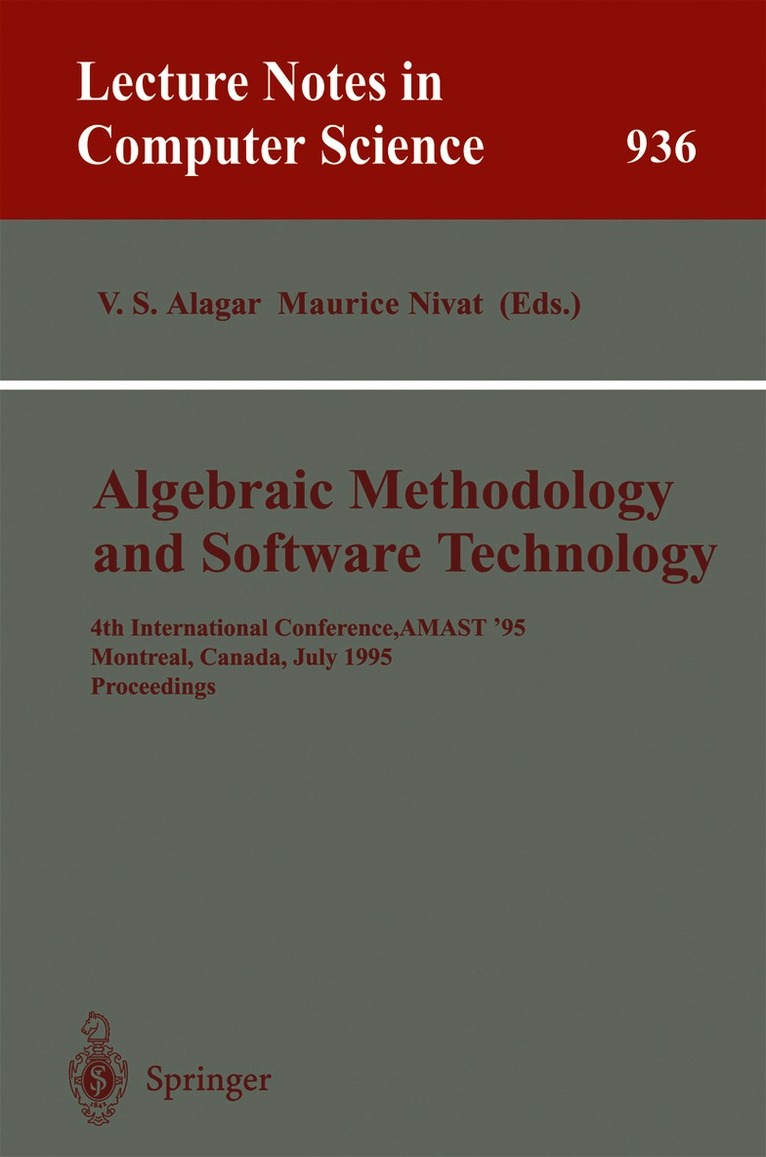
This volume constitutes the proceedings of the 4th International Conference on Algebraic Methodology and Software Technology, held in Montreal, Canada in July 1995.It includes full papers or extended abstracts of the invited talks, refereed selected contributions, and research prototype tools. The invited speakers are David Gries, Jeanette Wing, Dan Craigen, Ted Ralston, Ewa Orlowska, Krzysztof Apt, Joseph Goguen, and Rohit Parikh. The 29 refereed papers presented were selected from some 100 submissions; they are organized in sections on algebraic and logical foundations, concurrent and reactive systems, software technology, logic programming and databases.