W. Eric Emerson - Böcker
Visar alla böcker från författaren W. Eric Emerson. Handla med fri frakt och snabb leverans.
3 produkter
3 produkter
601 kr
Skickas inom 7-10 vardagar
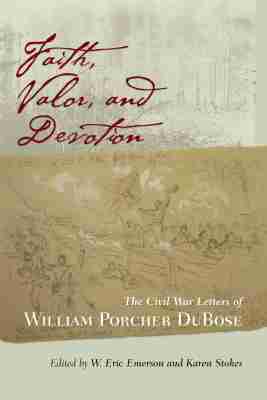
Brilliant and devout, William Porcher DuBose (1836-1918) considered himself a man of thought rather than of action. During the Civil War, he discovered that he was both, distinguishing himself as an able and courageous Confederate officer in the Holcombe Legion and later as a dedicated chaplain in Kershaw's Brigade. Published for the first time, these previously unknown letters of DuBose chronicle his Civil War actions with these two celebrated South Carolina units and make an important contribution to the literature and history of the war. They also advance our understanding of DuBose's burgeoning religious ideals as a Civil War combatant who would later become one of the foremost theologians of the Episcopal Church and a distinguished professor at the University of the South. A native of Winnsboro, South Carolina, DuBose was studying to enter the Episcopal priesthood when the war began. After struggling with the question of secular and spiritual obligations, he decided to join in the defense of the Confederacy and began a long and varied career as a soldier. After service in the lowcountry during the first year of the war, he was thrust into the thick of combat in Virginia, where he was wounded twice and taken as a prisoner of war. After being exchanged and returned to duty in 1862, DuBose was wounded again at the battle of Kinston in North Carolina, and a year later influential friends arranged for his appointment as chaplain in Kershaw's Brigade. He continued to share in the hazards of combat with the men to whom he ministered as they fought in the battles of Spotsylvania, Cold Harbor, Petersburg, and Cedar Creek in 1864. Adroitly edited by W. Eric Emerson and Karen Stokes, the more than 150 letters collected here prove DuBose to be a man of uncompromising duty to his faith, fellows, and the Confederate cause. He references his interactions with prominent figures of the day, including General Nathan ""Shanks"" Evans, John L. Girardeau, John Johnson, Colonel Peter F. Stevens, General Joseph B. Kershaw, Louisa Cheves McCord, and General John Bratton. Also included here are DuBose's wartime courtship letters to his fiancée and later wife, Anne Peronneau DuBose. Collectively these extraordinary documents illustrate the workings of a mind and heart devoted to his religion and dedicated to service in the Confederate ranks.
240 kr
Skickas inom 10-15 vardagar
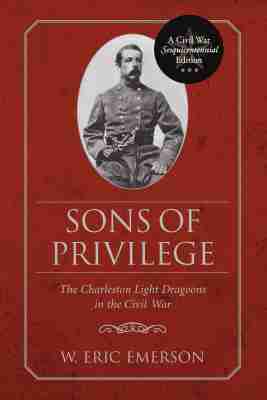
Sons of Privilege traces the wartime experiences of a unique Confederate cavalry unit drawn together from South Carolina's most prestigious families of planters, merchants, and politicos. Examining the military exploits of the Charleston Light Dragoons, W. Eric Emerson finds that the elite status of its membership dictated the terms of the dragoons' service. For much of the war, the dragoons were stationed close to home and faced little immediate danger. As the South's resources waned, however, such deference faded, and the dragoons were thrust into the bloody combat of Virginia. Recounting the unit's 1864 baptism by fire at the Battle of Haw's Shop, Emerson suggests that the dragoons' unrealistic expectations about their military prowess led the men to fight with more bravery than discretion. Thus the unit suffered heavy losses, and by 1865 only a handful survived. Emerson tracks the return of the survivors to ruined homes and businesses, the struggle to rebuild lost fortunes, and the resurrection of exclusive social organizations that would separate them from Charleston's more prosperous newcomers. He chronicles efforts of veterans to reestablish the unit and evaluates the influence of writings by survivors on the postwar veneration of the dragoons.
384 kr
Skickas inom 11-20 vardagar
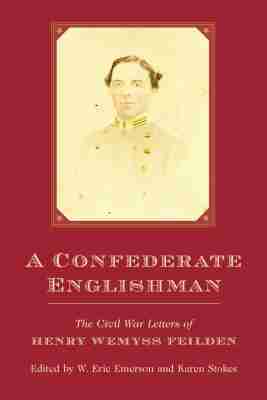
A Confederate Englishman presents for the first time the fascinating Civil War correspondence of Henry Wemyss Feilden (1838-1921), a young British officer who resigned his commission and ran the blockade to become a Confederate staff officer in Charleston, South Carolina. Editors W. Eric Emerson and Karen Stokes have compiled Feilden's letters to chart the history of his eventful career in the Confederacy from the time of his arrival in South Carolina in 1863 to the end of the war. Born the second son of the Baronet of Feniscowles, Feilden had experienced much before his arrival in America. As a young officer, he served during the Indian Mutiny and during the Second Opium War in China. His fascination and empathy with the Confederacy, however, propelled the young Englishman to risk his life to run the Federal blockade of Charleston. After traveling to Richmond, Virginia, the capital of the Confederacy, to obtain a commission as captain in the Confederate Army, he returned to Charleston to serve on the staff of General P. G. T. Beauregard, whom he greatly admired. During the war Feilden married a young South Carolinian, Julia McCord. His witty, vivid, highly readable, and sometimes romantic letters to her offer a compelling view into the operations of the military department headquartered in Charleston, conditions and events in and around the besieged city, and the heart of a man in love. A Confederate Englishman provides the insight and perspective of Feilden's experiences with operations in the large and vital Department of South Carolina, Georgia, and Florida during the war's final two years. After the war Feilden returned to England with his wife to resume his career in the British army, and later he became a noted Arctic explorer and naturalist. In addition to his Civil War correspondence, A Confederate Englishman features a selection of Feilden's letters from the early twentieth century that include his reflections on his extraordinary life, his service to the Confederacy, and his beloved wife of fifty-six years. Emerson's introduction examines Feilden's background and character and the reasons behind his choice to fight for the Confederacy. It also delves into Feilden's astute assessment of Confederate capabilities late in the war and his decision to benefit financially from blockade running.