W. G. Davenport – författare
Visar alla böcker från författaren W. G. Davenport. Handla med fri frakt och snabb leverans.
6 produkter
6 produkter
E-bok
Engelska, 20111 954 kr
Läs direkt efter köp
This book describes and explains the methods by which three related ores and recyclables are made into high purity metals and chemicals, for materials processing. It focuses on present day processes and future developments rather than historical processes. Nickel, cobalt and platinum group metals are key elements for materials processing. They occur together in one book because they (i) map together on the periodic table (ii) occur together in many ores and (iii) are natural partners for further materials processing and materials manufacturing. They all are, for example, important catalysts – with platinum group metals being especially important for reducing car and truck emissions. Stainless steels and CoNiFe airplane engine super alloys are examples of practical usage. The product emphasises a sequential, building-block approach to the subject gained through the author''s previous writings (particularly Extractive Metallurgy of Copper in four editions) and extensive experience. Due to the multiple metals involved and because each metal originates in several types of ore – e.g. tropical ores and arctic ores this necessitates a multi-contributor work drawing from multiple networks and both engineering and science.- Synthesizes detailed review of the fundamental chemistry and physics of extractive metallurgy with practical lessons from industrial consultancies at the leading international plants- Discusses Nickel, Cobalt and Platinum Group Metals for the first time in one book- Reviews extraction of multiple metals from the same tropical or arctic ore- Industrial, international and multidisciplinary focus on current standards of production supports best practice use of industrial resources
Häftad, Engelska, 2011
1 750 kr
Skickas inom 10-15 vardagar
This book describes and explains the methods by which three related ores and recyclables are made into high purity metals and chemicals, for materials processing. It focuses on present day processes and future developments rather than historical processes. Nickel, cobalt and platinum group metals are key elements for materials processing. They occur together in one book because they (i) map together on the periodic table (ii) occur together in many ores and (iii) are natural partners for further materials processing and materials manufacturing. They all are, for example, important catalysts - with platinum group metals being especially important for reducing car and truck emissions. Stainless steels and CoNiFe airplane engine super alloys are examples of practical usage. The product emphasises a sequential, building-block approach to the subject gained through the author's previous writings (particularly Extractive Metallurgy of Copper in four editions) and extensive experience. Due to the multiple metals involved and because each metal originates in several types of ore - e.g. tropical ores and arctic ores this necessitates a multi-contributor work drawing from multiple networks and both engineering and science. Synthesizes detailed review of the fundamental chemistry and physics of extractive metallurgy with practical lessons from industrial consultancies at the leading international plants Discusses Nickel, Cobalt and Platinum Group Metals for the first time in one book Reviews extraction of multiple metals from the same tropical or arctic ore Industrial, international and multidisciplinary focus on current standards of production supports best practice use of industrial resources
E-bok
PDF, Engelska, 2016756 kr
Läs direkt efter köp
The Iron Blast Furnace: Theory and Practice presents theoretical, experimental, and operational evidence about the iron blast furnace as well as a mathematical description of its operation. This book includes a set of equations that accurately describe stoichiometric and enthalpy balances for the process and which are consistent with observed temperatures and compositions in the furnace stack. These equations, which have been devised on the basis of the Rist approach, show the effects of altering any blast-furnace variable on the other operating requirements of the process. This monograph is comprised of 14 chapters and begins with a brief description of the blast-furnace process. The next chapter takes a look inside the furnace, paying particular attention to its behavior in front of the tuyères and the kinetics of the coke gasification reaction. The reader is then introduced to the thermodynamics and stoichiometry of the blast-furnace process; enthalpy balance for the bottom segment of the furnace; the effects of tuyères injectants on blast-furnace operations; and blast-furnace optimization by linear programming. A number of important variables covered by the equations are discussed, including hydrocarbon injection at the tuyères, oxygen enrichment of the blast, moisture, limestone decomposition, coke reactivity, and metalloid reduction. The effects of many of these variables are illustrated numerically in the text while others are demonstrated in sets of problems that follow each chapter. This text will be a valuable resource for metallurgists and materials scientists.
E-bok
PDF, Engelska, 2013756 kr
Läs direkt efter köp
The Iron Blast Furnace: Theory and Practice presents the significant role of iron blast furnace by which iron is efficiently and rapidly reduced from ore and it is the basis for all primary steelmaking. This book discusses the importance of blast-furnace process as a complete operation. Organized into 14 chapters, this book begins with an overview of the existing experimental, theoretical, and operational evidence about the blast furnace. This text then examines the blast furnace from the outside, including its size, production rate, products, raw materials, operation, and costs. Other chapters consider the primary objective of the blast furnace to produce molten iron of constant composition. This book discusses as well the operation of the furnace from the point of view of what happens to the raw materials after they enter the furnace. The final chapter deals with the linear programming methods by using the known physical constraints on industrial furnaces. This book is a valuable resource for engineers.
E-bok
PDF, Engelska, 2015756 kr
Läs direkt efter köp
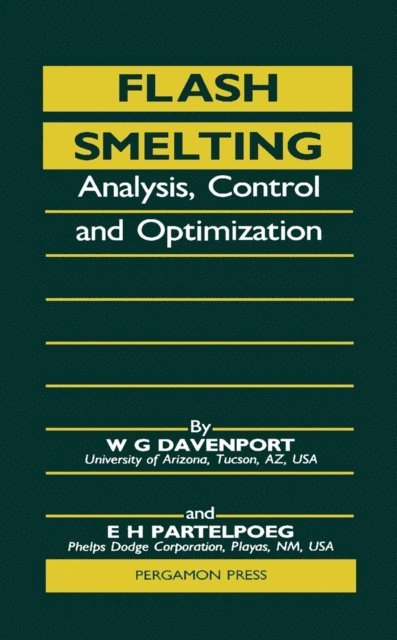
Flash Smelting: Analysis, Control and Optimization deals with the analysis, control, and optimization of flash smelting. This book explores flash smelting in general and Outokumpu and Inco flash smelting in particular, and also presents a mathematical description for the flash smelting process. A set of mass and heat balance equations that can be used to describe steady state smelting under autogenous or nearautogenous smelting conditions is developed. This text has 20 chapters and begins with an overview of flash smelting and its products; the main raw materials of copper flash smelting; chemical reactions in the flash furnace; impurities in the concentrates that are fed to the flash furnace; and the operation of industrial flash furnaces. Attention then turns to Outokumpu flash smelting, Inço flash smelting, and mathematical representation of flash smelting. The chapters that follow focus on the effects of blast preheat on flash smelting; the combustion of fossil fuel in the flash furnace; and the effect of matte grade on the fossil fuel, industrial oxygen, and blast preheat requirements of flash smelting. Equations are used to determine the effects of such factors as concentrate composition, blast temperature, and dust carryout, and as the basis for optimizing and controlling the flash smelting process. This book will be of interest to both mathematicians and metallurgists.
E-bok
PDF, Engelska, 2013756 kr
Läs direkt efter köp
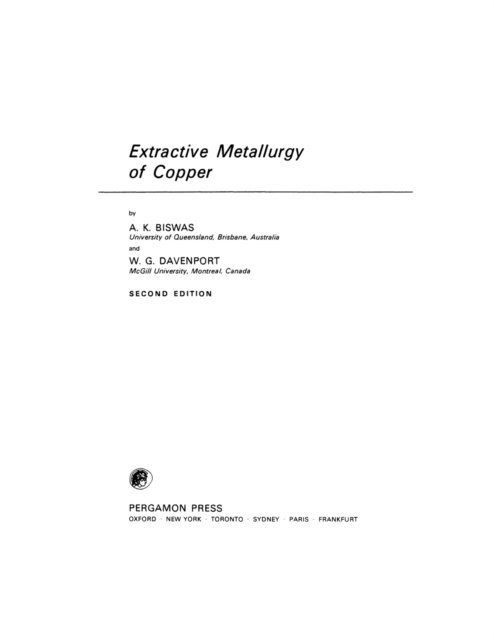
Extractive Metallurgy of Copper details the process of extracting copper from its ore. The book also discusses the significance of each process, along with the concerns in each process, such as pollution, energy demand, and cost. The text first provides an overview of the metallurgical process of copper extraction, and then proceeds to presenting the step-by-step representation of the whole process of copper extraction. The coverage of the book includes mineral beneficiation, roasting, smelting, converting, refining, casting, and quality control. The text will be of great use to metallurgists, materials engineers, and other professionals involved in mining industry.