W. Leinfellner - Böcker
Visar alla böcker från författaren W. Leinfellner. Handla med fri frakt och snabb leverans.
5 produkter
5 produkter
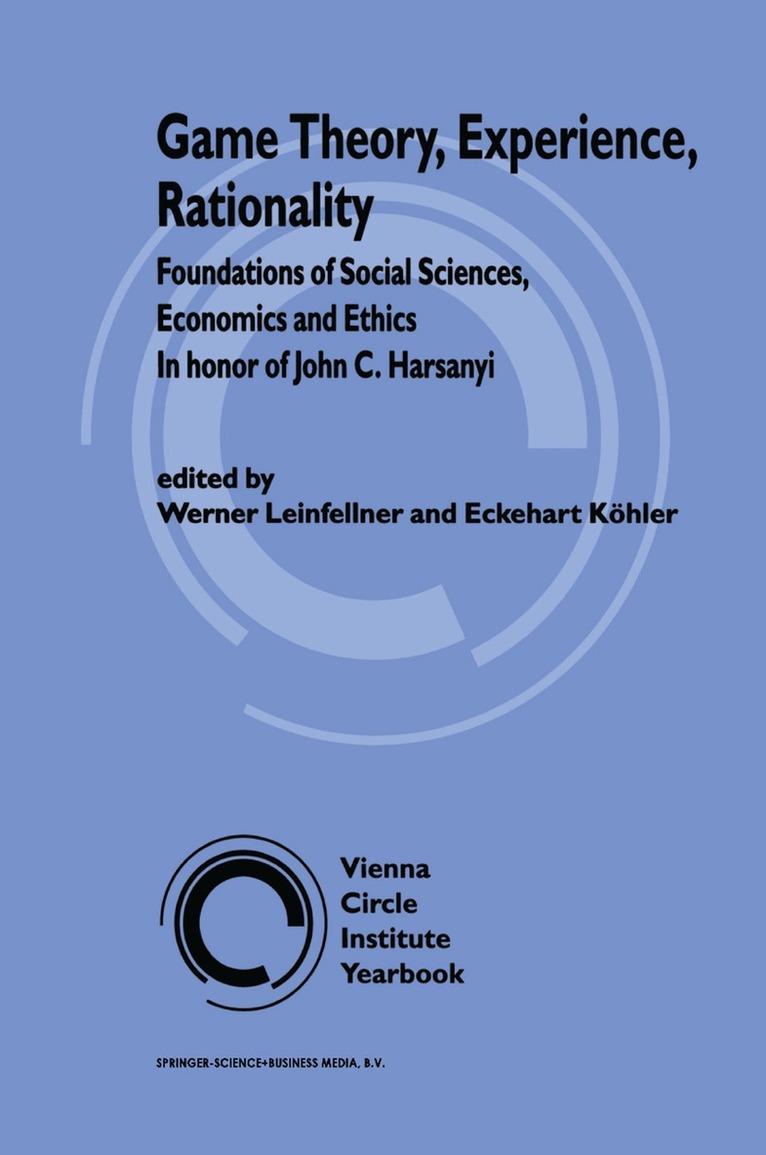
Game Theory, Experience, Rationality
Foundations of Social Sciences, Economics and Ethics in honor of John C. Harsanyi
Inbunden, Engelska, 1998
1 577 kr
Skickas inom 10-15 vardagar
This volume collects together contributions to the theory of games, the theory of game-theoretical rationality, and their applications. Twenty-seven articles present current advances in game theory after the award of the Nobel Prize in economics and especially in game theory to John F. Nash, John C. Harsanyi, and Reinhard Selten. Harsanyi and Selten, have themselves contributed leading articles to this volume. In utility and game theory, the question of which rationality governs their methods and the behaviour of the agents as well has emerged as one of the new conceptual foundations of all social sciences. The main aim of this book is to find an answer to this problem. Do we have to give up our belief in the traditional form of deductive and linear rationality in the social sciences in favour of probabilistic and stochastic methods? Which kind of rationality do we, and should we, use when we attempt to practically solve societal problems and conflicts? Quite a few articles in this book address these questions.The consequences of a new, multi-faceted rationality, which may to shake the traditional foundation of game theory, decision theory, and utility theory, and, finally, the social sciences in their entirety, are discussed in depth in seven chapters and a preface: "Rationality and the Foundations of the Social Sciences", "Cooperation and Rationality", "Rationality and Economics", "Bayesian Theory and Rationality", "Evolution and Evolutionary Game Theory", "Ethics and Game Theory", and "Applications of Game Theory". The contributors include economists, utility and decision theorists, psychologists, sociologists, physicists, philosophers of sciences and probability theorists. They attempt to make their contributions accessible to a wide audience. The book should be of interest to researchers, teachers and advanced students in the above-mentioned disciplines; it can be used for a one-semester course on the graduate level. The volume also includes a review section focusing on recent publications on Logical Empiricism and its influence. An autobiographical report on the Vienna Circle by Arne Naess follows the main part of the Yearbook.An overview of the activities of the Institute Vienna Circle 1997/98 concludes the volume.
2 100 kr
Skickas inom 10-15 vardagar
Philosophy of Science deals with the problem, 'What is science?' It seems that the answer to this question can only be found if we have an answer to the question, 'How does science function?' Thus, the study of the methodology of social sciences is a prominent factor in any analysis of these sciences. The history of philosophy shows clearly that the answer to the question, 'How does science function?' was the conditio sine qua non of any kind of philosophy of science, epistemology and even of logic. Aristotle, Hume, Kant, Mill, Russell, to mention a few classical authors, clearly emphasized the primacy of methodology of science for any kind of philosophy of science. One may even state that analyses of the presup positions, the foundations, the aims, goals and purposes of science are nothing else than analyses of their general and specific formal, as well as practical and empirical methods. Thus, the whole program of any phi losophy of science is dependent on the analysis of the methods of sciences and the establishment of their criteria. If the study of scientific method is the predominant factor in the philosophy of science, then all the other problems will depend on the outcome of such a study. For example, the old question of a possible unity of all social sciences will be brought to a solution by the study of the presuppositions, the methods, as well as of the criteria germane to all social sciences.
2 100 kr
Skickas inom 10-15 vardagar
Philosophy of Science deals with the problem, 'What is science?' It seems that the answer to this question can only be found if we have an answer to the question, 'How does science function?' Thus, the study of the methodology of social sciences is a prominent factor in any analysis of these sciences. The history of philosophy shows clearly that the answer to the question, 'How does science function?' was the conditio sine qua non of any kind of philosophy of science, epistemology and even of logic. Aristotle, Hume, Kant, Mill, Russell, to mention a few classical authors, clearly emphasized the primacy of methodology of science for any kind of philosophy of science. One may even state that analyses of the presup positions, the foundations, the aims, goals and purposes of science are nothing else than analyses of their general and specific formal, as well as practical and empirical methods. Thus, the whole program of any phi losophy of science is dependent on the analysis of the methods of sciences and the establishment of their criteria. If the study of scientific method is the predominant factor in the philosophy of science, then all the other problems will depend on the outcome of such a study. For example, the old question of a possible unity of all social sciences will be brought to a solution by the study of the presuppositions, the methods, as well as of the criteria germane to all social sciences.
Del 17 - Theory and Decision Library
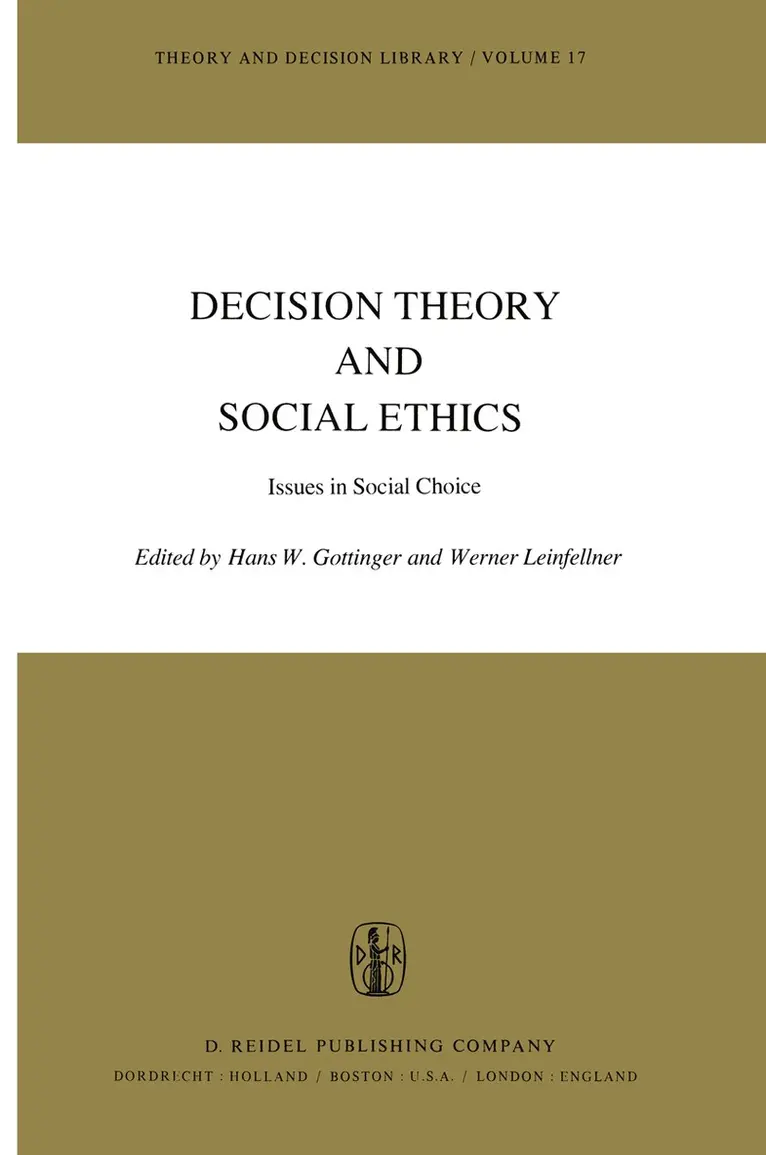
Decision Theory and Social Ethics
Issues in Social Choice
Häftad, Engelska, 1978
535 kr
Skickas inom 10-15 vardagar
Ethics, as one of the most respectable disciplines of philosophy, has undergone a drastic and revolutionary change in recent time. There are three main trends of this development. The first trend can be described as a tendency towards a rigorous formal and analytical language. This means simply that ethics has created beside its own formalized set theoretical language a variety of new formalized, logical and mathemati cal methods and concepts. Thus ethics has become a formalized meta or epidiscipline which is going to replace the traditional concepts, principles and ethical methods in the realm of social sciences. It is clear that a formalized form of ethics can be used more easily in social, economic and political theories if there are ethical conflicts to be solved. This first trend can be regarded as a conditio sine qua non for application in, and imposing ethical solutions on, social scientific theories. The second trend may be characterized as an association- or unification-tendency of a formalized and analytical ethics with decision theory. Decision theory as a new interdiscipline of social sciences is actually an assemblage of a variety of subtheories such as value-utility theory, game theory, collective decision theory, etc. Harsanyi has called this complex of subtheories a general theory of human behavior. Analytical or formal ethics is actually using this general theory of human behavior as a vehicle simply because this theory deals from the beginning with conflict solution, i. e.
Del 5 - Vienna Circle Institute Yearbook
Game Theory, Experience, Rationality
Foundations of Social Sciences, Economics and Ethics in honor of John C. Harsanyi
Häftad, Engelska, 2010
1 577 kr
Skickas inom 10-15 vardagar
This volume collects outstanding contributions to the theory of games, the theory of game-theoretical rationality, and their applications. 27 articles present the new situation and the recent advances in game theory after the award of the Nobel Prize in economics and especially in game theory to John F. Nash, John C. Harsanyi, and Reinhard Selten. Two of them, Harsanyi and Selten, have contributed leading articles to this volume. In utility and game theory, the question of which rationality governs their methods and the behavior of the agents as well has emerged as one of the most exciting new conceptual foundations of all social sciences. The main aim of this book is to find an answer to this problem. Do we have to give up our belief in the traditional form of deductive and linear rationality in the social sciences in favor of probabilistic and stochastic methods? Which kind of rationality do we, and should we, use when we attempt to practically solve societal problems and conflicts? Quite a few articles in this book address these questions.The consequences of a new, multi-faceted rationality, which is going to shake the traditional foundation of game theory, decision theory, and utility theory, and, finally, the social sciences in their entirety, are discussed in depth in seven chapters and a preface: 'Rationality and the Foundations of the Social Sciences,' 'Cooperation and Rationality,' 'Rationality and Economics,' 'Bayesian Theory and Rationality,' 'Evolution and Evolutionary Game Theory,' 'Ethics and Game Theory,' and 'Applications of Game Theory'. The contributors include economists, utility and decision theorists, psychologists, sociologists, physicists, philosophers of sciences and probability theorists. They attempt to make their contributions accessible to a wide audience. The book will interest researchers, teachers and advanced students in the above-mentioned disciplines; it can be used for a one-semester course on the graduate level. The volume also includes a review section focusing on recent publications on Logical Empiricism and its influence. An autobiographical report on the Vienna Circle by Arne Naess follows the main part of the Yearbook.An overview of the activities of the Institute Vienna Circle 1997/98 concludes the volume.