W. Mark Fruin – författare
Visar alla böcker från författaren W. Mark Fruin. Handla med fri frakt och snabb leverans.
6 produkter
6 produkter
Inbunden, Engelska, 1997
1 332 kr
Skickas inom 5-8 vardagar
This book offers a close-up look at a factory in Japan that is typical of what the author calls `Knowledge Works'. Like so many Japanese factories, this one - the Yanagicho works of the Toshiba Corporation - is highly productive, efficient, and flexible. While the factory is ordinary looking on the outside, its workers are anything but ordinary as they strive to improve the way they work and the quality of the products they produce. The key to this is the continuous creation and application of knowledge throughout the factory, from workers on the shop floor, to research and development engineers, to top management. The author explains how Japanese culture and religion prepare workers for their role in this process of creating and disseminating knowledge.
Inbunden, Engelska, 1999
1 986 kr
Skickas inom 5-8 vardagar
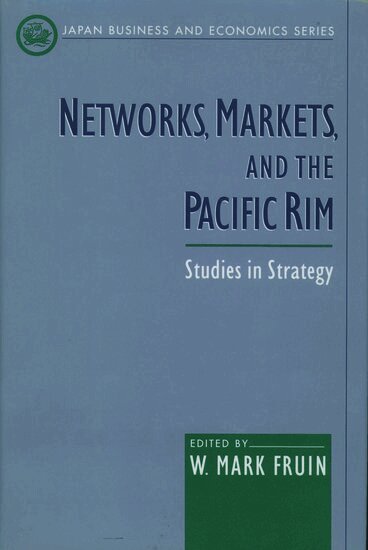
This volume explores the wide diversity in the kinds of networks that have been established between firms in Japan and the Pacific Rim. Editor W. Mark Fruin shows how networks in Japan and Korea are more prescribed and standardized than those found in the United States. For example, Toyota's satellite organizational system is more flexible, open-ended, and market-conforming than General Motors divisional organization. But less market-conforming networks can also arise. In China, for example, networks have arisen because of the unpredictable nature of markets. The contributors to this volume utilize new ideas and data to formulate an understanding of the importance of networks to the success of Asian firms. The book's postmodern approach--seeking not a single model but rather a variety of models of equally probable validity--makes it a unique resource for scholars and professionals in the field.
Inbunden, Engelska, 1999
2 261 kr
Skickas inom 5-8 vardagar
Over the last two decades, Japanese firms have challenged U.S. dominance in many manufacturing industries. This challenge has increasingly come in the form of transplant operations, and recognition has spread that their success owes a great deal to superior manufacturing management. Despite the ups and downs of the business cycle in Japan, there remains a core of world-class Japanese companies that have developed manufacturing management systems that companies throughout the world strive to emulate.In this edited volume, a team of eminent scholars uses case studies and large-scale surveys to explain in depth the process of transferring and transforming the best Japanese Management Systems (JMS) by both Japanese- and U.S.-owned firms. While the most successful of the Japanese manufacturing transplants rely, to varying degrees, on home country management techniques, they have had to adapt them to fit U.S. conditions. Similarly, the growing number of U.S. firms that are adopting these techniques to strengthen their own positions face a considerable challenge in transforming them to fit local conditions. A new environment necessarily compels the transformation of JMS. But despite the hurdles firms face, the evidence presented here and elsewhere strongly indicates that key aspects of JMS are remarkably transferable and successful in the United States.Combining scientific data with clear and engaging prose,Remade in America is a rich analytical resource for manufacturing professionals, as well as scholars and students of management and business.
E-bok
PDF, Engelska, 19991 320 kr
Läs direkt efter köp
Over the last two decades, Japanese firms have challenged U.S. dominance in many manufacturing industries. This challenge has increasingly come in the form of transplant operations, and recognition has spread that their success owes a great deal to superior manufacturing management. Despite the ups and downs of the business cycle in Japan, there remains a core of world-class Japanese companies that have developed manufacturing management systems that companies throughout the world strive to emulate. In this edited volume, a team of eminent scholars uses case studies and large-scale surveys to explain in depth the process of transferring and transforming the best Japanese Management Systems (JMS) by both Japanese- and U.S.-owned firms. While the most successful of the Japanese manufacturing transplants rely, to varying degrees, on home country management techniques, they have had to adapt them to fit U.S. conditions. Similarly, the growing number of U.S. firms that are adopting these techniques to strengthen their own positions face a considerable challenge in transforming them to fit local conditions. A new environment necessarily compels the transformation of JMS. But despite the hurdles firms face, the evidence presented here and elsewhere strongly indicates that key aspects of JMS are remarkably transferable and successful in the United States. Combining scientific data with clear and engaging prose,Remade in America is a rich analytical resource for manufacturing professionals, as well as scholars and students of management and business.
E-bok
PDF, Engelska, 19981 723 kr
Läs direkt efter köp
Despite the negative press Asian economies have received in connection with the recent financial crisis, their record of spectacular growth over the past few decades remains irrefutable. In an effort to provide a rich, textured analysis of these economies, editor W. Mark Fruin presents a collection of essays that explores the wide range of network organizations that have been established in the Pacific Rim. Conventional studies of economic organization have tended to center on markets and hierarchies, the two forms of organization most common in the West. But today the world moves too quickly and too unpredictably for the idealized organizations of microeconomic theory to keep up. It is no accident that the region that has generated the world''s most explosive economic growth is also the region where network organizations--sets of independent actors who cooperate frequently for mutual advantage--are most pervasive. Rapid economic, social, and technical changes favor the formation of network organizations, and vice versa. The contributors to this volume identify and elucidate four basic types of networks: naturally occurring networks, market replacing networks, hierarchy replacing networks, and market enhancing networks. They show how all of these have been shaped by the history, government, legal system, and culture of each country under consideration. These network organizations allow the authors to compare and contrast network forms in China, Japan, South Korea, Taiwan, and the United States according to features such as degrees of formalization, rule definition, and market conformance. The works collected here make an important contribution to a networks-markets- hierarchies framework that recognizes and emphasizes the diversity of organizational forms and behaviors. A unique resource for scholars and professionals in the fields of management and economics, this book enables a complex analysis of one of the world''s fastest growing and most theoretically challenging regions.
E-bok
PDF, Engelska, 19971 139 kr
Läs direkt efter köp
This book describes why, for the past twenty-five years, Japanese productivity has been growing more rapidly than productivity in the U.S. Unlike other books on the subject of the Japanese success in manufacturing, it looks at what actually happens in factories. The author brings his experience of working at the Yanagicho Works of the Toshiba Corporation, in Kawasaki City. Like so many Japanese factories, this one is highly productive, efficient, and flexible. While the factory is ordinary looking on the outside, its workers are anything but ordinary as they constantly strive to improve the way they work and the quality of the products they produce. The key to this is the continuous creation and application of knowledge throughout the factory, from workers on the shop floor, to research and development engineers, to top management. Fruin explains how Japanese culture and religion prepare workers for their role in this process of creating and disseminating knowledge.