W. Muckle – författare
Visar alla böcker från författaren W. Muckle. Handla med fri frakt och snabb leverans.
2 produkter
2 produkter
E-bok
PDF, Engelska, 2013756 kr
Läs direkt efter köp
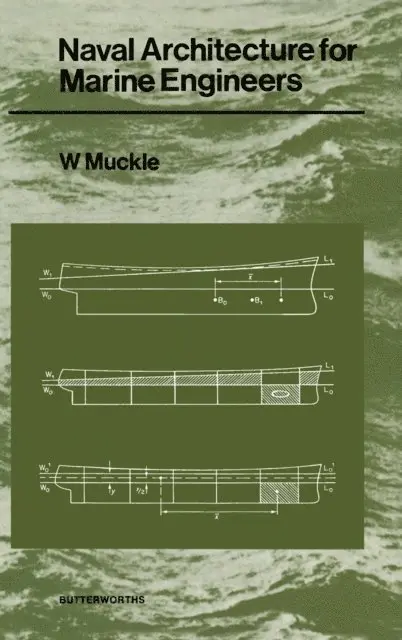
Naval Architecture for Marine Engineers focuses on resistance, propulsion, and vibration aspects of ships. The book first discusses the functions, layouts, and types of ships and terms used. The text looks at classification societies and governmental authorities influential on the design, construction, and safety of ships. Lloyd''s Register of Shipping; governmental authorities; and Inter-governmental Maritime Consultative Organization (IMCO) are noted. The book also highlights ship calculations, including trapezoidal rule, Simpson''s rule, and other rules for calculation. The text discusses as well the buoyancy, stability, and trim. Conditions for equilibrium of body floating in still water; calculation of underwater volume; stability at large angle of inclination; and flooding and damaged stability are considered. The selection also underscores structural strength of ships. Static forces on a ship in still water; dynamic longitudinal strength problem; resistance of ship to buckling; and materials used in ships are noted. The text also looks at resistance, powering, vibration, and propulsion of ships. The book is a vital source of data for readers interested in naval architecture.
E-bok
PDF, Engelska, 2013756 kr
Läs direkt efter köp
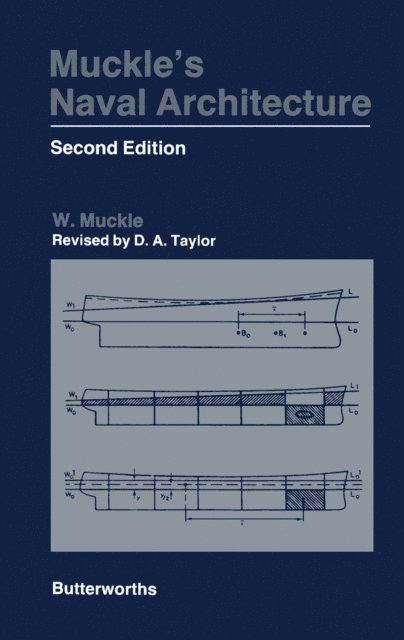
Muckle''s Naval Architecture, Second Edition is concerned with problems related to resistance, propulsion, and vibration in naval architecture. Topics include ship calculations, stability and trim, ship motions, and structural strength. This book also gives a brief reference to ship design. This text is comprised of 13 chapters; the first of which provides an overview of the function of the ship, its layout, and various types. The next chapter explains definitions, principal dimensions, and form coefficients, along with classification societies and governmental authorities that regulate ship design, construction, and safety. Various calculations that are performed to determine the form of a ship are the subject of the next chapter. Attention then turns to buoyancy, stability, and trim, along with sea and ship motions, the problem of structural strength, vibration, and resistance. The influence of rudders and control on ship movement is also discussed. Finally, this book describes the methods for determining the amount of power required to propel a ship. This book is intended primarily for practicing naval architects, marine engineers, deck officers, and all students of naval architecture.