W. Tatarkiewicz - Böcker
Visar alla böcker från författaren W. Tatarkiewicz. Handla med fri frakt och snabb leverans.
2 produkter
2 produkter
Del 5 - Melbourne International Philosophy Series
History of Six Ideas
An Essay in Aesthetics
Häftad, Engelska, 2011
1 589 kr
Skickas inom 10-15 vardagar
The history of aesthetics, like the histories of other sciences, may be treated in a two-fold manner: as the history of the men who created the field of study, or as the history of the questions that have been raised and resolved in the course of its pursuit. The earlier History of Aesthetics (3 volumes, 1960-68, English-language edition 1970-74) by the author of the present book was a history of men, of writers and artists who in centuries past have spoken up concerning beauty and art, form and crea tivity. The present book returns to the same subject, but treats it in a different way: as the history of aesthetic questions, concepts, theories. The matter of the two books, the previous and the present, is in part the same; but only in part: for the earlier book ended with the 17th century, while the present one brings the subject up to our own times. And from the 18th century to the 20th much happened in aesthetics; it was only in that period that aesthetics achieved recognition as a separate science, received a name of its own, and produced theories that early scholars and artists had never dreamed of.

1 378 kr
Skickas inom 10-15 vardagar
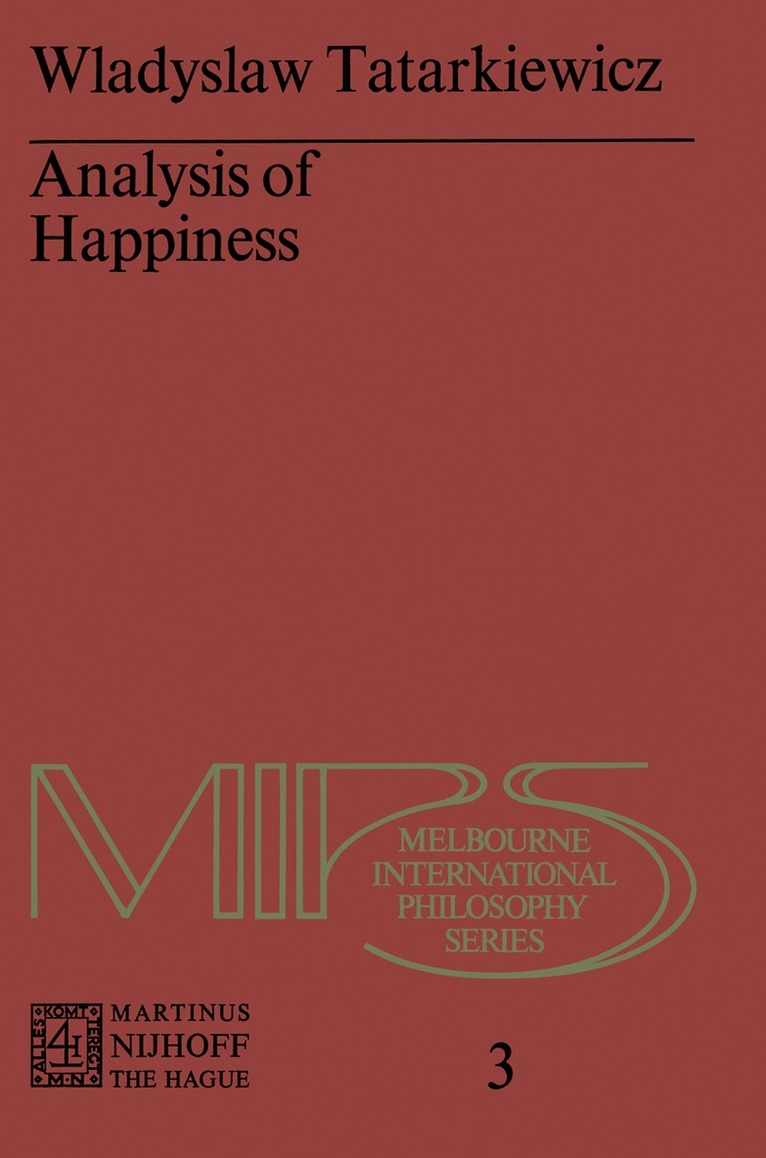
Learned men have been wntmg about happiness since antiquity: from Greek times, there is Aristotle's treatise, included in the Nicomachean Ethics; from Roman, Seneca's De Vita Beata. Later came the Christian writings on this subject, especially another De Beata Vita, written by St. Augustine. The point of view is different from Aristotle's or Seneca's but the subject remains the same. In the Middle Ages also treatises on happiness were produced, and these eventually became part of the 'summae'. St. Thomas devoted q. 2-5 of the Prima Secundae to happiness and q. 3 1-39 bear on it indirectly. In more modern times works on happiness continued to be written. Some authors carried on the Christian tradition which maintained that happi- ness is only attainable in the next world; to these belong the earliest works written in Polish. Other treatises - especially those of the Age of Reason - hold the opposite concept, that the only happiness man can expect is to be found on earth.In the 18th century there were so many of these treatises that it was possible to produce a whole anthology: The Temple of Happiness, or as it was originally called Le Temple du bonheur, ou recueuil des plus excellents traites sur Ie bonheur (2nd ed. , 1770).