Wahiduddin Mahmud - Böcker
Visar alla böcker från författaren Wahiduddin Mahmud. Handla med fri frakt och snabb leverans.
6 produkter
6 produkter
638 kr
Skickas inom 10-15 vardagar
The remarkable speed at which microcredit has expanded around the world in the last three decades has piqued the curiosity of practitioners and theorists alike. By developing innovative ways of making credit available to the poor, the idea of microcredit has challenged many traditional assumptions about both poverty reduction strategies and financial markets. While this has encouraged new theorising about how microcredit works, the practice of microcredit has itself evolved, often in unpredictable ways, outpacing the development of theory.The Theory and Practice of Microcredit aims to remedy this imbalance, arguing that a proper understanding of the evolution of practice is essential both for developing theories that are relevant for the real world and for adopting policies that can better realize the full potential of microcredit. By drawing upon their first-hand knowledge of the nature of this evolution in Bangladesh, the birthplace of microcredit, the authors have pushed the frontiers of current knowledge through a rich blend of theoretical and empirical analysis. The book breaks new grounds on a wide range of topics including: the habit-forming nature of credit repayment; the institutional strength and community-based role of microfinance institutions; the relationships between microcredit and informal credit markets; the pattern of long-term participation in microcredit programmes and the variety of loan use; the scaling up of microenterprises beyond subsistence; the "missing middle" in the credit market; and the prospects of linking micro-entrepreneurship with economic development.The book will be of interest to researchers, development practitioners and university students of Development Economics, Rural Development, or Rural Finance, as well as to public intellectuals.
2 160 kr
Skickas inom 10-15 vardagar
The remarkable speed at which microcredit has expanded around the world in the last three decades has piqued the curiosity of practitioners and theorists alike. By developing innovative ways of making credit available to the poor, the idea of microcredit has challenged many traditional assumptions about both poverty reduction strategies and financial markets. While this has encouraged new theorising about how microcredit works, the practice of microcredit has itself evolved, often in unpredictable ways, outpacing the development of theory.The Theory and Practice of Microcredit aims to remedy this imbalance, arguing that a proper understanding of the evolution of practice is essential both for developing theories that are relevant for the real world and for adopting policies that can better realize the full potential of microcredit. By drawing upon their first-hand knowledge of the nature of this evolution in Bangladesh, the birthplace of microcredit, the authors have pushed the frontiers of current knowledge through a rich blend of theoretical and empirical analysis. The book breaks new grounds on a wide range of topics including: the habit-forming nature of credit repayment; the institutional strength and community-based role of microfinance institutions; the relationships between microcredit and informal credit markets; the pattern of long-term participation in microcredit programmes and the variety of loan use; the scaling up of microenterprises beyond subsistence; the "missing middle" in the credit market; and the prospects of linking micro-entrepreneurship with economic development.The book will be of interest to researchers, development practitioners and university students of Development Economics, Rural Development, or Rural Finance, as well as to public intellectuals.
338 kr
Skickas inom 10-15 vardagar
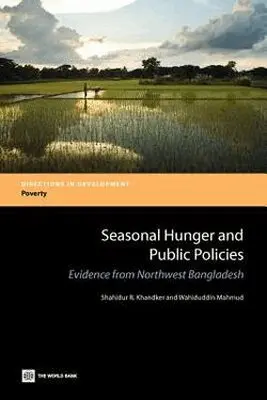
Agricultural development through crop diversification, irrigation, high yielding crop varieties, and public investments in infrastructure has improved food security and its seasonal dimension worldwide in recent years. Consequently, the severity of seasonal hunger caused by agricultural crop cycles has lessened substantially. Yet in agricultural pockets scattered throughout Sub-Saharan Africa and Asia, seasonal hunger persists, especially among the rural poor, owing primarily to idiosyncratic shocks caused by agricultural seasonality. More than four-fifths of the world’s poor live in rural areas and depend on agriculture for livelihoods. Because of seasonal income shocks, the poor who are generally poor are likely to be even poorer during a particular agricultural season, while those who are not poor year-round may also be so during that season. Also, seasonal hunger may lead to endemic poverty if its adverse effects on income and consumption are irreversible. Policies aimed at reducing overall poverty often disregard its seasonal dimension, because standard poverty statistics do not consider seasonal hunger in the official data collection and analysis, there is no direct way to determine how many of the “bottom billion,” as economist Paul Collier refers to the world’s poorest people, suffer from seasonal hunger. Even worse, regions prone to severe seasonal hunger are unlikely to attract the public investments required to raise the local economy’s resilience through income diversification and thus break the seasonal-poverty cycle.The book provides an exhaustive inquiry of Bangladesh’s seasonal hunger with special reference to the North West region. The seasonality of poverty and food deprivation is a common feature of rural livelihood but it is more marked in the north-west region of Bangladesh. The book also presents an evaluation of several policy interventions launched recently in mitigating seasonality, which provide a test case of what works and what does not in combating seasonal hunger. The major findings of the book are the following: (a) Policies to improve food security should explicitly take into account the seasonal dimension of food deprivation. (b) Gains from initiatives to combat seasonal hunger should be monitored and consolidated to ensure sustainable impacts. (c) Policies should also focus on areas that, owing to environmental degradation and climate change, are increasingly vulnerable to seasonal hunger and food insecurity in general.|Agricultural development through crop diversification, irrigation, high yielding crop varieties, and public investments in infrastructure has improved food security and its seasonal dimension worldwide in recent years. Consequently, the severity of seasonal hunger caused by agricultural crop cycles has lessened substantially. Yet in agricultural pockets scattered throughout Sub-Saharan Africa and Asia, seasonal hunger persists, especially among the rural poor, owing primarily to idiosyncratic shocks caused by agricultural seasonality. The book provides an exhaustive inquiry of Bangladesh’s seasonal hunger with special reference to the northwest region, where it is more pronounced. It also presents an evaluation of several policy interventions launched recently in mitigating seasonality, which provide a test case of what works and what does not in combating seasonal hunger. The major findings of the book are: (a) Policies to improve food security should explicitly take into account the seasonal dimension of food deprivation. (b) Gains from initiatives to combat seasonal hunger should be monitored and consolidated to ensure sustainable impacts, and (c) Policies should also focus on areas that, owing to environmental degradation and climate change, are increasingly vulnerable to seasonal hunger and food insecurity in general.
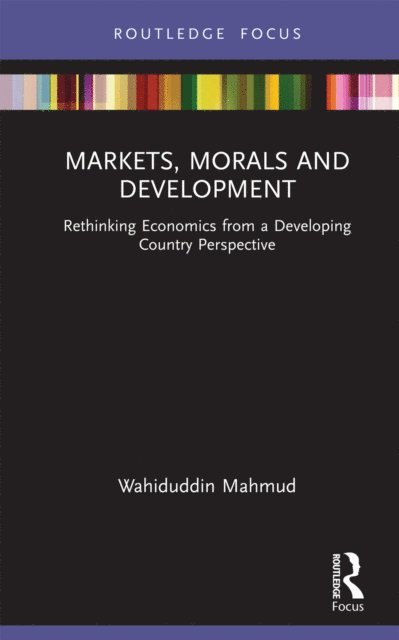
Markets, Morals and Development
Rethinking Economics from a Developing Country Perspective
Inbunden, Engelska, 2021
778 kr
Skickas inom 10-15 vardagar
This book presents, or rather “re-presents”, the intricacies of a developing economy in the light of recent theoretical developments in economics while also providing a fresh perspective on the perceived inadequacies of the discipline in addressing the discontents of the contemporary global economic order.The book argues that there is scope for economics to be a more humane discipline and more relevant to contemporary economic problems by embracing new ideas, including those from other disciplines. It attempts to show how economic concepts and theories can be contextualised to help better understand real-life economic phenomena; how to rethink the ways in which the market economy can address the moral issues of human wellbeing and social justice; and, overall, how the study of economics and public discourses on economic issues can be made more engaging as well as more relevant to the problems of developing countries. Based on public lectures given by the author in Dhaka, and using illustrations from Bangladesh, India and other countries, the book offers an authoritative understanding of diverse economic realities by taking a fresh look at the familiar.Comprehensive and accessible, the book will be of interest to students and researchers of economics, development economics and policy, sociology and business studies as well as to journalists, public intellectuals and policymakers in developing countries.
Markets, Morals and Development
Rethinking Economics from a Developing Country Perspective
Häftad, Engelska, 2023
344 kr
Skickas inom 10-15 vardagar
This book presents, or rather “re-presents”, the intricacies of a developing economy in the light of recent theoretical developments in economics while also providing a fresh perspective on the perceived inadequacies of the discipline in addressing the discontents of the contemporary global economic order.The book argues that there is scope for economics to be a more humane discipline and more relevant to contemporary economic problems by embracing new ideas, including those from other disciplines. It attempts to show how economic concepts and theories can be contextualised to help better understand real-life economic phenomena; how to rethink the ways in which the market economy can address the moral issues of human wellbeing and social justice; and, overall, how the study of economics and public discourses on economic issues can be made more engaging as well as more relevant to the problems of developing countries. Based on public lectures given by the author in Dhaka, and using illustrations from Bangladesh, India and other countries, the book offers an authoritative understanding of diverse economic realities by taking a fresh look at the familiar.Comprehensive and accessible, the book will be of interest to students and researchers of economics, development economics and policy, sociology and business studies as well as to journalists, public intellectuals and policymakers in developing countries.
2 644 kr
Skickas inom 7-10 vardagar
This Handbook on the South Asian Economies (a companion to the Handbook on the Northeast and Southeast Asian Economies) is a comprehensive and unique collection of original studies on the economic and social development of countries in South Asia. The analytical narratives draw upon a wide range of extant literature in an easily accessible way, whilst highlighting the impact of socio-political factors on economic outcomes. The introductory chapter by the editors provides a comprehensive survey of the main features of South Asian economic development, especially in respect of the policy reforms since the late 1970s. The Handbook seeks to understand the varying degrees of achievements in economic transformation and social development in various parts of South Asia, and ponders whether these experiences indicate alternative pathways of socio-economic progress or provide a unique framework for a South Asian development model. The experiences of economic reforms across the South Asian countries, with their distinctive socio-economic settings and public cultures, may thus provide fresh perspectives on the emerging development paradigms. The Handbook is indeed based on the premise that development economics and South Asia have a lot to learn from each other.As with the Handbook on the Northeast and Southeast Asian Economies, this latest Handbook will be an invaluable reference work for many years to come for researchers, academics and students of Asian studies and economics. Policymakers interested in learning more about the background and future opportunities and challenges posed by these economies will also find much to engage them.