Walter Blum – författare
Visar alla böcker från författaren Walter Blum. Handla med fri frakt och snabb leverans.
9 produkter
Particle Detection with Drift Chambers
Av Walter Blum, Werner Riegler m. fl.
Inbunden, 2008
1750 kr
Lägg i varukorg
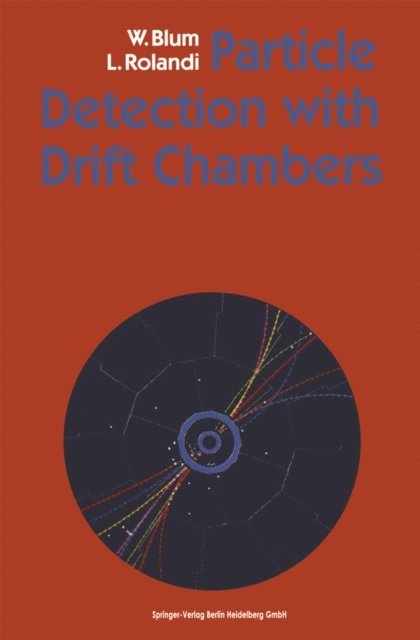
A drift chamber is an apparatus for measuring the space coordinates of the trajectory of a charged particle. This is achieved by detecting the ionization electrons produced by the charged particle in the gas of the chamber and by measuring their drift times and arrival positions on sensitive …
Particle Detection with Drift Chambers
Av Luigi Rolandi, Werner Riegler m. fl.
E-bok, 2008
2274 kr
Lägg i varukorg
A drift chamber is an apparatus for measuring the space coordinates of the trajectory of a charged particle. This is achieved by detecting the ionization electrons produced by the charged particle in the gas of the chamber and by measuring their drift times and arrival positions on sensitive …
Particle Detection with Drift Chambers
Av Walter Blum, Werner Riegler m. fl.
Häftad, 2010
1750 kr
Lägg i varukorg
A drift chamber is an apparatus for measuring the space coordinates of the trajectory of a charged particle. This is achieved by detecting the ionization electrons produced by the charged particle in the gas of the chamber and by measuring their drift times and arrival positions on sensitive …
Original Scientific Papers / Wissenschaftliche Originalarbeiten
Av Walter Blum, Hans-Peter Dürr m. fl.
Häftad, 2014
770 kr
Lägg i varukorg
This second Series A volume of Werner Heisenberg's Collected Works covers a period of about 15 years beginning with the early papers on quantum field theory in 1929/30 and ending with those on the scattering matrix (up to 1946). The reader will find Heisenberg contributions to Dirac's theory of the …
Original Scientific Papers Wissenschaftliche Originalarbeiten
Av Hans-Peter Durr, Helmut Rechenberg m. fl.
E-bok, 2013
848 kr
Lägg i varukorg
Original Scientific Papers Wissenschaftliche Originalarbeiten
Av Walter Blum, Helmut Rechenberg m. fl.
Häftad, 2011
821 kr
Lägg i varukorg
Werner Heisenberg is one of the greatest scientists of our century. His work extends over a period of fifty years, ranging from turbulence theory, the establishment of quantum mechanics, its fundamental applications in atomic and solid state physics, to the theory of cosmic ray phenomena and of …
Original Scientific Papers / Wissenschaftliche Originalarbeiten
Av Helmut Rechenberg, Hans-Peter Durr m. fl.
E-bok, 2019
447 kr
Lägg i varukorg
This is the final volume of Heisenberg''s Collected Works. Itcontains his papers on a (nonlinear) unified theory ofelementary particles, as well as his contribution tosuperconductivity and multiparticle production. Especiallyinteresting is the first group of papers, which is splitintotwo sections …
Original Scientific Papers / Wissenschaftliche Originalarbeiten
Av Walter Blum, Hans-Peter Dürr m. fl.
Häftad, 2014
770 kr
Lägg i varukorg
This is the final volume of Heisenberg's Collected Works. Itcontains his papers on a (nonlinear) unified theory ofelementary particles, as well as his contribution tosuperconductivity and multiparticle production. Especiallyinteresting is the first group of papers, which is splitintotwo sections …
Particle Detection with Drift Chambers
E-bok, 2013
1174 kr
Lägg i varukorg
A drift chamber is an apparatus for measuring the space coordinates of the trajectory of a charged particle. This is achieved by detecting the ionization electrons produced by the charged particle in the gas of the chamber and by measuring their drift times and arrival positions on sensitive …