Walter F. Baber – författare
Visar alla böcker från författaren Walter F. Baber. Handla med fri frakt och snabb leverans.
14 produkter
14 produkter
Häftad, Engelska, 2020
239 kr
Skickas inom 7-10 vardagar
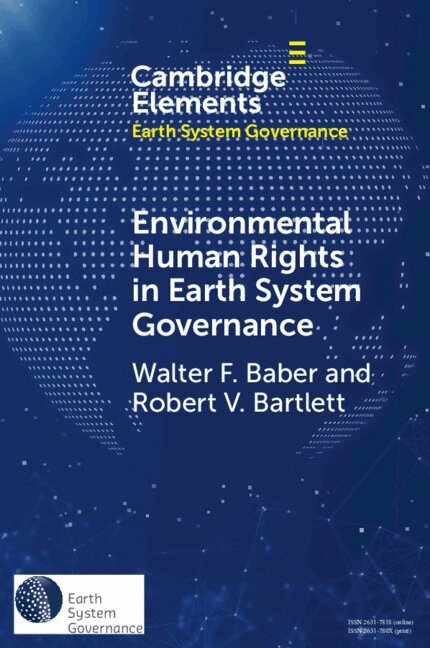
Environmental rights are a category of human rights necessarily central to both democracy and effective earth system governance (any environmental-ecological-sustainable democracy). For any democracy to remain democratic, some aspects must be beyond democracy and must not be allowed to be subjected to any ordinary democratic collective choice processes shy of consensus. Real, established rights constitute a necessary boundary of legitimate everyday democratic practice. We analyze how human rights are made democratically and, in particular, how they can be made with respect to matters environmental, especially matters that have import beyond the confines of the modern nation state.
E-bok
PDF, Engelska, 2020294 kr
Läs direkt efter köp
Environmental rights are a category of human rights necessarily central to both democracy and effective earth system governance (any environmental-ecological-sustainable democracy). For any democracy to remain democratic, some aspects must be beyond democracy and must not be allowed to be subjected to any ordinary democratic collective choice processes shy of consensus. Real, established rights constitute a necessary boundary of legitimate everyday democratic practice. We analyze how human rights are made democratically and, in particular, how they can be made with respect to matters environmental, especially matters that have import beyond the confines of the modern nation state.
Inbunden, Engelska, 2021
1 306 kr
Skickas inom 7-10 vardagar
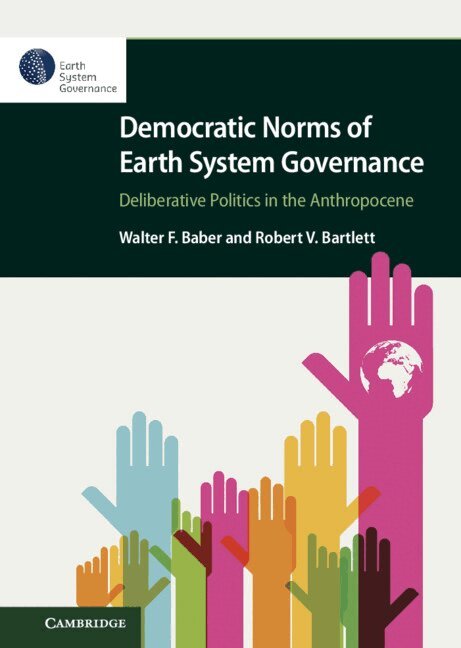
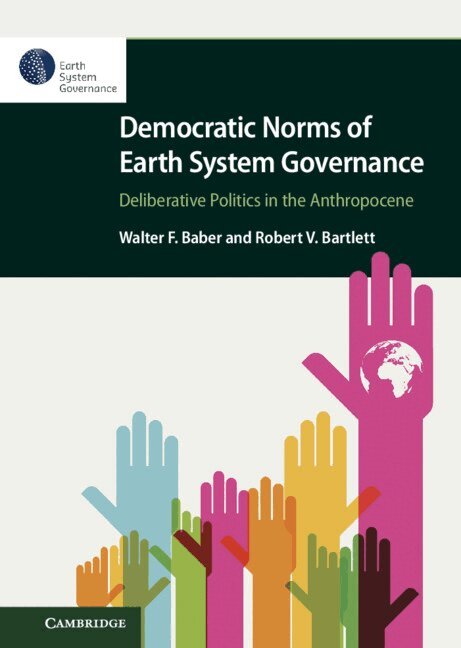
Deliberative democracy is well-suited to the challenges of governing in the Anthropocene. But deliberative democratic practices are only suited to these challenges to the extent that five prerequisites - empoweredness, embeddedness, experimentality, equivocality, and equitableness - are successfully institutionalized. Governance must be: created by those it addresses, applicable equally to all, capable of learning from (and adapting to) experience, rationally grounded, and internalized by those who adopt and experience it. This book analyzes these five major normative principles, pairing each with one of the Earth System Governance Project's analytical problems to provide an in-depth discussion of the minimal conditions for environmental governance that can be truly sustainable. It is ideal for scholars and graduate students in global environmental politics, earth system governance, and international environmental policy. This is one of a series of publications associated with the Earth System Governance Project. For more publications, see www.cambridge.org/earth-system-governance.
E-bok
PDF, Engelska, 2021681 kr
Läs direkt efter köp
Deliberative democracy is well-suited to the challenges of governing in the Anthropocene. But deliberative democratic practices are only suited to these challenges to the extent that five prerequisites - empoweredness, embeddedness, experimentality, equivocality, and equitableness - are successfully institutionalized. Governance must be: created by those it addresses, applicable equally to all, capable of learning from (and adapting to) experience, rationally grounded, and internalized by those who adopt and experience it. This book analyzes these five major normative principles, pairing each with one of the Earth System Governance Project''s analytical problems to provide an in-depth discussion of the minimal conditions for environmental governance that can be truly sustainable. It is ideal for scholars and graduate students in global environmental politics, earth system governance, and international environmental policy. This is one of a series of publications associated with the Earth System Governance Project. For more publications, see www.cambridge.org/earth-system-governance.
E-bok
Engelska, 2021681 kr
Läs direkt efter köp
Deliberative democracy is well-suited to the challenges of governing in the Anthropocene. But deliberative democratic practices are only suited to these challenges to the extent that five prerequisites - empoweredness, embeddedness, experimentality, equivocality, and equitableness - are successfully institutionalized. Governance must be: created by those it addresses, applicable equally to all, capable of learning from (and adapting to) experience, rationally grounded, and internalized by those who adopt and experience it. This book analyzes these five major normative principles, pairing each with one of the Earth System Governance Project''s analytical problems to provide an in-depth discussion of the minimal conditions for environmental governance that can be truly sustainable. It is ideal for scholars and graduate students in global environmental politics, earth system governance, and international environmental policy. This is one of a series of publications associated with the Earth System Governance Project. For more publications, see www.cambridge.org/earth-system-governance.
Häftad, Engelska, 2021
515 kr
Skickas inom 7-10 vardagar
Deliberative democracy is well-suited to the challenges of governing in the Anthropocene. But deliberative democratic practices are only suited to these challenges to the extent that five prerequisites - empoweredness, embeddedness, experimentality, equivocality, and equitableness - are successfully institutionalized. Governance must be: created by those it addresses, applicable equally to all, capable of learning from (and adapting to) experience, rationally grounded, and internalized by those who adopt and experience it. This book analyzes these five major normative principles, pairing each with one of the Earth System Governance Project's analytical problems to provide an in-depth discussion of the minimal conditions for environmental governance that can be truly sustainable. It is ideal for scholars and graduate students in global environmental politics, earth system governance, and international environmental policy. This is one of a series of publications associated with the Earth System Governance Project. For more publications, see www.cambridge.org/earth-system-governance.
Inbunden, Engelska, 2023
1 145 kr
Skickas inom 7-10 vardagar
Human rights and environmental protection are closely intertwined, and both are critically dependent on supportive legal opportunity structures. These legal structures consist of access to the courts; 'legal stock' or the set of available standards and precedents on which to base litigation; and institutional receptiveness to potential litigation. These elements all depend on a variety of social, political, and economic variables. This book critically analyses the complexities of uniting human rights advocacy and environmental protection. Bringing together international experts in the field, it documents the current state of our environmental human rights knowledge, strategically critical questions that remain unanswered, and the initiatives required to develop those answers. It is ideal for researchers in environmental governance and law, as well as interested practitioners and advanced students working in public policy, political science and environmental studies.
Inbunden, Engelska, 2026
1 691 kr
Skickas inom 10-15 vardagar
Over a time lapse of only about 170 years, the trajectory of greenhouse gas (GHG) in the atmosphere has exceeded the 1.5°C security level established in the Paris Agreement. States and international organisations have thus far addressed global warming primarily by means of policy-making and law-making–that is, from the standpoint of ‘primary’ rules, but convergence is still limited. Climate science indeed warns that the timely achievement of carbon neutrality by 2050 currently necessitates drastic cuts in GHG emissions on a yearly basis. Can therefore a progressive implementation of ‘secondary’ norms, that is, sanctions and ensuing enforcement procedures, meaningfully contribute to fostering a fast transition to a low-carbon economy based on renewables and, possibly, nuclear energy and further innovative technologies, including corresponding adaptation measures? ‘Hard’ and ‘soft’ mechanisms, both ‘public’ and ‘private’ in nature, whereby enforceable sanctions integrate goal setting, pledges and a variety of behavioural incentives, disclose a fragmented ‘enforcement deficit’, which compels case-by-case decentralised solutions, whereby the threshold is by now set at a 2°C temperature increase above pre-industrial levels, with fast-approaching tipping points.
E-bok
Engelska, 20262 176 kr
Läs direkt efter köp
Over a time lapse of only about 170 years, the trajectory of greenhouse gas (GHG) in the atmosphere has exceeded the 1.5°C security level established in the Paris Agreement. States and international organisations have thus far addressed global warming primarily by means of policy-making and law-making–that is, from the standpoint of ‘primary’ rules, but convergence is still limited. Climate science indeed warns that the timely achievement of carbon neutrality by 2050 currently necessitates drastic cuts in GHG emissions on a yearly basis. Can therefore a progressive implementation of ‘secondary’ norms, that is, sanctions and ensuing enforcement procedures, meaningfully contribute to fostering a fast transition to a low-carbon economy based on renewables and, possibly, nuclear energy and further innovative technologies, including corresponding adaptation measures? ‘Hard’ and ‘soft’ mechanisms, both ‘public’ and ‘private’ in nature, whereby enforceable sanctions integrate goal setting, pledges and a variety of behavioural incentives, disclose a fragmented ‘enforcement deficit’, which compels case-by-case decentralised solutions, whereby the threshold is by now set at a 2°C temperature increase above pre-industrial levels, with fast-approaching tipping points.
Inbunden, Engelska, 2005
135 kr
Tillfälligt slut
Inbunden, Engelska, 2015
91 kr
Tillfälligt slut
Häftad, Engelska, 2009
56 kr
Tillfälligt slut
Häftad, Engelska, 2005
99 kr
Tillfälligt slut
Häftad, Engelska, 2015
267 kr
Tillfälligt slut