Ward Edwards - Böcker
Visar alla böcker från författaren Ward Edwards. Handla med fri frakt och snabb leverans.
5 produkter
5 produkter
570 kr
Skickas inom 7-10 vardagar
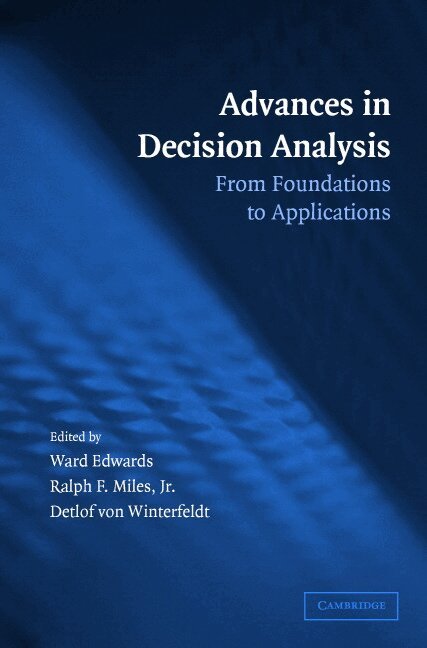
Decision analysis is a prescriptive theory that aids individuals or groups confronted with complex problems in a wide variety of contexts. By framing issues, identifying risks, eliciting stakeholder preferences, and suggesting alternative approaches, decision analysts can offer workable solutions in domains such as the environment, health and medicine, engineering and operations research, and public policy. This book is a mixture of historical and forward-looking essays on key topics in decision analysis. Part I covers the history and foundations of decision analysis. Part II discusses structuring decision problems, including the development of objectives and their attributes, and influence diagrams. Part III discusses probabilities and their elicitation and Bayes nets. Part IV discusses additive and multiplicative utilities, risk preferences, and 'option pricing' methods. Part V discusses risk analysis. Part VI puts decision analysis in a behavioral and organizational context. Part VII presents case studies of applications.
1 210 kr
Skickas inom 7-10 vardagar
Decision analysis is a prescriptive theory that aids individuals or groups confronted with complex problems in a wide variety of contexts. By framing issues, identifying risks, eliciting stakeholder preferences, and suggesting alternative approaches, decision analysts can offer workable solutions in domains such as the environment, health and medicine, engineering and operations research, and public policy. This book is a mixture of historical and forward-looking essays on key topics in decision analysis. Part I covers the history and foundations of decision analysis. Part II discusses structuring decision problems, including the development of objectives and their attributes, and influence diagrams. Part III discusses probabilities and their elicitation and Bayes nets. Part IV discusses additive and multiplicative utilities, risk preferences, and 'option pricing' methods. Part V discusses risk analysis. Part VI puts decision analysis in a behavioral and organizational context. Part VII presents case studies of applications.
Del 3 - Studies in Risk and Uncertainty
Utility Theories: Measurements and Applications
Inbunden, Engelska, 1992
2 121 kr
Skickas inom 10-15 vardagar
Traditional utility theory, growing out of the ideas of von Neumann & Morgenstern and Savage, asserts that wise decision makers should maximize some form of expected utility. Decision analysis as a technology implements this prescription. But even after careful thought, people do not necessarily behave that way. The new generalized utility theories attempt to model what people actually do. This book grows out of a NSF-sponsored Conference that brought generalized utlilty theorists and decision analysts together to examine the normative, prescriptive and descriptive implications of the new utility theories. The book begins with a review of the phenomena that the new utility theories are intended to explain and of the theories themselves. It then presents the "old time religion" of utility maximization as a normative and prescriptive theory. It explores how utility maximization needs to be and can be amplified and supplemented for practical prescriptive purposes. The next section of the book looks at what characteristics generalized utility theories would need to have in order to be prescriptively useful. The crucial one turns out to be a form of path independence.Two chapters show that the form of path independence essentially forces the theory embodying it to be a version of traditional utility maximization. The next section of the book looks at the relation between generalized utility theories and the data they are intended to explain. A final section contains an evaluative discussion that weaves the themes of the book together. "Utility Theories: Measurements and Applications" provides a definitive answer to the question about the relation between new utility theories and decision analysis that inspired it. It also brings into focus a number of related questions, and reports a great deal of theoretical and empirical progress on the topics to which it is addressed.
2 121 kr
Skickas inom 10-15 vardagar
The Conference on "Utility: Theories, Measurements, and Applications" met at the Inn at Pasatiempo in Santa Cruz, California, from June II to 15, 1989. The all-star cast of attendees are listed as authors in the Table of Contents of this book (see p. V), except for Soo Hong Chew and Amos Tversky. The purpose of the conference, and of National Science Foundation Grant No. SES-8823012 that supported it, was to confront proponents of new generalized theories of utility with leading decision analysts com mitted to the implementation, in practice, of the more traditional theory that these new theories reject. That traditional model is variously iden tified in this book as expected utility or subjectively expected utility maximization (EU or SEU for short) and variously attributed to von Neumann and Morgenstern or Savage. I had feared that the conference might consist of an acrimonious debate between Olympian normative theorists uninterested in what people actually do and behavioral modelers obsessed with the cognitive illusions and uninterested in helping people to make wise decisions. I was entirely wrong. The conferees, in two dramatic straw votes at the open ing session, unanimously endorsed traditional SEU as the appropriate normative model and unanimously agreed that people don't act as that model requires. (These votes had a profound impact on my thinking; detail about them and about that impact is located in Chapter 10.
Del 26 - Quantitative Applications in the Social Sciences
Multiattribute Evaluation
Häftad, Engelska, 1982
804 kr
Skickas inom 3-6 vardagar
Ward Edwards and J. Robert Newman clearly explain Multiattribute Utility Technology (MAUT), a technique that facilitates decision making by identifying and weighting the objectives of the stakeholders in a specific decision.