Warren Gay – författare
595 kr
Skickas inom 3-6 vardagar
708 kr
Läs direkt efter köp
You probably already know that the Raspberry Pi is an excellent teaching tool. If you want to teach Linux basics or Python programming or basic electronics, it''s a great place to start. But what if you are an electronics engineer or a Linux systems administrator or a very experienced maker? You want to know all of the details and inner working of the Raspberry Pi -- how to (figuratively or maybe even literally) make it get up and dance without wading through basics and introductory material.
If you want to get right into the pro-level guts of the Raspberry Pi, complete with schematics, detailed hardware explanations, messing around with runlevels, reporting voltages and temperatures, and recompiling the kernel, then Mastering the Raspberry Pi is just the book you need. Along with all of the thorough explanations of hardware and operating system, you''ll also get a variety of project examples and explanations that you can tune for your own project ideas.
You''ll find yourself turning to Mastering the Raspberry Pi over and over again for both inspiration and reference. Whether you''re an electronics professional, an entrepreneurial maker, or just looking for more detailed information on the Raspberry Pi, this is exactly the book for you.
393 kr
Läs direkt efter köp
Need some inspiration for your Raspberry Pi projects? Wondering how to work with Wii nunchucks, stepper motors, how to create a remote control panel? If you need guidance, Experimenting with Raspberry Pi is your own personal idea generator. Experimenting with Raspberry Pi covers how to work with various components and hardware like humidity and temperature sensors, Wii nunchucks, GPIO extenders, and IR receivers so you can add these to your own projects.
Written with budgets in mind, author Warren Gay encourages you to build, experiment, and swap out various parts to learn more about the Pi and come up with the best ideas and instructions for your own amazing Raspberry Pi project ideas.
317 kr
Skickas inom 10-15 vardagar
393 kr
Läs direkt efter köp
317 kr
Skickas inom 10-15 vardagar
472 kr
Läs direkt efter köp
The Raspberry Pi is deceptively simple. Plug it in, boot it up, and use it as a personal computer, or attach a million gizmos and modules and invent something new and amazing. Either way, what it can actually do is not simple, and you should know exactly what the Raspberry Pi hardware is all about. Raspberry Pi Hardware Reference, from Mastering the Raspberry Pi, is the hardware guide you need on your desk or workbench.
Every detail is covered: from power to memory, from the CPU to working with USB. You''ll find all the details about working with both wired and wireless Ethernet, SD cards, and the UART interface. The GPIO chapter is invaluable, covering power budgeting, access, and even small but important details like the correct usage of sudo when working with GPIO pins. You''ll also find details about the 1-Wire driver, the I2C bus, and the SPI bus. If you need to know anything about your Raspberry Pi''s hardware, you will find it here, in Raspberry Pi Hardware Reference.
395 kr
Skickas inom 10-15 vardagar
505 kr
Skickas inom 10-15 vardagar
629 kr
Läs direkt efter köp
464 kr
Skickas inom 10-15 vardagar
629 kr
Läs direkt efter köp
Design and build custom hardware interfaces for the Raspberry Pi and discover low cost display and sensor options for embedded system projects.
With this book you''ll master 12C communications using Raspbian Linux in C++ and perform ADC and DAC experiments. You''ll experiment with debounce buttons and switches using hardware and software solutions. Develop flywheel rotary encoder effects for ease of tuning and construct a hardware interface to the Music Playing Daemon (MPD) with developed software. Discover how to add your own hardware keypad for remote combination lock applications.
Custom Raspberry Pi Interfaces offers a thorough chapter on interfacing 5-volt systems to 3.3-volt Raspberry Pis designed to expand your choice of peripheral options. Ready to go C++ programs involving GPIO and I2C peripherals are provided. This book also explores ADC, DAC, rotary encoders, CMOS shift registers. I2C I/O extenders.
What you''ll learn:Build simple, low cost input/output interfaces including rotary encoders Interface with 5-volt devices from a 3-volt Raspberry Pi system Apply analog to digital and digital to analog conversions on the Pi Read potentiometers (volume control) from the Pi Determine step, directions, and velocity of a rotary encoder Perform remote interfacing using the I2 PCF8574 chipWork with external CMOS devices like the 74HC595 (in C++)Who this book is for:Students and hobbyists interested in building custom interfaces for their Raspberry Pis.865 kr
Läs direkt efter köp
Using FreeRTOS and libopencm3 instead of the Arduino software environment, this book will help you develop multi-tasking applications that go beyond Arduino norms. In addition to the usual peripherals found in the typical Arduino device, the STM32 device includes a USB controller, RTC (Real Time Clock), DMA (Direct Memory Access controller), CAN bus and more.
Each chapter contains clear explanations of the STM32 hardware capabilities to help get you started with the device, including GPIO and several other ST Microelectronics peripherals like USB and CAN bus controller. You’ll learn how to download and set up the libopencm3 + FreeRTOS development environment, using GCC. With everything set up, you’ll leverage FreeRTOS to create tasks, queues, and mutexes. You’ll also learn to work with the I2C bus to add GPIO using the PCF8574 chip. And how to create PWM output for RC control using hardware timers.
You''ll be introduced to new concepts that are necessary to master theSTM32, such as how to extend code with GCC overlays using an external Winbond W25Q32 flash chip. Your knowledge is tested at the end of each chapter with exercises. Upon completing this book, you’ll be ready to work with any of the devices in the STM32 family. Beginning STM32 provides the professional, student, or hobbyist a way to learn about ARM without costing an arm!What You''ll Learn Initialize and use the libopencm3 drivers and handle interruptsUse DMA to drive a SPI based OLED displaying an analog meterRead PWM from an RC control using hardware timersWho This Book Is ForExperienced embedded engineers, students, hobbyists and makers wishing to explore the ARM architecture, going beyond Arduino limits.616 kr
Skickas inom 10-15 vardagar
865 kr
Läs direkt efter köp
Jump right into the pro-level guts of the Raspberry Pi with complete schematics and detailed hardware explanations as your guide. You''ll tinker with runlevels, reporting voltages and temperatures, and work on a variety of project examples that you can tune for your own project ideas..
This book is fully updated for the latest Pi boards with three chapters dedicated to GPIO to help you master key aspects of the Raspberry Pi. You''ll work with Linux driver information and explore the different Raspberry Pi models, including the Pi Zero, Pi Zero W, Pi 2, Pi3 B and Pi3 B+. You''ll also review a variety of project examples that you can tune for your own project ideas. Other topics covered include the 1-Wire driver interface, how to configure a serial Linux console, and cross-compile code, including the Linux kernel.
You''ll find yourself turning to Advanced Raspberry Pi over and over again for both inspiration and reference. Whether you''re an electronics professional, an entrepreneurial maker, or just looking for more detailed information on the Raspberry Pi, this is exactly the book for you.
What You''ll LearnMaster I2C and SPI communications from Raspbian Linux in CProgram USB peripherals, such as a 5-inch LCD panel with touch control and the Pi cameraStudy GPIO hardware, the sysfs driver interface and direct access from C programsUse and program the UART serial device. Who This Book Is ForAdvanced Raspberry Pi users who have experience doing basic projects and want to take their projects further.340 kr
Läs direkt efter köp
335 kr
Läs direkt efter köp
865 kr
Läs direkt efter köp
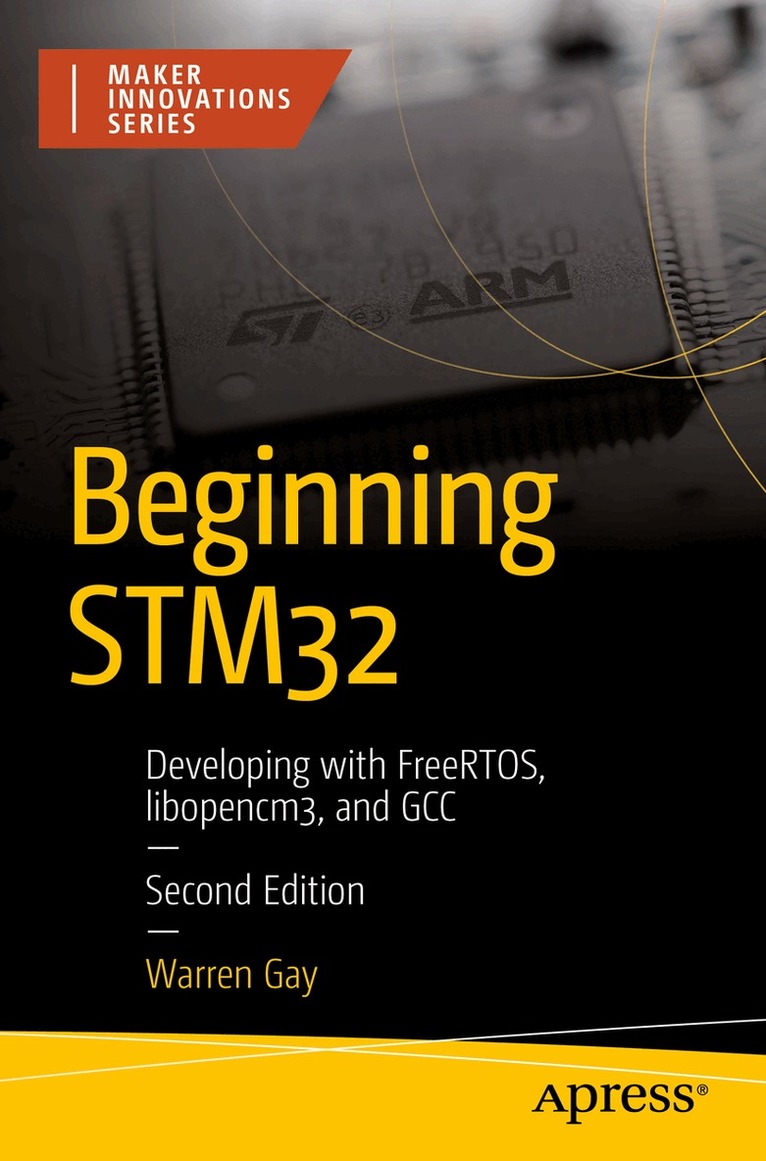
See how using FreeRTOS and libopencm3 instead of the Arduino software environment will help you develop multi-tasking applications that go beyond Arduino norms. This updated version includes expanded coverage of software setup for Windows 10 and 11, additional TM32 hardware capabilities, including clear explanations of "totem pole outputs" versus "open drain outputs," and a new section on project showcasing an interrupt-driven approach for processing USART data.
Each chapter contains clear explanations of the STM32 hardware capabilities to help get you started with the device, including GPIO and several other ST Microelectronics peripherals like USB and CAN bus controller. You’ll learn how to download and set up the libopencm3 + FreeRTOS development environment, using GCC. With everything set up, you’ll leverage FreeRTOS to create tasks, queues, and mutexes. You’ll also learn to work with the I2C bus to add GPIO using the PCF8574 chip. And how to create PWM output for RC control using hardware timers.
You''ll be introduced to new concepts that are necessary to master the STM32, such as how to extend code with GCC overlays using an external Winbond W25Q32 flash chip. Your knowledge is tested at the end of each chapter with exercises. Upon completing this book, you’ll be ready to work with any of the devices in the STM32 family. Beginning STM32, Second Edition provides the professional, student, or hobbyist a way to learn about ARM without costing an arm!What You''ll Learn Initialize and use the libopencm3 drivers and handle interruptsUse DMA to drive a SPI based OLED displaying an analog meterRead PWM from an RC control using hardware timersUnderstand STM32 capabilities, including USB controller, RTC, DMA, CAN bus, and more Who This Book Is ForExperienced embedded engineers, students, hobbyists and makers wishing to explore the ARM architecture, going beyond Arduino limits.