Wayne Flynt – författare
Visar alla böcker från författaren Wayne Flynt. Handla med fri frakt och snabb leverans.
9 produkter
9 produkter
279 kr
Skickas inom 3-6 vardagar
234 kr
Skickas inom 10-15 vardagar
"The best sort of introductory study . . . packed with enlightening information." —The Times Literary SupplementPoor whites have been isolated from mainstream white Southern culture and have been in turn stereotyped as rednecks and Holy Rollers, discriminated against, and misunderstood. In their isolation, they have developed a unique subculture and defended it with a tenacity and pride that puzzles and confuses the larger society. Written 25 years ago, this book was one scholar's attempt to understand these people and their culture. For this new edition, Wayne Flynt has provided a new retrospective introduction and an up-to-date bibliography.
427 kr
Skickas inom 5-8 vardagar
481 kr
Skickas inom 5-8 vardagar
A new and up-to-date edition of Alabama’s history to celebrate the state’s bicentennial.Alabama: The History of a Deep South State, Bicentennial Edition is a comprehensive narrative account of the state from its earliest days to the present. This edition, updated to celebrate the state’s bicentennial year, offers a detailed survey of the colorful, dramatic, and often controversial turns in Alabama’s evolution. Organized chronologically and divided into three main sections—the first concluding in 1865, the second in 1920, and the third bringing the story to the present—makes clear and interprets the major events that occurred during Alabama’s history within the larger context of the South and the nation.Once the home of aboriginal inhabitants, Alabama was claimed and occupied by a number of European nations prior to becoming a permanent part of the United States in 1819. A cotton and slave state for more than half of the nineteenth century, Alabama seceded in 1861 to join the Confederate States of America, and occupied an uneasy and uncertain place in America’s post-Civil War landscape. Alabama’s role in the twentieth century has been equally tumultuous and dramatic.General readers as well as scholars will welcome this up-to-date and scrupulously researched history of Alabama, which examines such traditional subjects as politics, military history, economics, race, and class. It contains essential accounts devoted to Native Americans, women, and the environment, as well as detailed coverage of health, education, organized labor, civil rights, and the many cultural developments, from literature to sport, that have enriched Alabama’s history. The stories of individual leaders, from politicians to creative artists, are also highlighted. A key facet of this landmark historical narrative is the strong emphasis placed on the common everyday people of Alabama, those who have been rightly described as the “bone and sinew” of the state.
309 kr
Skickas inom 5-8 vardagar
Southern Religion and Christian Diversity in the Twentieth Century is a collection of fifteen essays by award-winning scholar Wayne Flynt that explores and reveals the often-forgotten religious heterogeneity of the American South. Throughout its dramatic history, the American South has wrestled with issues such as poverty, social change, labor reform, civil rights, and party politics, and Flynt’s writing reaffirms religion as the lens through which southerners understand and attempt to answer these contentious questions. In Southern Religion and Christian Diversity in the Twentieth Century, however, Flynt gently but persuasively dispels the myth—comforting to some and dismaying to others—of religion in the South as an inert cairn of reactionary conservatism. Flynt introduces a wealth of stories about individuals and communities of faith whose beliefs and actions map the South’s web of theological fault lines. In the early twentieth century, North Carolinian pastor Alexander McKelway became a relentless crusader against the common practice of child labor. In 1972, Rev. Dr. Ruby Kile, in a time of segregated churches led by men, took the helm of the eight-member Powderly Faith Deliverance Center in Jefferson County, Alabama and built the fledgling group into a robust congregation with more than 700 black and white worshippers. Flynt also examines the role of religion in numerous pivotal court cases, such as the US Supreme Court school prayer case Engel v. Vitale, whose majority opinion was penned by Justice Hugo Black, an Alabamian. These fascinating case studies and many more illuminate a religious landscape of far more varied texture and complexity than is commonly believed. Southern Religion and Christian Diversity in the Twentieth Century offers much to readers and scholars interested in the South, religion, and theology. Writing with his hallmark wit, warmth, and erudition, Flynt’s Southern Religion and Christian Diversity in the Twentieth Century is a vital record of gospel-inspired southerners whose stories revivify sclerotic assumptions about the narrow conformity of southern Christians.
366 kr
Kommande
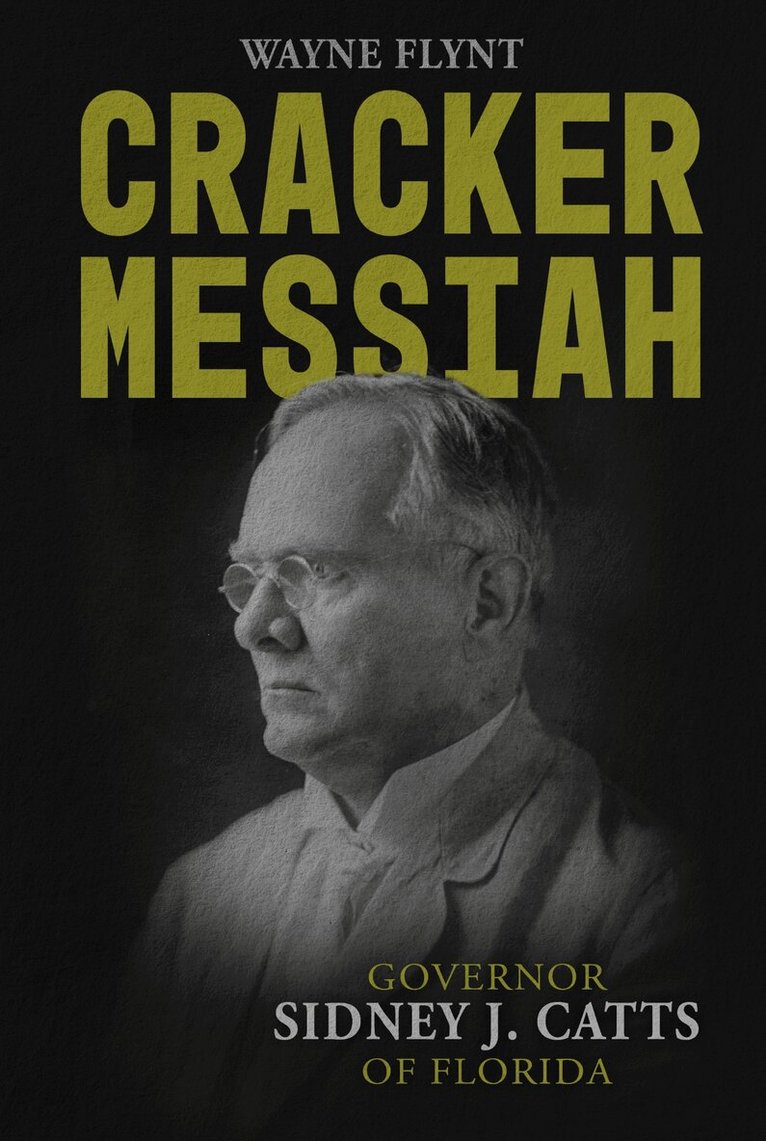
The definitive biography of Sidney J. Catts—Florida's fiery governor who fused pulpit rhetoric with populist politics in the early twentieth century. Cracker Messiah by Wayne Flynt is a riveting portrait of Sidney J. Catts, one of the most controversial figures in Southern political history. Catts rose from Baptist pulpits and Chautauqua stages to Florida's governor's mansion in 1916, riding a wave of rural populism, prohibition fervor, and anti-Catholic rhetoric. His fiery oratory and outsider persona electrified "Florida crackers" at a time when industrial and urban forces were reshaping the South. Yet Catts was more than a demagogue. His administration championed progressive reforms—good roads, penal improvements, vocational education, and even women's political participation—while his career oscillated between idealism and opportunism.Wayne Flynt's meticulously documented biography illuminates this complicated politician, tracing Catts's battles with the Democratic establishment, his failed Senate bid, and his later flirtations with gambling and real estate during Florida's boom years. Drawing on interviews, archival sources, and legislative records, Cracker Messiah illuminates the tensions between nativism and reform, faith and hypocrisy, populism and progressivism in the early twentieth-century South. This new edition will appeal to readers of Southern history, political biography, and Progressive Era studies, as well as anyone interested in the roots of American populism and the enduring complexities of cultural and political identity in the Deep South.
366 kr
Kommande
A Southern senator at the crossroads of change.Duncan Upshaw Fletcher: Dixie's Reluctant Progressive is the definitive portrait of one of Florida's most influential yet overlooked political figures. Serving in the U.S. Senate from 1909 to 1936, Fletcher bridged the gap between Wilsonian progressivism and Roosevelt's New Deal, shaping landmark legislation such as the Federal Farm Loan Act, the Shipping Act, and major banking reforms. Far from a demagogue, Fletcher was a methodical, pragmatic leader who championed moderation, urban progressivism, and economic development while resisting racial and religious extremism. Wayne Flynt's deeply researched biography illuminates Fletcher's paradoxical career—a Unitarian in a fundamentalist state, a reformer who later embraced conservatism, and a Southern Democrat who became a loyal New Dealer. Through vivid analysis of Florida's turbulent political landscape, the book explores themes of coalition-building, economic modernization, and the South's evolving role in national politics. This work will captivate readers interested in Southern history, political biography, and the roots of modern progressivism. Scholars of the New Deal, reform movements, and Florida history will find it indispensable, while general readers will appreciate its lucid style and insights into a leader whose story resonates with today's debates over moderation, governance, and social change.
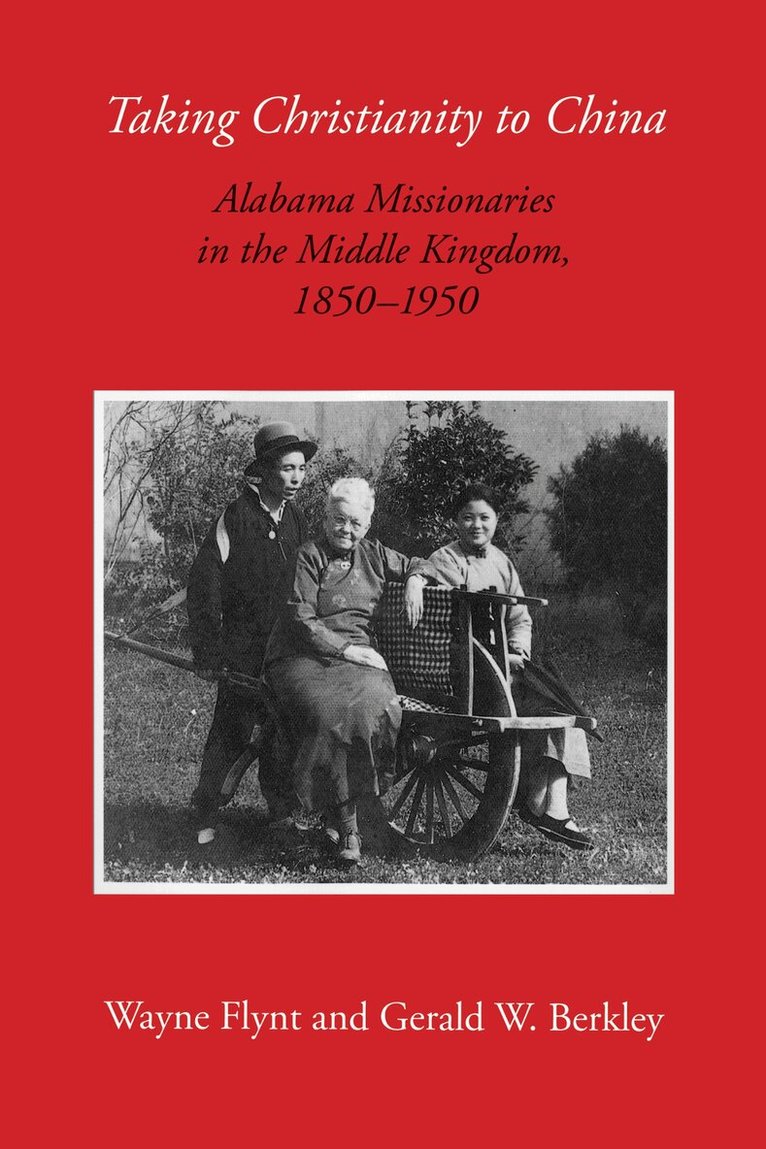
Taking Christianity to China
Alabama Missionaries in the Middle Kingdom, 1850-1950
Häftad, Engelska, 2017
373 kr
Skickas inom 5-8 vardagar
Beginning early in the 19th century, the American missionary movement made slow headway in China. Alabamians became part of that small beachhead. After 1900 both the money and personnel rapidly expanded, peaking in the early 1920s. By the 1930s many American denominations became confused and divided over the appropriateness of the missionary endeavor. Secular American intellectuals began to criticize missionaries as meddling do-gooders trying to impose American Evangelicalism on a proud, ancient culture.By examining the lives of 47 Alabama missionaries who served in China between 1850 and 1950, Flynt and Berkley reach a different conclusion. Although Alabama missionaries initially fit the negative description of Americans trying to superimpose their own values and beliefs on "heathen," they quickly learned to respect Chinese civilization. The result was a new synthesis, neither entirely southern nor entirely Chinese. Although previous works focus on the failure of Christianity to change China, this book focuses on the degree to which their service in China changed Alabama missionaries. And the change was profound.In their consideration of 47 missionaries from a single state--their call to missions, preparation for service in China, living, working, contacts back home, cultural clashes, political views, internal conflicts, and gender relations--the authors suggest that the efforts by Baptist, Methodist, and Presbyterian missionaries from Alabama were not the failure judged by many historians. In fact, the seeds sown in the hundred years before the Communist revolution in 1950 seem to be reaping a rich harvest in the declining years of the 20th century, when the number of Chinese Christians is estimated by some to be as high as one hundred million.
313 kr
Skickas inom 3-6 vardagar
Imagine sitting with an esteemed writer on his or her front porch somewhere in the world and swapping life stories. Dr. Wayne Flynt got the opportunity to do just this with Nelle Harper Lee. In a friendship that blossomed over a dozen years starting when Lee relocated back to Alabama after having had a stroke, Flynt and his wife Dartie became regular visitors at the assisted living facility that was Lee’s new home. And there the conversation began. It began where it always begins with Southern storytellers, with an invitation to “Come in, sit down, and stay a while."The stories exchanged ranged widely over the topics of Alabama history, Alabama folklore, family genealogy, and American literature, of course. On the way from beginning to end there were many detours: talks about Huntingdon College; The University of Alabama; New York City; the United Kingdom; Garden City, Kansas; and Mobile, Alabama, to name just a few. Wayne and his wife were often joined by Alice Lee, the oldest Lee sister, a living encyclopedia on the subject of family genealogy, and middle sister Louise Lee Conner. The hours spent visiting, in intimate closeness, are still cherished by Wayne Flynt. They yielded revelations large and small, which have been shaped into Afternoons with Harper Lee. Part memoir, part biography, this book offers a unique window into the life and mind and preoccupations of one of America’s best-loved writers. Flynt and Harper Lee and her sisters learned a great deal from each other, and though this is not a history book, their shared interest in Alabama and its history made this extraordinary work possible.