
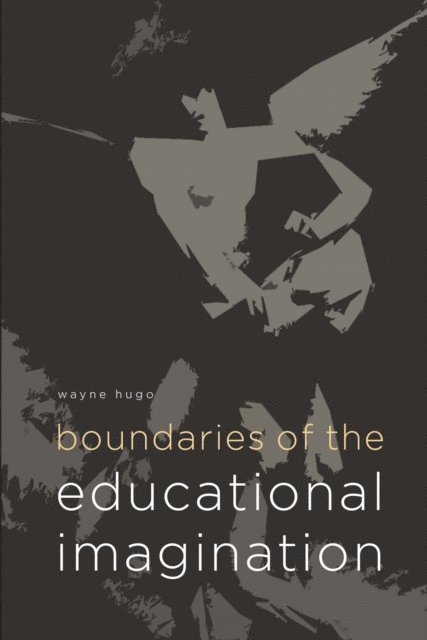
The educational imagination is the capacity to think critically beyond our located, daily experiences of education. It breaks away from the immediacy of personal understanding by placing education within wider, deeper and longer contexts. Boundaries of the Educational Imagination develops the educational imagination by answering six questions: What happens when we expand continuously outwards from one school to all the schools of the world?; What happens if we go inside a school and explore how its material equipment has changed over the past 300 years?; What is the smallest educational unit in our brain and how does it allow an almost infinite expansion of knowledge?; What is the highest level of individual development we can teach students to aspire towards?; What role does education play in a world that is producing more and more complex knowledge increasingly quickly?; How do small knowledge elements combine to produce increasingly complex knowledge forms? Each question goes on a journey towards limit points in education so that educational processes can be placed within a bigger framework that allows new possibilities, fresh options and more critical engagement. These questions are then pulled together into a structuring framework enabling the reader to grasp how this complex subject works.
Del 943 - Europaeische Hochschulschriften / European University Studies / Publications Universitaires Européennes
Pedagogy and hierarchy are intimately connected. This book traces historical versions of the relationship between hierarchy and education through four key figures: Plato, Augustine, Abelard and Dante. Each provided canonical contributions to how hierarchies both work and fail in education: Plato through the ladder of beauty and the cave metaphor; Augustine through his Confessions; Abelard through his relationship with Heloise; and Dante through the Divine Comedy. All four worked within the tradition of a Great Chain of Being. Its basic premise was that there were qualitatively different orders of experience that needed to be described with the intent of pedagogically revealing to the reader how to travel through the varying stages. As such this tradition exists as one of the great repositories of hierarchical pedagogic practice in the West. This book is an introduction to the history of hierarchical teaching practice by describing various journeys of learning and discussing the techniques and paths used in the process.
The educational imagination is the capacity to think critically beyond our located, daily experiences of education. It breaks away from the immediacy of personal understanding by placing education within wider, deeper and longer contexts. Boundaries of the Educational Imagination develops the educational imagination by answering six questions: What happens when we expand continuously outwards from one school to all the schools of the world?; What happens if we go inside a school and explore how its material equipment has changed over the past 300 years?; What is the smallest educational unit in our brain and how does it allow an almost infinite expansion of knowledge?; What is the highest level of individual development we can teach students to aspire towards?; What role does education play in a world that is producing more and more complex knowledge increasingly quickly?; How do small knowledge elements combine to produce increasingly complex knowledge forms? Each question goes on a journey towards limit points in education so that educational processes can be placed within a bigger framework that allows new possibilities, fresh options and more critical engagement. These questions are then pulled together into a structuring framework enabling the reader to grasp how this complex subject works.
Del 943 - Europaeische Hochschulschriften / European University Studies / Publications Universitaires Européennes
Pedagogy and hierarchy are intimately connected. This book traces historical versions of the relationship between hierarchy and education through four key figures: Plato, Augustine, Abelard and Dante. Each provided canonical contributions to how hierarchies both work and fail in education: Plato through the ladder of beauty and the cave metaphor; Augustine through his Confessions; Abelard through his relationship with Heloise; and Dante through the Divine Comedy. All four worked within the tradition of a Great Chain of Being. Its basic premise was that there were qualitatively different orders of experience that needed to be described with the intent of pedagogically revealing to the reader how to travel through the varying stages. As such this tradition exists as one of the great repositories of hierarchical pedagogic practice in the West. This book is an introduction to the history of hierarchical teaching practice by describing various journeys of learning and discussing the techniques and paths used in the process.