Wayne L. Myers - Böcker
Visar alla böcker från författaren Wayne L. Myers. Handla med fri frakt och snabb leverans.
6 produkter
6 produkter
1 064 kr
Skickas inom 10-15 vardagar
We offer here a non-conventional approach to muhivariate ima- structured data for which the basis is well tested but the analytical ramifi cations are still unfolding. Although we do not formally pursue them, there are several parallels with the nature of neural networks. We employ a systematic set of statistical heuristics for modeling multivariate image data in a quasi-perceptual manner. When the human eye perceives a scene, the elements of the scene are segregated heuristically into compo nents according to similarity and dissimilarity, and then the relationships among the components are interpreted. Similarly, we segregate or seg ment the scene into hierarchically organized components that are subject to subsequent statistical analysis in many modes for interpretive purposes. We refer to the segregated scene segments as patterns, since they provide a basis for perception of pattern. Since they are also hierarchically organ ized, we refer to them further as polypatterns. This leads us to our acro nym of Progressively Segmented Image Modeling As Poly-Patterns (PSIMAPP). Likewise, we formalize our approach in terms of pattern processes and segmentation sequences. In alignment with the terminology of image analysis, we refer to our multivariate measures as being signal bands.
928 kr
Skickas inom 10-15 vardagar
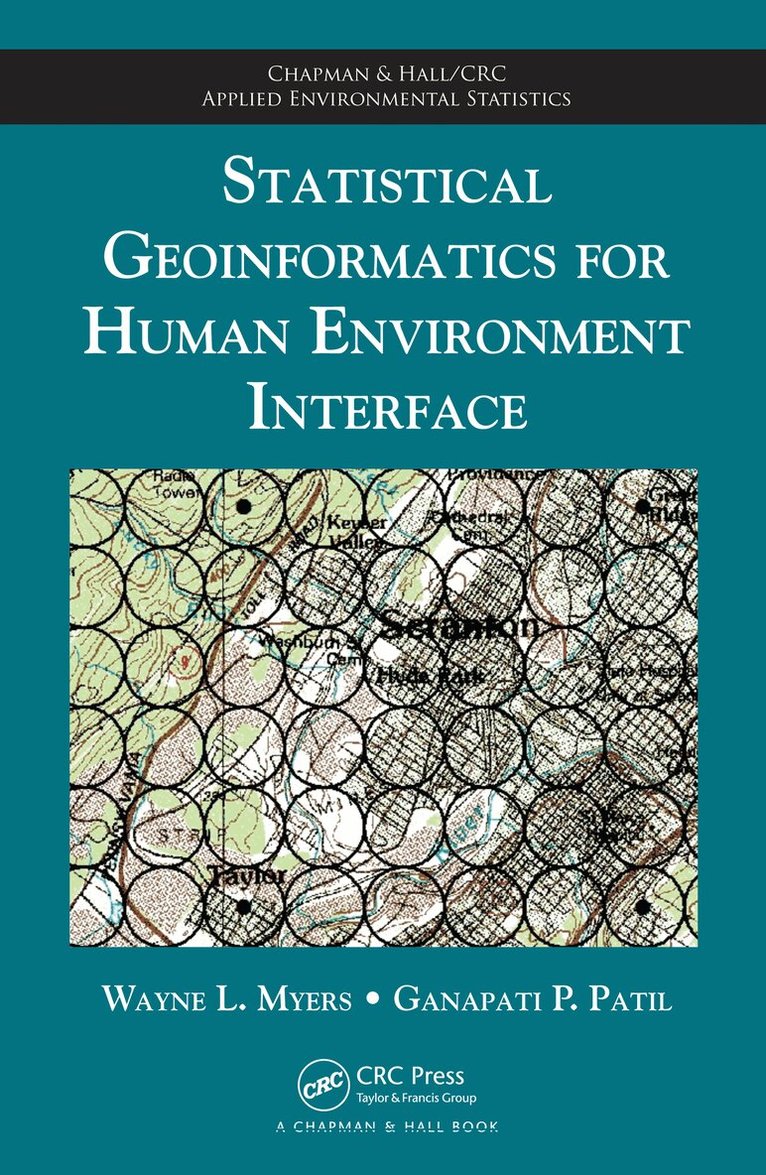
Statistical Geoinformatics for Human Environment Interface presents two paradigms for studying both space and interface with regard to human/environment: localization and multiple indicators. The first approach localizes thematic targets by treating space as a pattern of vicinities, with the pattern being a square grid and the placement of vicinities centrically referenced. The second approach explores human/environment interface as an abstraction through indicators, neutralizing the common conundrum of how to reconcile disparate spatial structures such as points, lines, and polygons. These paired paradigms enable: The capacity to cope with complexity Systematic surveillanceVisualization and communication Preliminary prioritizationCoupling of GIS and statistical softwareAvenues for automationIllustrating the interdisciplinary nature of geoinformatics, this book offers a novel approach to the spatial analysis of human influences and environmental resources. It includes practical strategies for statistical and spatial analysis.
930 kr
Tillfälligt slut
Statistical Geoinformatics for Human Environment Interface presents two paradigms for studying both space and interface with regard to human/environment: localization and multiple indicators. The first approach localizes thematic targets by treating space as a pattern of vicinities, with the pattern being a square grid and the placement of vicinities centrically referenced. The second approach explores human/environment interface as an abstraction through indicators, neutralizing the common conundrum of how to reconcile disparate spatial structures such as points, lines, and polygons. These paired paradigms enable: The capacity to cope with complexity Systematic surveillanceVisualization and communication Preliminary prioritizationCoupling of GIS and statistical softwareAvenues for automationIllustrating the interdisciplinary nature of geoinformatics, this book offers a novel approach to the spatial analysis of human influences and environmental resources. It includes practical strategies for statistical and spatial analysis.
Del 2 - Environmental and Ecological Statistics
Pattern-Based Compression of Multi-Band Image Data for Landscape Analysis
Häftad, Engelska, 2010
1 064 kr
Skickas inom 10-15 vardagar
We offer here a non-conventional approach to muhivariate ima- structured data for which the basis is well tested but the analytical ramifi cations are still unfolding. Although we do not formally pursue them, there are several parallels with the nature of neural networks. We employ a systematic set of statistical heuristics for modeling multivariate image data in a quasi-perceptual manner. When the human eye perceives a scene, the elements of the scene are segregated heuristically into compo nents according to similarity and dissimilarity, and then the relationships among the components are interpreted. Similarly, we segregate or seg ment the scene into hierarchically organized components that are subject to subsequent statistical analysis in many modes for interpretive purposes. We refer to the segregated scene segments as patterns, since they provide a basis for perception of pattern. Since they are also hierarchically organ ized, we refer to them further as polypatterns. This leads us to our acro nym of Progressively Segmented Image Modeling As Poly-Patterns (PSIMAPP). Likewise, we formalize our approach in terms of pattern processes and segmentation sequences. In alignment with the terminology of image analysis, we refer to our multivariate measures as being signal bands.
Del 6 - Environmental and Ecological Statistics
Multivariate Methods of Representing Relations in R for Prioritization Purposes
Selective Scaling, Comparative Clustering, Collective Criteria and Sequenced Sets
Inbunden, Engelska, 2012
1 064 kr
Skickas inom 10-15 vardagar
Innovation requires capacity to operate in ways that are not ordinary, which means that conventional computations and generic graphics will not meet the needs of an adaptive approach. Flexible formulation and special schematics are essential elements that must be manageable and economical.
Del 6 - Environmental and Ecological Statistics
Multivariate Methods of Representing Relations in R for Prioritization Purposes
Selective Scaling, Comparative Clustering, Collective Criteria and Sequenced Sets
Häftad, Engelska, 2014
1 064 kr
Skickas inom 10-15 vardagar
Innovation requires capacity to operate in ways that are not ordinary, which means that conventional computations and generic graphics will not meet the needs of an adaptive approach. Flexible formulation and special schematics are essential elements that must be manageable and economical.