
Weigand Edda Weigand – författare
Visar alla böcker från författaren . Handla med fri frakt och snabb leverans.
8 produkter
8 produkter
E-bok
Engelska, 20181 353 kr
Läs direkt efter köp
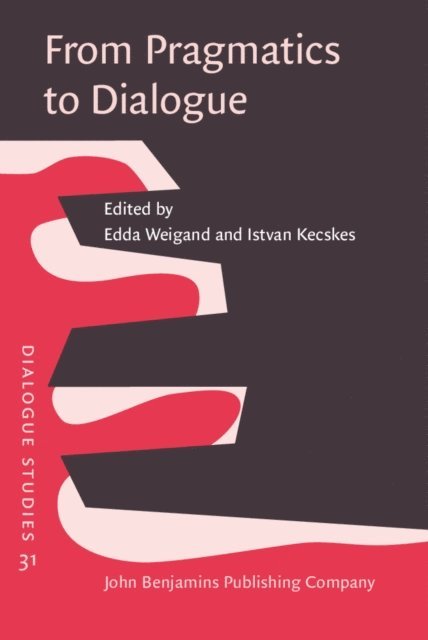
This volume aims at building bridges from pragmatics to dialogue and overcoming the gap between two 'circles' which have cut themselves off from each other in recent decades even if both addressed the same object, 'language use'. Pragmatics means the study of natural language use. There is however no clear answer as to what language use means. We are instead confronted with multiple and diverse models in an uncircumscribed field of language use. When trying to transform such a puzzle of pieces into a meaningful picture we are confronted with the complexity of language use which does not mean 'language' put to 'use' but represents the unity of a complex whole and calls for a total change in methodology towards a holistic theory. Human beings as dialogic individuals use language as dialogue which allows them to tackle the vicissitudes of their lives. Dialogue and its methodology of action and reaction can be traced back to human nature and provides the key to the unstructured field of pragmatics. The contributions to this volume share this common ground and address various perspectives in different types of action game.
E-bok
PDF, Engelska, 19981 495 kr
Läs direkt efter köp
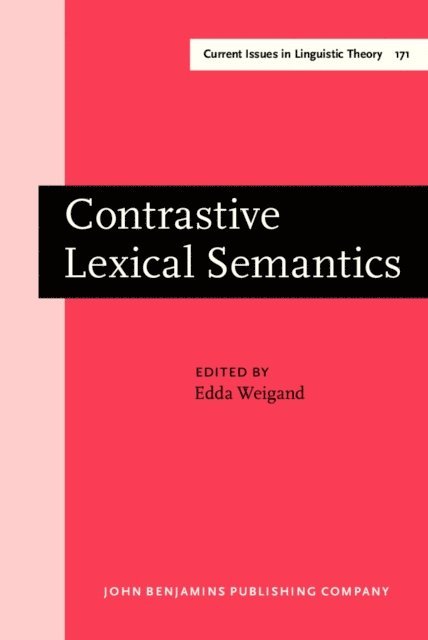
Contrastive lexical semantics was the main topic of an International Workshop at the University of Münster in May, 1997. It was addressed from different perspectives, from the pragmatic perspective of a corpus-oriented approach as well as from the model-oriented perspective of sign theoretic linguistics. Whereas the rule-governed model-oriented approach is necessarily restricted to subsets of vocabulary, the pragmatic approach aims to analyse and describe the whole vocabulary-in-use. After the pragmatic turn, lexical semantics can no longer be seen as a discipline on its own but has to be developed as an integral part of a theory of language use. Essential features of individual languages can be discovered only by looking beyond the limits of our mother languages and including a contrastive perspective. Within a pragmatic, corpus-oriented approach essential new ideas are discussed, mainly the insight that single words can no longer be considered to be the lexical unit. It is the complex multi-word lexical unit a pragmatic approach has to deal with.
E-bok
PDF, Engelska, 201055 kr
Läs direkt efter köp
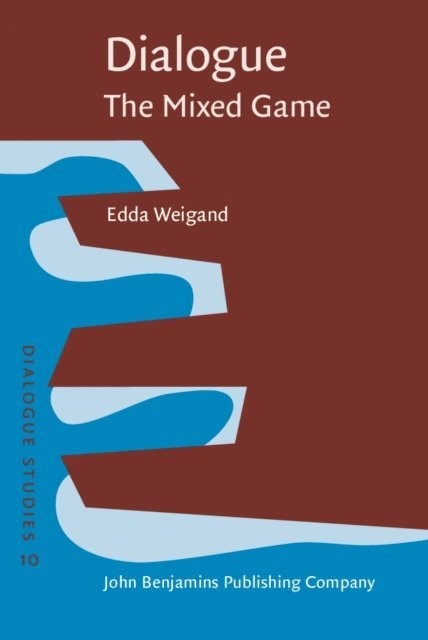
The ‘Mixed Game Model’ represents a holistic theory of dialogue which starts from human beings’ competence-in-performance and describes how language is integrated in a general theory of human action and behaviour. Human beings are able to adapt to changing conditions and to pursue their interests by the integrated use of various communicative means, mainly verbal, perceptual and cognitive. The core unit is the dialogic action game or ‘the mixed game’ with human beings at the centre acting and reacting in cultural surroundings. The key to opening up the complex whole is human beings’ nature. The Mixed Game Model demonstrates how the different disciplines of the natural and social sciences and the humanities are mutually interconnected. After a detailed overview of the state of the art, the fundamentals of the theory are laid down. They include a typology of action games which ranges from minimal games to complex institutional games. The description is illustrated by analyses of authentic games.
E-bok
PDF, Engelska, 20091 353 kr
Läs direkt efter köp
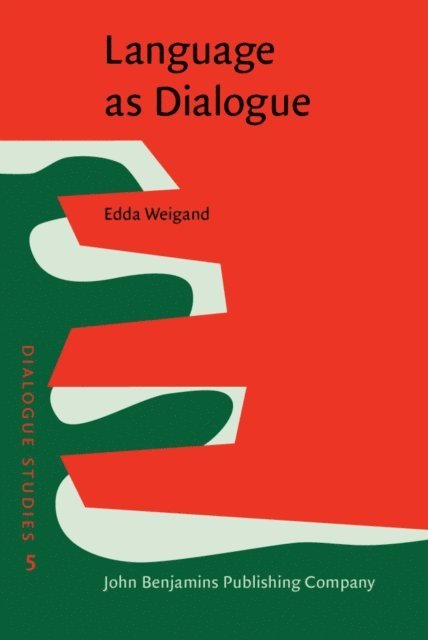
With her theory of ‘Language as Dialogue’, Edda Weigand has opened up a new and promising perspective in linguistic research and its neighbouring disciplines. Her model of ‘competence-in-performance’ solved the problem of how to bridge the gap between competence and performance and thus substantially shaped the way in which people look at language today. This book traces Weigand’s linguistic career from its beginning to today and comprises a selection of articles which take the reader on a vivid and fascinating journey through the most important stages of her theorizing. The initial stage when a model of communicative competence was developed is followed by a gradual transition period which finally resulted in the theory of the dialogic action game as a mixed game or the Mixed Game Model. The articles cover a wide range of linguistic topics including, among others, speech act theory, lexical semantics, utterance grammar, emotions, the media, rhetoric and institutional communication. Editorial introductions give further information on the origin and theoretical background of the articles included.
E-bok
PDF, Engelska, 20081 434 kr
Läs direkt efter köp
The volume deals with the relationship between dialogue and rhetoric. The actual state of the art in dialogue analysis is characterized by a tendency to overcome the distinction between competence and performance and to combine components from both sides of the dichotomy, in a way which includes rules as well as inferences. The same is true of rhetoric: the guidelines proposed here no longer state that rationality and persuasion are mutually exclusive but suggest that they interact in what might be called the ‘mixed game’. The concept of a dialogic rhetoric thus poses the question of how to integrate the different voices. Part I of the volume assembles several ‘rhetorical paradigms’ which are applied to real-life performance. Part II on ‘rhetoric in the mixed game’ contains a selection of papers which illustrate the interaction of various components. The Round Table discussion in Part III brings proponents of different paradigms face to face with each other and shows how they justify their own positions and present arguments against rival paradigms.
E-bok
PDF, Engelska, 20071 430 kr
Läs direkt efter köp
The volume deals with the relationship between language, dialogue, human nature and culture by focusing on an approach that considers culture to be a crucial component of dialogic interaction. Part I refers to the so-called ‘language instinct debate’ between nativists and empiricists and introduces a mediating position that regards language and dialogue as determined by both human nature and culture. This sets the framework for the contributions of Part II which propose varying theoretical positions on how to address the ways in which culture influences dialogue. Part III presents more empirically oriented studies which demonstrate the interaction of components in the ‘mixed game’ and focus, in particular, on specific action games, politeness and selected verbal means of communication.
E-bok
PDF, Engelska, 20041 384 kr
Läs direkt efter köp
This volume contains a selection of papers given at the European Science Foundation Exploratory Workshop on ‘Emotion in Dialogic Interaction’ at the University of Münster in October 2002. In the literature, the complex network of ‘emotion in dialogic interaction’ is mostly addressed by reducing the complex and separating emotions or defining them by means of simple artificial units. The innovative claim of the workshop was to analyse emotion as an integrated component of human behaviour in dialogic interaction as demonstrated by recent findings in neurology and to develop a linguistic model which is able to deal with the complex integrated whole. Specific emphasis was laid on communicative means for expressing emotions and on emotional principles in dialogue. Furthermore, the issue of specific European principles for dealing with emotions was highlighted.
E-bok
PDF, Engelska, 20011 646 kr
Läs direkt efter köp
The topic of negotiation has turned out to be of crucial interdisciplinary interest for our understanding of what we are doing in language use. Are we exchanging meanings defined in advance and presupposing equal understanding on the basis of a rule-governed system, or are we negotiating meaning and understanding in the framework of an open dialogic universe? Negotiation, on the one hand, can be taken as the name of a specific dialogue type or action game of bargaining. On the other hand, it represents a methodological concept for describing and explaining dialogic interaction which replaces the orthodox view of pattern transference. The papers collected in this volume deal with both versions of the concept of negotiation. This volume contains a selection of papers presented at the International Conference on Pragmatics and Negotiation at Tel Aviv University and the Hebrew University of Jerusalem in June, 1999. The dialogic aspect was taken as the key concept to guide the present selection.