Weizman Elda Weizman – författare
Visar alla böcker från författaren Weizman Elda Weizman. Handla med fri frakt och snabb leverans.
4 produkter
4 produkter
E-bok
Engelska, 20191 258 kr
Läs direkt efter köp
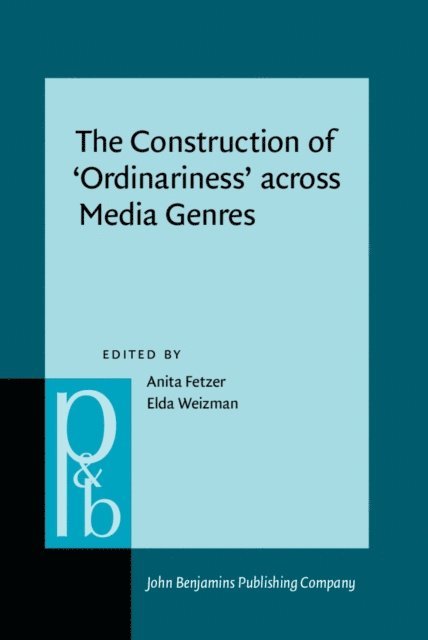
Departing from the premise that 'being ordinary' is brought into the discourse and brought out in the discourse and is thus an interactional achievement, the contributions to this edited volume investigate its construction, reconstruction and deconstruction in media discourse. Ordinariness is perceived as a scalar notion which is conceptualised against the background of both non-ordinariness and extra-ordinariness. The chapters address its strategic construction across media genres (public talk, Prime Minister's Questions, interview, radio call-in, commenting) and discursive activities (tweets, social media posts) as done in various languages (American English, Austrian German, British English, Chinese, French, Finnish, Hebrew and Japanese) by professional participants (e.g., politicians, journalists, scientists) and by ordinary people participating in media discourse (e.g., ordinary citizens, viewers, members of the audience). Discursive strategies used to bring about (non/extra) ordinariness include small stories, quotations, conversational style, irony, naming and addressing as well as references to the private-public interface.
E-bok
PDF, Engelska, 20151 266 kr
Läs direkt efter köp
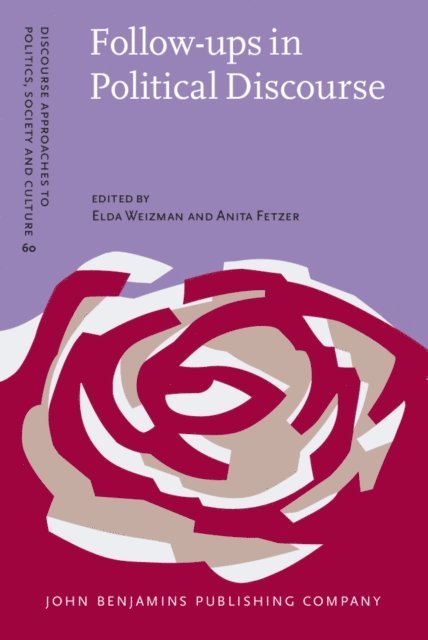
Rethinking Sinclair and Coulthard’s sequentiality-based notion of the follow-up, this volume explores its forms and communicative functions in traditional and contemporary modes of communication (parliamentary sessions, interviews, debates, speeches, op-eds, discussion forums and Twitter) wherein political actors address challenges to their political agenda and to their political face. In so doing, the volume achieves two major advances. First, its contributions expand the understanding of follow-ups beyond the traditional focus on structural sequentiality, considering communicative function as a defining feature of a follow-up. Second, it broadens the understanding of what constitutes political discourse, as not being limited to a single discourse, but also being able to span multiple discourses of different forms and speech events over time.
E-bok
PDF, Engelska, 20151 314 kr
Läs direkt efter köp
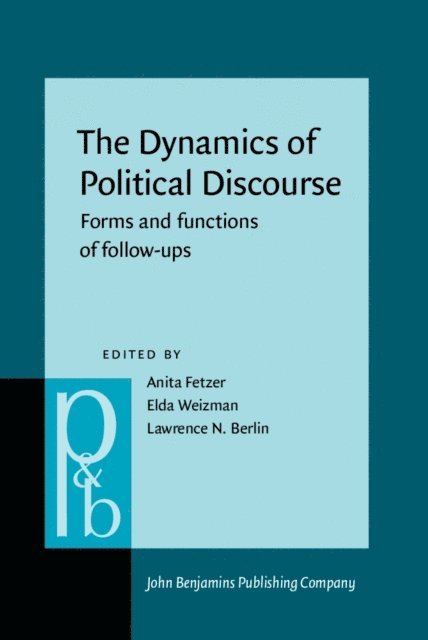
This book explores the various forms and functions of follow-ups in a range of political speech events. Follow-ups are conceptualized as communicative acts, in and through which a prior communicative act is accepted, challenged, or otherwise negotiated by ratified participants in the exchange or by third parties. The broad view suggested here accommodates a large variation in the functions of follow-ups, e.g. positioning, third-party involvement, evaluation and argumentation, ratification, support, challenge and attendance to face wants. These variations are explored in a range of cultural environments, such as the UK, The Netherlands, Israel and France. Inter-cultural exchanges are studied through the analysis of diplomatic discourse, interpreting and cross-cultural comparison.
E-bok
PDF, Engelska, 20081 314 kr
Läs direkt efter köp
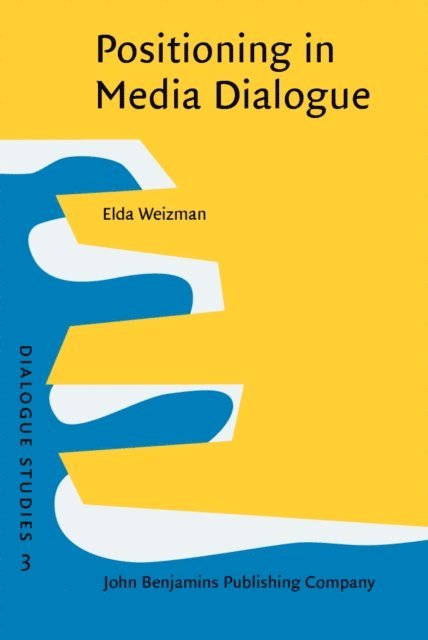
This book proposes a socio-pragmatic exploration of the discursive practices used to construe and dynamically negotiate positions in news interviews. It starts with a discursive interpretation of ‘positioning’, ‘role’ and ‘challenge’, puts forward the relevance of a distinction between social and interactional roles, demonstrates how challenges bring to the fore the relevant roles and role-components of the participants, and shows that in news interviews speakers constantly position and re-position themselves and each other through discourse.The discussion draws on an empirical fine-grained analysis of a 24-hour corpus of news interviews on Israeli television and a corpus of media references. The author postulates a discrepancy between interlocutors’ normative expectations, which presuppose an asymmetrical division of labor, on the one hand, and real-life practice, which exhibits partial symmetry in speakers’ selection of discourse patterns as well as reciprocity in the use of challenge strategies, on the other. Special attention is given to irony and terms of address, which are shown to act as the center-points of satellite challenge strategies, geared as an ensemble toward the co-construction of reciprocal positioning. The analysis of three case studies further sheds light on the negotiations of intertwined positionings in context.