Wesley C. Salmon - Böcker
Visar alla böcker från författaren Wesley C. Salmon. Handla med fri frakt och snabb leverans.
9 produkter
9 produkter
1 078 kr
Skickas inom 5-8 vardagar
Wesley Salmon is renowned for his scholarly contributions to the philosophy of science. This unique volume brings together twenty-six of his essays on subjects related to causality and explanation, written over the period 1971-1995. Six of the essays have never been published before and many others have only appeared in obscure venues. It includes a section of introductory pieces, as well as more advanced and technical pieces.
1 888 kr
Skickas inom 5-8 vardagar
This volume of articles (most published, some new) is a follow-up to the late Wesley C. Salmon's widely read collection Causality And Explanation (OUP 1998). It contains both published and unpublished articles, and focuses on two related areas of inquiry: First, is science a rational enterprise? Secondly, does science yield objective information about our world, even the aspects that we cannot observe directly? Salmon's own take is that objective knowledge of the world is possible, and his work in these articles centers around proving that this can be so. Salmon's influential standing in the field ensures that this volume will be of interest to both undergraduates and professional philosophers, primarily in the philosophy of science.
719 kr
Skickas inom 5-8 vardagar
This volume of articles (most published, some new) is a follow-up to the late Wesley C. Salmon's widely read collection Causality And Explanation (OUP 1998). It contains both published and unpublished articles, and focuses on two related areas of inquiry: First, is science a rational enterprise? Secondly, does science yield objective information about our world, even the aspects that we cannot observe directly? Salmon's own take is that objective knowledge of the world is possible, and his work in these articles centers around proving that this can be so. Salmon's influential standing in the field ensures that this volume will be of interest to both undergraduates and professional philosophers, primarily in the philosophy of science.
282 kr
Skickas inom 7-10 vardagar
The philosophical theory of scientific explanation proposed here involves a radically new treatment of causality that accords with the pervasively statistical character of contemporary science. Wesley C. Salmon describes three fundamental conceptions of scientific explanation--the epistemic, modal, and ontic. He argues that the prevailing view (a version of the epistemic conception) is untenable and that the modal conception is scientifically out-dated. Significantly revising aspects of his earlier work, he defends a causal/mechanical theory that is a version of the ontic conception. Professor Salmon's theory furnishes a robust argument for scientific realism akin to the argument that convinced twentieth-century physical scientists of the existence of atoms and molecules. To do justice to such notions as irreducibly statistical laws and statistical explanation, he offers a novel account of physical randomness. The transition from the "reviewed view" of scientific explanation (that explanations are arguments) to the causal/mechanical model requires fundamental rethinking of basic explanatory concepts.
621 kr
Skickas inom 10-15 vardagar
Scientific Explanation was first published in 1962. Minnesota Archive Editions uses digital technology to make long-unavailable books once again accessible, and are published unaltered from the original University of Minnesota Press editions.Is a new consensus emerging in the philosophy of science? The nine distinguished contributors to this volume apply that question to the realm of scientific explanation and, although their conclusions vary, they agree in one respect: there definitely was an old consensus.Co-editor Wesley Salmon's opening essay, "Four Decades of Scientific Explanation," grounds the entire discussion. His point of departure is the founding document of the old consensus: a 1948 paper by Carl G. Hempel and Paul Oppenheim, "Studies in the Logic of Explanation," that set forth, with remarkable clarity, a mode of argument that came to be known as the deductive-nomological model. This approach, holding that explanation dies not move beyond the sphere of empirical knowledge, remained dominant during the hegemony of logical empiricism from 1950 to 1975. Salmon traces in detail the rise and breakup of the old consensus, and examines the degree to which there is, if not a new consensus, at least a kind of reconciliation on this issue among contemporary philosophers of science and clear agreement that science can indeed tell us why.The other contributors, in the order of their presentations, are: Peter Railton, Matti Sintonen, Paul W. Humphreys, David Papineau, Nancy Cartwright, James Woodward, Merrilee H. Salmon, and Philip Kitcher.
644 kr
Skickas inom 7-10 vardagar
As Aristotle stated, scientific explanation is based on deductive argument--yet, Wesley C. Salmon points out, not all deductive arguments are qualified explanations. The validity of the explanation must itself be examined. Four Decades of Scientific Explanation provides a comprehensive account of the developments in scientific explanation that transpired in the last four decades of the twentieth century. It continues to stand as the most comprehensive treatment of the writings on the subject during these years.Building on the historic 1948 essay by Carl G. Hempel and Paul Oppenheim, \u0022Studies in the Logic of Explanation,\u201d which introduced the deductive-nomological (D-N) model on which most work on scientific explanation was based for the following four decades, Salmon goes beyond this model's inherent basis of describing empirical knowledge to tells us \u201cnot only what, but also why.\u201d Salmon examines the predominant models in chronological order and describes their development, refinement, and criticism or rejection.Four Decades of Scientific Explanation underscores the need for a consensus of approach and ongoing evaluations of methodology in scientific explanation, with the goal of providing a better understanding of natural phenomena.
757 kr
Skickas inom 7-10 vardagar
Logical empiricism, a program for the study of science that attempted to provide logical analyses of the nature of scientific concepts, the relation between evidence and theory, and the nature of scientific explanation, formed among the famed Vienna and Berlin Circles of the 1920s and '30s and dominated the philosophy of science throughout much of the twentieth century. In recent decades, a "post-positivist" philosophy, deriding empiricism and its claims in light of more recent historical and sociological discoveries, has been the ascendant mode of philosophy and other disciplines in the arts and sciences.This book features original research that challenges such broad oppositions. In eleven essays, leading scholars from many nations construct a more nuanced understanding of logical empiricism, its history, and development, offering promising implications for current philosophy of science debates.Tapping rich resources of unpublished material from archives in Haarlem, Konstanz, Pittsburgh, and Vienna, contributors conduct a deep investigation into the origins and development of the Vienna and Berlin Circles. They expose the roots of the philosophy in such varied sources as Cassirer, Poincaire, Husserl, Heidegger, and Wittgenstein. Important connections between the empiricists and other movements--neo-empiricism, British empiricism--are vigorously explored.Building on these historical studies, a critical reevaluation emerges that shrinks the distance between old and new philosophers of science, between "analytic" and "Continental" philosophy. A number of compelling recent debates, including those involving Kuhn, Feyerabend, Hesse, Glymour, and Hanson, are reopened to show the ways in which logical empiricist theory can still be validly applied.Logical Empiricism is the result of a remarkable conference, convened in the spirit of reflection and international cooperation, that took place in Florence, Italy, in 1999.
644 kr
Skickas inom 7-10 vardagar
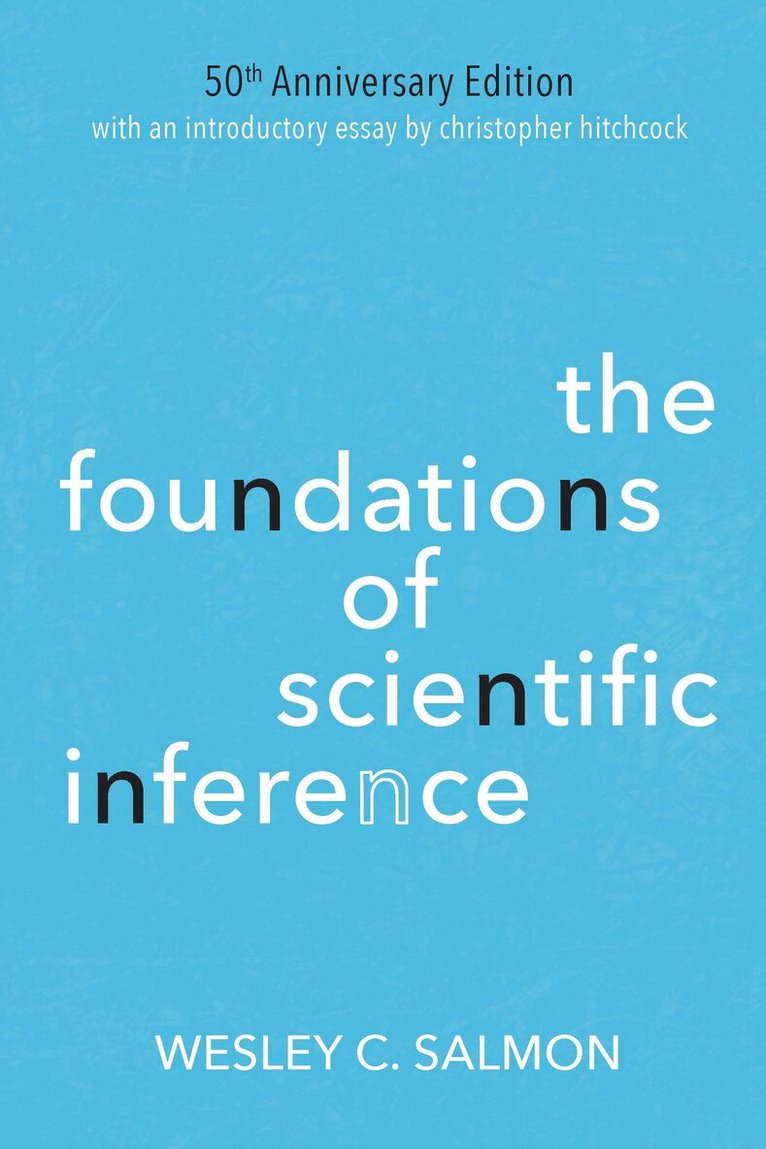
After its publication in 1967, The Foundations of Scientific Inference taught a generation of students and researchers about the problem of induction, the interpretation of probability, and confirmation theory. Fifty years later, Wesley C. Salmon’s book remains one of the clearest introductions to these fundamental problems in the philosophy of science. This anniversary edition of Salmon’s foundational work features a detailed introduction by Christopher Hitchcock, which examines the book’s origins, influences, and major themes, its impact and enduring effects, the disputes it raised, and its place in current studies, revisiting Salmon’s ideas for a new audience of philosophers, historians, scientists, and students.
586 kr
Skickas inom 11-20 vardagar
A reprint of the Bobbs-Merrill edition of 1970.These essays lead the reader through the land of the wonderful shrinking genie to the warehouse where the infinity machines are kept. By careful examination of a lamp that is switched on and off infinitely many times, or the workings of a machine that prints out an infinite decimal expansion of pi, we begin to understand how it is possible for Achilles to overtake the tortoise. The concepts that form the basis of modern science—-space, time, motion, change, infinity-—are examined and explored in this edition. Includes an updated bibliography.