W.G. Knauss – författare
Visar alla böcker från författaren W.G. Knauss. Handla med fri frakt och snabb leverans.
6 produkter
6 produkter
2 117 kr
Skickas inom 10-15 vardagar
From time to time the International Journal of Fracture has presented special matters thought to be of interest to its readers. In previous issues, for example, Dr. H.W. Liu as Guest Editor assembled a series of review papers dealing with fatigue processes and characteristics in metals and non-metals (December 1980 and April 1981). Five years ago Guest Editor W.G. Knauss collected works dealing with dynamic fracture (March and April 1985). Continuing this policy, Dr. W.G. Knauss and Dr. A.J. Rosakis of the California Institute of Technology as Guest Editors have now organized an extensive set of papers concerning the influence of non-linear effects upon the mechanics of the fracture process. This collection is based upon contributions to a relatively small international Symposium on Non Linear Fracture Mechanics held under the auspices of the International Union of Theoretical and Applied Mechanics (IUTAM) and convened at the California Institute of Technology in March 1988. It should be noted that although the description of non-linear fracture inherently encompasses a strong material science component, this aspect is not heavily emphasized in the ensuing papers due to the intentional focus upon mechanics. Volume 42 of the International Journal of Fracture will therefore, in successive issues, deal respectively with topics in (1) Damage, (2) Interfaces and Creep, (3) Time Dependence, and (4) Continuum Plasticity. On behalf of the editors and publishers, I wish to express our appreciation to Dr. Knauss, Dr. Rosakis, and their colleagues for their collective efforts.
1 589 kr
Skickas inom 10-15 vardagar
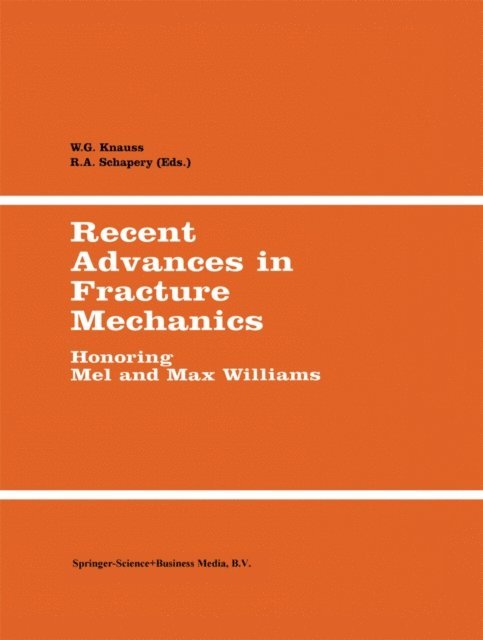
This volume represents a cross-section of the field of fracture mechanics, a testimony to the breadth of interest that Mel and Max Williams' friends share with them. Several are expanded versions of papers that were given in special sessions honoring them at the 1997 Ninth International Conference on Fracture Mechanics in Sydney, Australia. The subjects treated in this volume can be classified as follows: dynamic fracture problems as viewed primarily from a classical continuum point of view; analysis of relatively general crack geometrics; fracture problems of polymers and other relatively ductile materials; scaling rules that allow extension of results obtained at one size to be translated into behavior at different size scales; problems dealing with interactions that produce complex stress fields; fracture problems directly appropriate to composite materials; analysis of stress concentrations in anisotropic, elastic solids; and the problem of cracks in thin plates bending. This volume will be of interest to engineers and scientists working on all aspects of the physics and mechanics of fracture.
2 117 kr
Skickas inom 10-15 vardagar
From time to time the International Journal of Fracture has presented matters thought to be of special interest to its readers. In previous special issues (December 1980 and April 1981), Dr H.W. Liu as Guest Editor presented a series of review papers dealing with fatigue processes and characteristics in metals and non-metals. Continuing this policy, which is consistent with our stated objectives, a second review dealing with time depen dence in the fracture process, including the effect of material inertia but essentially excluding very strong shock effects in solids, has been assembled under the generic term "dynamic fracture". We hope that the ensuing state-of-the-art review will yield an instructive and timely product which readers will find useful. To assist us in presenting this subject, we have prevailed upon a well-known worker in dynamic fracture, Dr W.G. Knauss, Professor of Aeronautics and Applied Mechanics, California Institute of Technology to act as Guest Editor for this special double issue. On behalf of the editors and publisher, I wish to express our indebtedness to Professor Knauss and his invited authors for undertaking this special effort.
2 117 kr
Skickas inom 10-15 vardagar
From time to time the International Journal of Fracture has presented special matters thought to be of interest to its readers. In previous issues, for example, Dr. H.W. Liu as Guest Editor assembled a series of review papers dealing with fatigue processes and characteristics in metals and non-metals (December 1980 and April 1981). Five years ago Guest Editor W.G. Knauss collected works dealing with dynamic fracture (March and April 1985). Continuing this policy, Dr. W.G. Knauss and Dr. A.J. Rosakis of the California Institute of Technology as Guest Editors have now organized an extensive set of papers concerning the influence of non-linear effects upon the mechanics of the fracture process. This collection is based upon contributions to a relatively small international Symposium on Non Linear Fracture Mechanics held under the auspices of the International Union of Theoretical and Applied Mechanics (IUTAM) and convened at the California Institute of Technology in March 1988. It should be noted that although the description of non-linear fracture inherently encompasses a strong material science component, this aspect is not heavily emphasized in the ensuing papers due to the intentional focus upon mechanics. Volume 42 of the International Journal of Fracture will therefore, in successive issues, deal respectively with topics in (1) Damage, (2) Interfaces and Creep, (3) Time Dependence, and (4) Continuum Plasticity. On behalf of the editors and publishers, I wish to express our appreciation to Dr. Knauss, Dr. Rosakis, and their colleagues for their collective efforts.
1 589 kr
Skickas inom 10-15 vardagar
The papers in this volume represent a considerable cross-section of the field of fracture mechanics, a testimony to the breadth of interest that Mel and Max Williams' friends share with them. Several are expanded versions of papers that were given in special sessions honoring them at the 1997 Ninth International Conference on Fracture Mechanics in Sydney, Australia. The subjects treated in this volume can be classified as follows: dynamic fracture problems as viewed primarily from a classical continuum point of view; analysis of relatively general crack geometrics; fracture problems of polymers and other relatively ductile materials; scaling rules that allow extension of results obtained at one size to be translated into behavior at different size scales; problems dealing with interactions that produce complex stress fields; fracture problems directly appropriate to composite materials; analysis of stress concentrations in anisotropic, elastic solids; and the problem of cracks in thin plates bending. This volume will be of interest to engineers and scientists working on all aspects of the physics and mechanics of fracture.
2 117 kr
Skickas inom 10-15 vardagar
From time to time the International Journal of Fracture has presented matters thought to be of special interest to its readers. In previous special issues (December 1980 and April 1981), Dr H.W. Liu as Guest Editor presented a series of review papers dealing with fatigue processes and characteristics in metals and non-metals. Continuing this policy, which is consistent with our stated objectives, a second review dealing with time depen dence in the fracture process, including the effect of material inertia but essentially excluding very strong shock effects in solids, has been assembled under the generic term "dynamic fracture". We hope that the ensuing state-of-the-art review will yield an instructive and timely product which readers will find useful. To assist us in presenting this subject, we have prevailed upon a well-known worker in dynamic fracture, Dr W.G. Knauss, Professor of Aeronautics and Applied Mechanics, California Institute of Technology to act as Guest Editor for this special double issue. On behalf of the editors and publisher, I wish to express our indebtedness to Professor Knauss and his invited authors for undertaking this special effort.