Will D Campbell – författare
Visar alla böcker från författaren . Handla med fri frakt och snabb leverans.
20 produkter
20 produkter
Häftad, Engelska, 1999
198 kr
Skickas inom 5-8 vardagar
Häftad, Engelska, 2024
243 kr
Skickas inom 5-8 vardagar
Inbunden, Engelska, 2021
451 kr
Skickas inom 3-6 vardagar
Häftad, Engelska, 2021
295 kr
Skickas inom 3-6 vardagar
Häftad, Engelska, 2018
269 kr
Skickas inom 10-15 vardagar
In Forty Acres and a Goat, Will D. Campbell picks up where the award-winning Brother to a Dragonfly leaves off, accounting his adventures during the tumultuous civil rights era. As he navigates through the explosive 1960s, including pivotal moments like the integration of Little Rock High School and the assassination of Dr. Martin Luther King Jr., Brother Will finds his faith challenged. To further complicate matters, a series of jobs did not pan out as expected--pastorate in Louisiana, director of religious life at the University of Mississippi, and with the National Council of Churches--leaving Brother Will ""with a call but no steeple."" In an effort to find his place as a preacher, he moves his family to a farm in rural Tennessee and fashions his own unique style of ministry and a maverick relationship with God, land, and all his fellow pilgrims.
Häftad, Engelska, 2018
269 kr
Skickas inom 10-15 vardagar
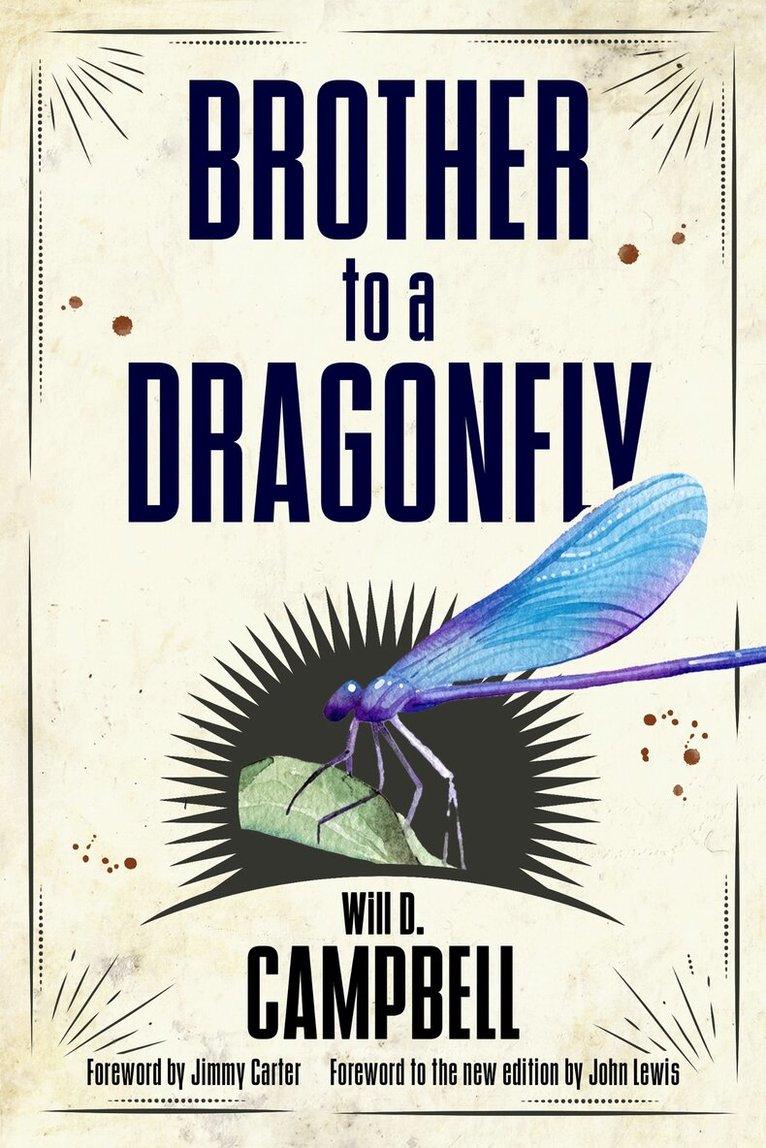
In Brother to a Dragonfly, Will D. Campbell writes about his life growing up poor in Amite County, Mississippi, during the 1930s alongside his older brother, Joe. Though they grew up in a close-knit family and cared for each other, the two went on to lead very different lives. After serving together in World War II, Will became a highly educated Baptist minister who later became a major figure in the early years of the civil rights movement, and Joe became a pharmacist who developed a substance abuse problem that ultimately took his life.Brother to a Dragonfly also serves as a historical record. Though Will's love and dedication to his brother are the primary story, interwoven throughout the narrative is the story of the Jim Crow South and the civil rights movement. Will is present through many of the most pivotal moments in history--he was one of four people who escorted black students integrating the Little Rock public schools; he was the only white person present at the founding of the SCLC; he helped CORE and SNCC Freedom Riders integrate interstate bus travel; he joined Dr. Martin Luther King Jr.'s campaign of boycotts, sit-ins, and marches in Birmingham; and he was at the Lorraine Motel the night Dr. King was assassinated.Will's accomplishments, however, never take the spotlight from his brother, and as his relationship with Joe evolves, so does Will's faith. Featuring a new foreword by Congressman John Lewis, this book brings back to print the combined lives of Will Campbell--Will the brother and Will the preacher.
Inbunden, Engelska, 2010
466 kr
Skickas inom 5-8 vardagar
Inbunden, Engelska, 2010
466 kr
Skickas inom 5-8 vardagar
Inbunden, Engelska, 2012
591 kr
Skickas inom 5-8 vardagar
Häftad, Engelska, 2005
258 kr
Skickas inom 5-8 vardagar
Häftad, Engelska, 2004
308 kr
Skickas inom 5-8 vardagar
Häftad, Engelska, 2004
240 kr
Skickas inom 5-8 vardagar
Häftad, Engelska, 2010
297 kr
Skickas inom 5-8 vardagar
Häftad, Engelska, 2010
308 kr
Skickas inom 5-8 vardagar
Häftad, Engelska, 2012
352 kr
Skickas inom 5-8 vardagar
E-bok
Engelska, 2010518 kr
Läs direkt efter köp
If prophets are called to unveil and expose the illegitimacy of those principalities masquerading as the right and purportedly using their powers for the good, then Will D. Campbell is one of the foremost prophets in American religious history. Like Clarence Jordan and Dorothy Day, Campbell incarnates the radical iconoclastic vocation of standing in contraposition to society, naming and smashing the racial, economic, and political idols that seduce and delude.Despite an action-packed life, Campbell is no activist seeking to control events and guarantee history''s right outcomes. Rather, Campbell has committed his life to the proposition that Christ has already set things right. Irrespective of who one is, or what one has done, each human being is reconciled to God and one another, now and forever. History''s most scandalous message is, therefore, Be reconciled! because once that imperative is taken seriously, social constructs like race, ethnicity, gender, and nationality are at best irrelevant and at worst idolatrous.Proclaiming that far too many disciples miss the genius of Christianity''s good news (the kerygma) of reconciliation, this Ivy League-educated preacher boldly and joyfully affirms society''s so-called least one, cultivating community with everyone from civil rights leaders and Ku Klux Klan militants, to the American literati and exiled convicts. Except for maybe the self-righteous, none is excluded from the beloved community.For the first time in nearly fifty years, Campbell''s provocative Race and Renewal of the Church is here made available. Gayraud Wilmore called Campbell''s foundational work an unsettling reading experience, but one that articulates an unwavering confidence in the victory which God can bring out of the weakness of the church.
E-bok
Engelska, 2012606 kr
Läs direkt efter köp
In 1972, Will Campbell published an issue of the Committee of Southern Churchmen''s journal, Katallagete, to shed light on the US prison system. None could anticipate how the system would expand exponentially in the next four decades. Today, the US operates the world''s largest prison system, incarcerating nearly 1 in every 100 American adults. How did this expansion happen? What is the human toll of this retributive system? How might ambassadors of reconciliation respond to such a punitive institution? Replicating the firsthand nature of Will Campbell''s original Katallagete collection, twenty new essays pull back the veil on today''s prison-industrial complex. The plea throughout this collection is not for some better, more progressive institution to exact justice. Rather, the invitation is to hear from voices of experience how the system functions, listen to what the institution does to those locked in its cells, consider what an execution involves, and, most importantly, contemplate the scandalous call to be in reconciled community with those whom society discards and the system silences. Our story is that there are neither good nor bad people, neither felon nor free world. We are all one.
E-bok
Engelska, 2010505 kr
Läs direkt efter köp
If prophets are called to unveil and expose the illegitimacy of those principalities masquerading as the right and purportedly using their powers for the good, then Will D. Campbell is one of the foremost prophets in American religious history. Like Clarence Jordan and Dorothy Day, Campbell incarnates the radical iconoclastic vocation of standing in contraposition to society, naming and smashing the racial, economic, and political idols that seduce and delude.In this anthology Campbell diagnoses a problem afflicting much of the church today. Zealous to make a difference in the world by acquiring the power of legislation and enforcement, Christians employ society''s political science rather than the scandalous politics of Jesus. Although well-intentioned, Christians are, Campbell laments, mistakenly up to our steeples in politics. Campbell''s prescription is for disciples simply to incarnate the reconciliation that Christ has achieved. Rather than crafting savvy strategies and public policies, Do nothing, Campbell counsels. Be reconciled!Yet his encouragement to do nothing is no endorsement of passivity or apolitical withdrawal. Rather, Campbell calls for disciples to give their lives in irrepressible resistance against all principalities and powers that would impede or deny our reconciliation in Christ--an unrelenting prophetic challenge leveled especially at institutional churches, as well as Christian colleges and universities.In sermons, difficult-to-access journal articles, and archival manuscripts, Campbell then develops what reconciliation looks like. Being the church, for example, means identifying with, and advocating for, society''s least one-including violent offenders, disenfranchised minorities, and even militant bigots. In fact, in Campbell''s ordo the scorned sectarian and disinherited denizen is often closer to the peculiar Christian genius than are society''s well-healed powerbrokers.Disciples seeking to discern their calling can hardly do better than taking direction from this bootleg, pulpitless preacher.
E-bok
PDF, Engelska, 2004353 kr
Läs direkt efter köp
In this book we are trying to confess that the goals of the contemporary Church - that is to say, the church of St. John's by the Gas Station, the Christian college, the denominational and interdenominational seminary - the 'goals' of these Christian communities are blasphemous. The reconciliation the Church is seeking to accomplish today by these subterfuges has already been wrought. The brotherhood - the one blood of Acts 17, 26 - that the Church makes its goal today is already a 'fact'. And because this is so, that very fact judges our goals and our efforts to achieve brotherhood by social action as blasphemous, as trying to 'be' God. Instead of witnessing to Christ, the social action of the Church lends support to the totalitarianism of wars and political systems of the 20th century. By its social action, the Church permits and encourages the State and culture to define all issues and rules and fields of battle. The Church then tries to do what the State, without the Church's support, had already decided to do to solve all human problems by politics. And this is specifically the political messianism of contemporary totalitarianism and of Revelation 13. Politics by definition can only adjust and rearrange. It cannot - as politics - solve anything. But the Church's social action encourages the very movements in the contemporary political processes which are moving us straightaway into 20th-century totalitarianism. from the Foreword
E-bok
PDF, Engelska, 2004488 kr
Läs direkt efter köp
Contributors: Beverly A. Asbury, Ann Beard, James Branscome, Will D. Campbell, Duncan Gray, Jr., John Howard Griffin, Fannie Lou Hamer, Vincent Harding, James Y. Holloway, Loyal Jones, Thomas Merton, Walker Percy, William P. Randall, Pete Young.