William G Shepherd – författare
Visar alla böcker från författaren William G Shepherd. Handla med fri frakt och snabb leverans.
5 produkter
5 produkter
Inbunden, Engelska, 2026
373 kr
Skickas inom 5-8 vardagar
Häftad, Engelska, 2026
214 kr
Skickas inom 5-8 vardagar
Inbunden, Engelska, 2007
2 522 kr
Skickas inom 5-8 vardagar
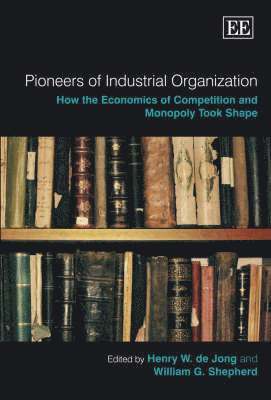
This encyclopaedic work celebrates the scores of leading pioneers who created the modern economic field of industrial organization, at the heart of which lie competition and monopoly, the two great forces that drive modern markets. Their pioneering work has shaped the field's growing research as well as the past, present and future debates in Europe and America over several centuries. This landmark book includes authoritative entries on all the major figures in both Europe and North America.Pioneers of Industrial Organization also reveals how public policies such as antitrust and regulation - and deregulation since the 1970s - can promote, or impede economic results and progress. Readers will find the intellectual pioneers, the theories and policies, and the debates, in all their variety herein. Some pioneers have been free-market advocates, others have been more protective of popular values, but all have strained to make the economic engine promote more wealth, progress and fairness. This book presents the people, ideas and debates with careful neutrality, and also with clear, concise writing.For all those interested in modern economic progress and its problems, this book provides deep insight as well as great personal colour. It will be an essential source of reference for students, researchers and professors of economics, as well as those concerned with the historical foundations or the conceptual and thematic developments in industrial organization.
E-bok
PDF, Engelska, 20131 408 kr
Läs direkt efter köp
The present two volumes contain the essays and part of the discussions as presented at the conference on Mainstreams in Industrial Organiza tion, held at the University of Amsterdam, 21-23 August 1985. The thema was chosen because the field of studies commonly designated "industrial organization" in the Anglo-Saxon countries, or "market theory" in Continental Europe, has experienced important alterations during the past decade. Partly this reflects changing theoretical views inside the field, in which shifts in the core concepts have occurred and different emphasis is laid on time-honoured views and results. Partly, critical views have been voiced from outside the field. As in all open scientific debate, they have to be weighed and, if necessary, taken into account. Partly also, diver gent developments in thinking between the Anglo-Saxon, European and Japanese areas need to be considered, because both the problems and the ways of approaching them still differ. The variety of views, theori~s and results is testimony to the vitality of this field of economics; variety is generated by the creative endeavours, from which the chaff is being beaten out by critical discussions. That is especially true for the concept of competition itself, which industrial organization economists are debating intensively.
Del 6 - Studies in Industrial Organization
Mainstreams in Industrial Organization
Book I. Theory and International Aspects. Book II. Policies: Antitrust, Deregulation and Industrial
2014
1 324 kr
Skickas inom 10-15 vardagar
The present two volumes contain the essays and part of the discussions as presented at the conference on Mainstreams in Industrial Organiza tion, held at the University of Amsterdam, 21-23 August 1985. The thema was chosen because the field of studies commonly designated "industrial organization" in the Anglo-Saxon countries, or "market theory" in Continental Europe, has experienced important alterations during the past decade. Partly this reflects changing theoretical views inside the field, in which shifts in the core concepts have occurred and different emphasis is laid on time-honoured views and results. Partly, critical views have been voiced from outside the field. As in all open scientific debate, they have to be weighed and, if necessary, taken into account. Partly also, diver gent developments in thinking between the Anglo-Saxon, European and Japanese areas need to be considered, because both the problems and the ways of approaching them still differ. The variety of views, theori~s and results is testimony to the vitality of this field of economics; variety is generated by the creative endeavours, from which the chaff is being beaten out by critical discussions. That is especially true for the concept of competition itself, which industrial organization economists are debating intensively.