William H. Clements – författare
Visar alla böcker från författaren William H. Clements. Handla med fri frakt och snabb leverans.
4 produkter
4 produkter
E-bok
PDF, Engelska, 20031 755 kr
Läs direkt efter köp
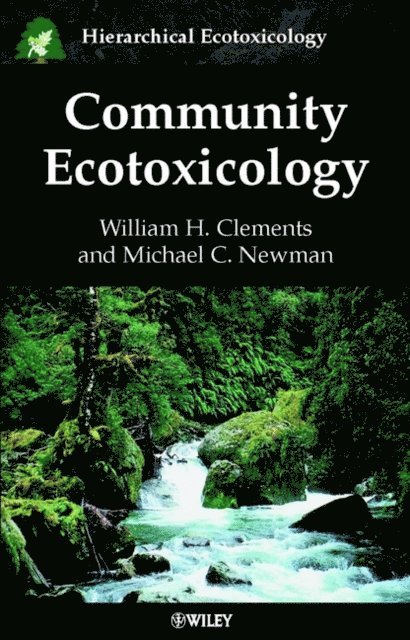
Ecotoxicology is the study of the effects of toxicants on ecological systems. Ecological effects of contaminants may occur at several levels of biological organisation, from individual organisms to the entire biosphere. Communities consist of interacting populations that overlap in time and space. Thus, community ecotoxicology is concerned with effects of contaminants on communities. This is one of a series of five books that will provide a comprehensive treatment of field ecotoxicology, it provides important insights into how contaminants affect the distribution and abundance of organisms in nature. * Both authors are well known highly respected scientists in the field. * The first book to be dedicated to ''community ecotoxicology.''
Inbunden, Engelska, 2007
2 809 kr
Skickas inom 10-15 vardagar
Integrating ecotoxicological concepts across a range of hierarchical levels, Ecotoxicology: A Comprehensive Treatment focuses on the paradigms and fundamental themes of ecotoxicology while providing the detail and practical application of concepts often found in more specialized books. By synthesizing the best qualities of a general textbook and the narrower, more specific scope of a technical reference, the authors create a volume flexible enough to cover a variety of instructional vantages and thorough enough to engender a respect for the importance of understanding and integrating concepts from all levels of biological organization.Divided into six sections, the book builds progressively from the biomolecular level toward a discussion of effects on the global biosphere. It begins with the fundamentals of hierarchical ecotoxicology and vantages for exploring ecotoxicological issues. The second section introduces organismal ecotoxicology and examines effects to biochemicals, cells, organs, organ systems, and whole organisms, and bioaccumulation and bioavailability of contaminants. Population ecotoxicology, section three, places the discussion in the larger context of entire populations by analyzing epidemiology, population dynamics, demographics, genetics, and natural selection. Section four encompasses issues of community ecotoxicology. This section presents biotic and abiotic factors influencing communities, biomonitoring and community response, and the application of multimetric and multivariate approaches. Section five evaluates the entire ecosystem by describing assessment approaches, identifying patterns, analyzing relationships between species, and reviewing the effects of global atmospheric stressors. A detailed conclusion integrating the concepts discussed and promoting a balanced assessment of the overarching paradigms rounds out the coverage in section six.
E-bok
Engelska, 20073 244 kr
Läs direkt efter köp
A unique presentation that unifies the field, this book brings together concepts and information about contaminant effects at all levels of the biological hierarchy. Beginning at the biomolecular level, this book builds progressively toward a discussion of effects to the global biosphere. Emphasizing ecological components and fundamental paradigms, the authors strike a balance between the presentation of details relevant at each level and the integration of phenomena and processes among levels. A milestone in the field, the book is suitable for graduate courses, as well as a reference for professionals in the field.
E-bok
Engelska, 20071 221 kr
Läs direkt efter köp
A unique presentation that unifies the field, this book brings together concepts and information about contaminant effects at all levels of the biological hierarchy. Beginning at the biomolecular level, this book builds progressively toward a discussion of effects to the global biosphere. Emphasizing ecological components and fundamental paradigms, the authors strike a balance between the presentation of details relevant at each level and the integration of phenomena and processes among levels. A milestone in the field, the book is suitable for graduate courses, as well as a reference for professionals in the field.