William Honeychurch - Böcker
Visar alla böcker från författaren William Honeychurch. Handla med fri frakt och snabb leverans.
3 produkter
3 produkter
Del 98 - Yale University Publications in Anthropology, Yale Peabody Museum
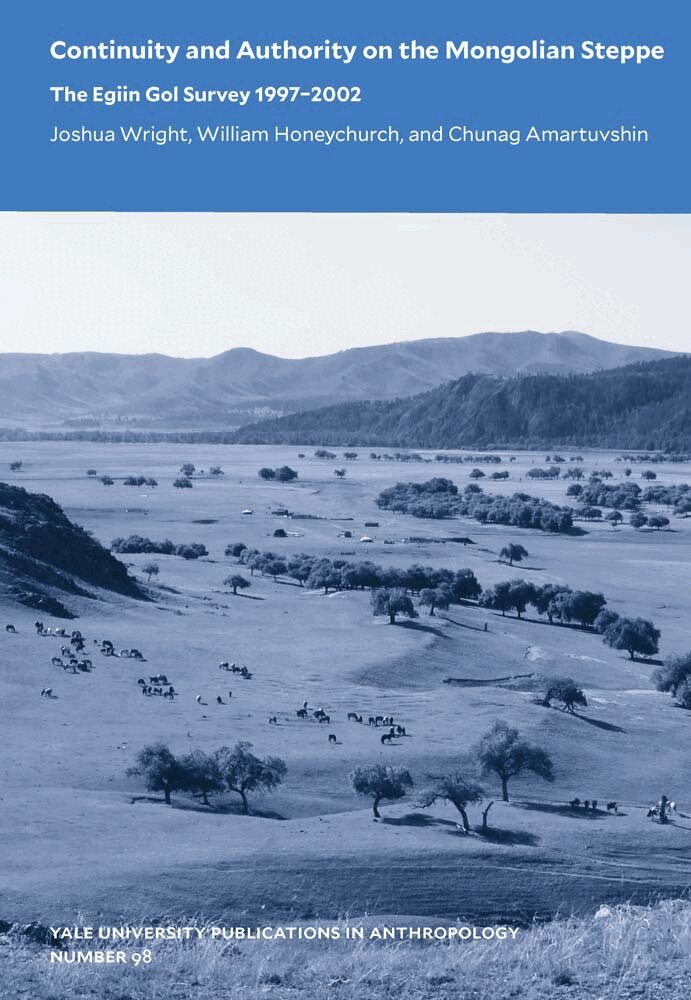
Continuity and Authority on the Mongolian Steppe
The Egiin Gol Survey 1997–2002
Häftad, Engelska, 2024
421 kr
Skickas inom 7-10 vardagar
The first published archaeological survey of the Egiin Gol valley of Mongolia, spanning the last 30,000 years and centering on the integration of local sites and landscape This is the first complete intensive regional archaeological survey report for Mongolia to be published. It presents the experiences and results of groundbreaking fieldwork that detected ephemeral steppe settlement sites, extensive monumental constructions, and changing land use that span the last 30,000 years, from the late Upper Paleolithic to the nineteenth century. Extensive illustrations of monuments and ceramics provide comparative data and local detail in an integrated landscape- and settlement-based approach to the prehistory and history of eastern Eurasia. The authors examine the place of Egiin Gol in the Xiongnu and Early Turkic polities and reveal the historical landscape of Buddhist monasteries and farms, highlighting this region of northern Mongolia as a historical breadbasket. Throughout, the focus is on the local and immediate archaeology of the Egiin Gol valley, the impetus for change and continuity, and how sites and features worked together to create past cultural landscapes. This volume is aimed at Eurasian and Mongolian specialists, archaeologists in general, landscape archaeologists, historians of East Asia and Eurasia, environmental historians, and agrarian studies scholars interested in the history and study of pastoralism, including development and rangeland management. Distributed for the Yale Peabody Museum
Inner Asia and the Spatial Politics of Empire
Archaeology, Mobility, and Culture Contact
Inbunden, Engelska, 2014
1 092 kr
Skickas inom 10-15 vardagar
This monograph uses the latest archaeological results from Mongolia and the surrounding areas of Inner Asia to propose a novel understanding of nomadic statehood, political economy, and the nature of interaction with ancient China. In contrast to the common view of the Eurasian steppe as a dependent periphery of Old World centers, this work views Inner Asia as a locus of enormous influence on neighboring civilizations, primarily through the development and transmission of diverse organizational models, technologies, and socio-political traditions. This work explores the spatial management of political relationships within the pastoral nomadic setting during the first millennium BCE and argues that a culture of mobility, horse-based transport, and long-distance networking promoted a unique variant of statehood. Although states of the eastern steppe were geographically large and hierarchical, these polities also relied on techniques of distributed authority, multiple centers, flexiblestructures, and ceremonialism to accommodate a largely mobile and dispersed populace. This expertise in “spatial politics” set the stage early on for the expansionistic success of later Asian empires under the Mongols and Manchus.Inner Asia and the Spatial Politics of Empire brings a distinctly anthropological treatment to the prehistory of Mongolia and is the first major work to explore key issues in the archaeology of eastern Eurasia using a comparative framework. The monograph adds significantly to anthropological theory on interaction between states and outlying regions, the emergence of secondary complexity, and the growth of imperial traditions. Based on this approach, the window of Inner Asian prehistory offers a novel opportunity to investigate the varied ways that complex societies grow and the processes articulating adjacent societies in networks of mutual transformation.
Inner Asia and the Spatial Politics of Empire
Archaeology, Mobility, and Culture Contact
Häftad, Engelska, 2016
1 092 kr
Skickas inom 10-15 vardagar
This monograph uses the latest archaeological results from Mongolia and the surrounding areas of Inner Asia to propose a novel understanding of nomadic statehood, political economy, and the nature of interaction with ancient China. In contrast to the common view of the Eurasian steppe as a dependent periphery of Old World centers, this work views Inner Asia as a locus of enormous influence on neighboring civilizations, primarily through the development and transmission of diverse organizational models, technologies, and socio-political traditions. This work explores the spatial management of political relationships within the pastoral nomadic setting during the first millennium BCE and argues that a culture of mobility, horse-based transport, and long-distance networking promoted a unique variant of statehood. Although states of the eastern steppe were geographically large and hierarchical, these polities also relied on techniques of distributed authority, multiple centers, flexiblestructures, and ceremonialism to accommodate a largely mobile and dispersed populace. This expertise in “spatial politics” set the stage early on for the expansionistic success of later Asian empires under the Mongols and Manchus.Inner Asia and the Spatial Politics of Empire brings a distinctly anthropological treatment to the prehistory of Mongolia and is the first major work to explore key issues in the archaeology of eastern Eurasia using a comparative framework. The monograph adds significantly to anthropological theory on interaction between states and outlying regions, the emergence of secondary complexity, and the growth of imperial traditions. Based on this approach, the window of Inner Asian prehistory offers a novel opportunity to investigate the varied ways that complex societies grow and the processes articulating adjacent societies in networks of mutual transformation.