William J Hinke – författare
Visar alla böcker från författaren William J Hinke. Handla med fri frakt och snabb leverans.
6 produkter
Life and Letters of the Rev. John Philip Boehm; Founder of the Reformed Church in Pennsylvania
Av William J Hinke, Publication and Sunday School Board O
Inbunden, 2023
504 kr
Lägg i varukorg
Life and Letters of the Rev. John Philip Boehm; Founder of the Reformed Church in Pennsylvania
Av William J Hinke, Publication and Sunday School Board O
Häftad, 2023
385 kr
Lägg i varukorg
Records of the Evangelical Reformed Church in Frederick, Maryland 1746-1800
Av William J Hinke, E W Reinecke
Häftad, 2019
252 kr
Lägg i varukorg
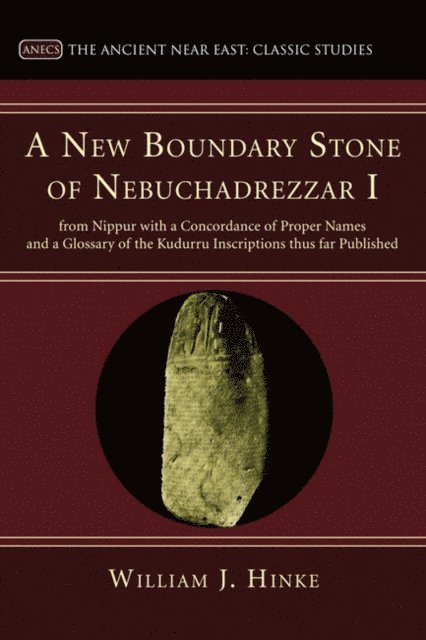
New Boundary Stone of Nebuchadrezzar I from Nippur with a Concordance of Proper Names and a Glossary of the Kudurru Inscriptions thus far Published
Av William J. Hinke, K. C. Hanson
E-bok, 2009
572 kr
Lägg i varukorg
The remains of ancient societies often require decades to unearth, but much longer to interpret and understand. The methods of archaeology have progressed dramatically in recent years. Archaeologists have continuously refined their tools, methods, and techniques. Today archaeology is characterized …
New Boundary Stone of Nebuchadrezzr I
From Nippur
Inbunden, 1907
1350 kr
Tillfälligt slut
This book is a volume in the Penn Press Anniversary Collection. To mark its 125th anniversary in 2015, the University of Pennsylvania Press rereleased more than 1,100 titles from Penn Press's distinguished backlist from 1899-1999 that had fallen out of print. Spanning an entire century, the …