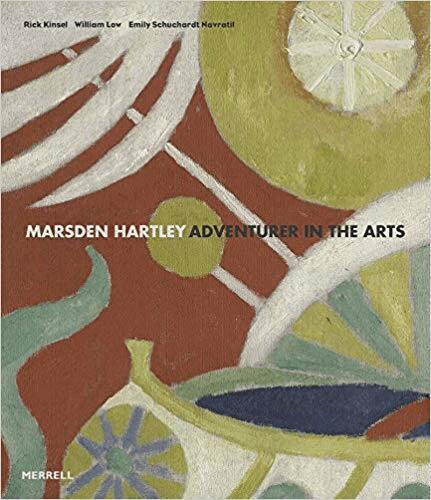
Marsden Hartley (1877-1943) was proud to call himself an American artist, but he dreamed of travel to Europe, believing instinctively that he would learn more there than would be possible in his home state of Maine or even in New York. In 1909 Alfred Stieglitz gave Hartley his first solo exhibition in New York, and a second successful show three years later enabled him to head to Europe, where he spent time in Paris, Berlin and Munich. His rise to prominence as a specifically American modernist was based largely on the visual ideas and influences that he encountered in these vibrant cities, which he then synthesized through his own New England point of view. Hartley, who was by nature something of a loner, never lost his wanderlust, and throughout his life found inspiration in many other landscapes and cultures, including in southern France, Italy, Bermuda, Mexico and Canada.Marsden Hartley: Adventurer in the Arts, published to coincide with an exhibition opening at the Vilcek Foundation in New York, offers a fresh appraisal of a pioneering modernist whose work continues to be celebrated for its spirituality, experimentation and innovation. Rick Kinsel's introduction provides an overview of the manifold ways in which Hartley's travels shaped his artistic vision, from experiencing the latest art in Paris and finding a mentor there in Gertrude Stein to meeting members of the Blaue Reiter group in Germany and developing an interest in both Prussian military pageantry and Bavarian folk art; from becoming fascinated with ancient Aztec and Mayan cultures while in Mexico to being inspired by the traditional pueblo life of the Native Americans of the Southwest. William Low surveys items from the Marsden Hartley Memorial Collection of Bates College Museum in Maine - including memorabilia from the artist's travels and artefacts reflecting his diverse spiritual interests - and explains how they aid our understanding of Hartley's motivation and passions. Among them are a photograph album tracing the course of Hartley's peripatetic life from 1908 to 1930 and a notebook of `Color Exercises', both of which are reproduced in full. Emily Schuchardt Navratil considers how Hartley's desire for escape was reflected in his love of the circus, a recurrent theme in his paintings, drawings and writings. He was enthralled by the spectacle and the nomadic existence, and he imagined circus performers to be members of his own wandering troupe. For fifteen years he worked on a book devoted to the subject, but it was left unfinished at his death; an 18-page typescript version is reproduced here in its entirety. Kinsel then explores Hartley's painting Canoe (Schiff), created in Berlin in 1915 as part of his Amerika series of brightly coloured works defined by imagery drawn from both Native American material culture and German folk art. For Hartley, these paintings represented a dual cultural identity. The main part of the book, by Navratil, features some 100 paintings, drawings, photographs and postcards, arranged into seven country- or state-themed sections, with a concluding section on Hartley's personal possessions, which - because he had no permanent home of his own - held extraordinary significance for him.