William M. Tepfenhart – författare
Visar alla böcker från författaren William M. Tepfenhart. Handla med fri frakt och snabb leverans.
3 produkter
3 produkter
E-bok
PDF, Engelska, 2007712 kr
Läs direkt efter köp
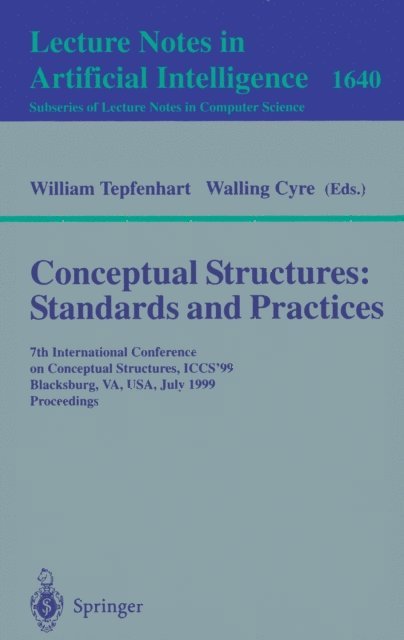
With all of the news about the Internet and the Y2K problem, it is easy to forget that other areas of computer science still exist. Reading the newspaper or watching the television conveys a very warped view of what is happening in computer science. This conference illustrates how a maturing subdiscipline of computer science can continue to grow and integrate within it both old and new approaches despite (or perhaps due to) a lack of public awareness. The conceptual graph community has basically existed since the 1984 publication of John Sowa''s book, "Conceptual Structures: Information Processing In Mind and Machine." In this book, John Sowa laid the foundations for a knowledge representation model called conceptual graphs based on semantic networks and the existential graphs of C.S. Peirce. Conceptual graphs constitutes a very powerful and expressive knowledge representation scheme, inheriting the benefits of logic and the mathematics of graphs. The expressiveness and formal underpinnings of conceptual graph theory have attracted a large international community of researchers and scholars. The International Conferences on Conceptual Structures, and this is the seventh in the series, is the primary forum for these researchers to report their progress and activities. As in the past, the doors were open to admit alternate representation models and approaches.
Häftad, Engelska, 1994
560 kr
Skickas inom 10-15 vardagar
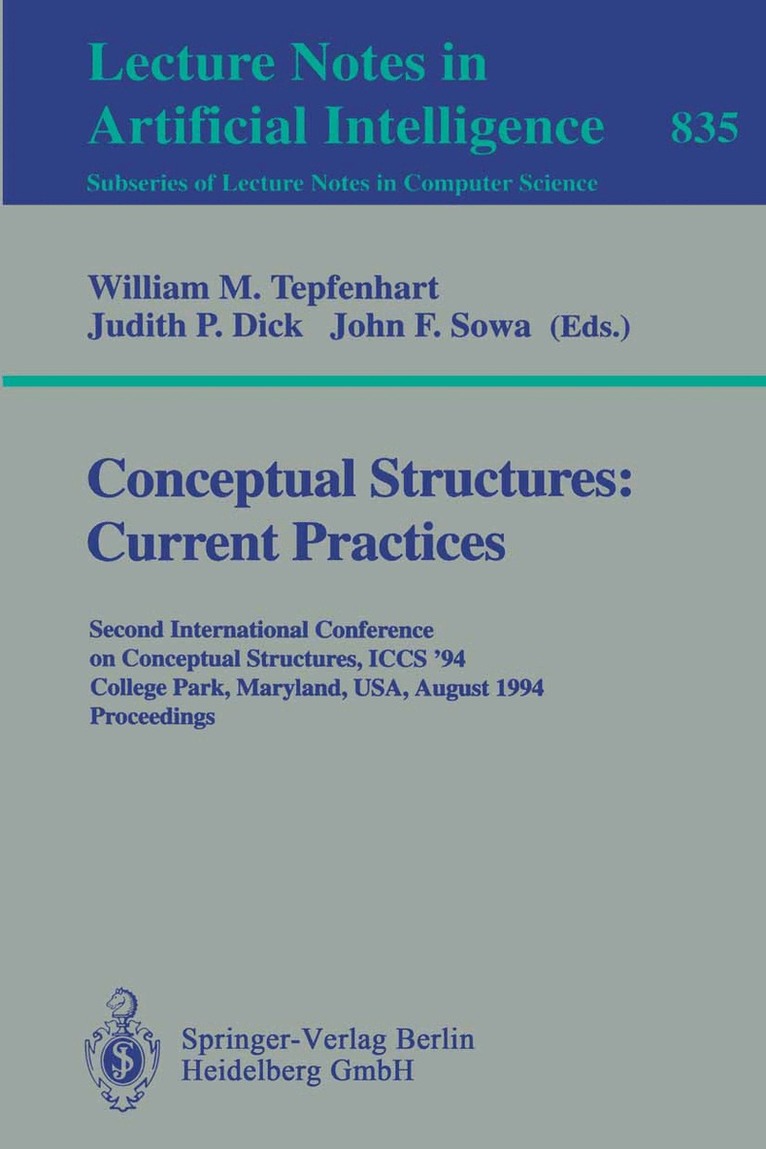
This book is the proceedings of the Second International Conference on Conceptual Structures, ICCS '94, held at College Park, Maryland, USA in August 1994.This proceedings presents, on an international scale, up-to- the-minute research results on theoretical and applicational aspects of conceptual graphs, particularly on the use of contexts in knowledge representation. The concept of contexts is highly important for all kinds of knowledge-intensive systems. The book is organized into sections on natural language understanding, rational problem solving, conceptual graph theory, contexts and canons, and data modeling.
Häftad, Engelska, 1999
560 kr
Skickas inom 10-15 vardagar
With all of the news about the Internet and the Y2K problem, it is easy to forget that other areas of computer science still exist. Reading the newspaper or watching the television conveys a very warped view of what is happening in computer science. This conference illustrates how a maturing subdiscipline of computer science can continue to grow and integrate within it both old and new approaches despite (or perhaps due to) a lack of public awareness. The conceptual graph community has basically existed since the 1984 publication of John Sowa's book, "Conceptual Structures: Information Processing In Mind and Machine." In this book, John Sowa laid the foundations for a knowledge representation model called conceptual graphs based on semantic networks and the existential graphs of C.S. Peirce. Conceptual graphs constitutes a very powerful and expressive knowledge representation scheme, inheriting the benefits of logic and the mathematics of graphs. The expressiveness and formal underpinnings of conceptual graph theory have attracted a large international community of researchers and scholars. The International Conferences on Conceptual Structures, and this is the seventh in the series, is the primary forum for these researchers to report their progress and activities. As in the past, the doors were open to admit alternate representation models and approaches.