William Meyer - Böcker
Visar alla böcker från författaren William Meyer. Handla med fri frakt och snabb leverans.
5 produkter
5 produkter
How to Sell Music, Collectibles, and Instruments on eBay... And Make a Fortune
Häftad, Engelska, 2004
210 kr
Skickas inom 5-8 vardagar
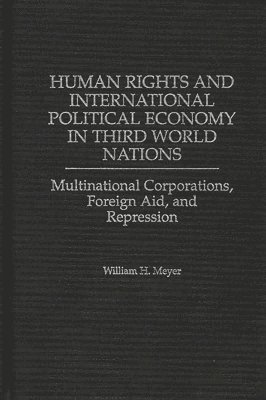
Human Rights and International Political Economy in Third World Nations
Multinational Corporations, Foreign Aid, and Repression
Inbunden, Engelska, 1998
1 009 kr
Skickas inom 10-15 vardagar
What impact do international economic inputs have on human rights in Third World nations? William Meyer explores the effects of direct investment by U.S. multinational corporations, economic and military aid, and MNC manufacturing plants. He examines the international political economy of human rights at both the national and the international levels. Case studies are combined with quantitative studies that use aggregate cross-national data, and theories that link MNCs to human rights are subjected to empirical testing.As Meyer illustrates, at the national level, human rights violations are associated with U.S. MNCs in Chile, Honduras, India, Indonesia, and Mexico. MNCs have been especially guilty of violating labor rights, particularly through their reliance on sweatshops. MNCs have also been responsible for widespread pollution and environmental degradation. At a broader international level, increased investment by MNCs tends to go along with human rights improvements in the Third World as a whole. Meyer shows that there is a broad positive relationship between direct investment by MNCs and broader political rights and improved living standards. Aggregate data are also analyzed for human rights as compared to U.S. economic and military aid. Economic aid is found to be associated with improved civil-political rights and improved socioeconomic rights. Military aid, by contrast, is associated with declining levels of civil rights and with lower levels of social welfare. This book will serve as an important study for researchers, activists, and students of human rights.
Human Rights and International Political Economy in Third World Nations
Multinational Corporations, Foreign Aid, and Repression
Häftad, Engelska, 1998
474 kr
Skickas inom 10-15 vardagar
What impact do international economic inputs have on human rights in Third World nations? William Meyer explores the effects of direct investment by U.S. multinational corporations, economic and military aid, and MNC manufacturing plants. He examines the international political economy of human rights at both the national and the international levels. Case studies are combined with quantitative studies that use aggregate cross-national data, and theories that link MNCs to human rights are subjected to empirical testing.As Meyer illustrates, at the national level, human rights violations are associated with U.S. MNCs in Chile, Honduras, India, Indonesia, and Mexico. MNCs have been especially guilty of violating labor rights, particularly through their reliance on sweatshops. MNCs have also been responsible for widespread pollution and environmental degradation. At a broader international level, increased investment by MNCs tends to go along with human rights improvements in the Third World as a whole. Meyer shows that there is a broad positive relationship between direct investment by MNCs and broader political rights and improved living standards. Aggregate data are also analyzed for human rights as compared to U.S. economic and military aid. Economic aid is found to be associated with improved civil-political rights and improved socioeconomic rights. Military aid, by contrast, is associated with declining levels of civil rights and with lower levels of social welfare. This book will serve as an important study for researchers, activists, and students of human rights.
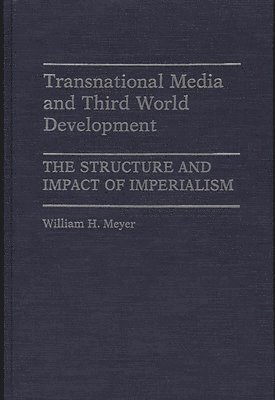
Transnational Media and Third World Development
The Structure and Impact of Imperialism
Inbunden, Engelska, 1988
797 kr
Skickas inom 10-15 vardagar
The study first addresses the political issues and media theories that culminated in the demand for the NWIO, and the ongoing debate among scholars, policymakers, and diplomats concerning reforms in communications. Through a comparative analysis of Western and Third World media practices, Meyer examines the relationship between the understanding of the term news and two conflicting theories of communication and development. The structuralist theoretical alternative is tested in empirical, quantitative studies on the following topics: imbalances in the structure of international information flows; cultural change in less-developed countries produced by media inputs from the West; and Western news and information flows as factors contributing to political instability and violence in the Third World. Based on an examination of economic, social, and cultural indicators in twenty-four less developed countries, the author critically assesses charges relating to neocolonialist features of news and information management, as well as cultural imperialism and political unrest. The final chapter summarizes these empirical tests as they relate to stuctural communications theory. Bridging the gap between general theories of mass media and empirical examination of media relationships, Meyer's book is a major contribution to our understanding of the global ramifications of the Information Revolution.
187 kr
Skickas