William R. Cotton – författare
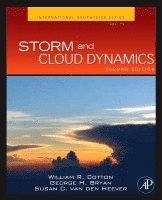
Storm and Cloud Dynamics
801 kr
Skickas inom 10-15 vardagar
Storm and Cloud Dynamics focuses on the dynamics of clouds and of precipitating mesoscale meteorological systems. Clouds and precipitating mesoscale systems represent some of the most important and scientifically exciting weather systems in the world. These are the systems that produce torrential rains, severe winds including downburst and tornadoes, hail, thunder and lightning, and major snow storms. Forecasting such storms represents a major challenge since they are too small to be adequately resolved by conventional observing networks and numerical prediction models.
Provides a complete treatment of clouds integrating the analysis of air motions with cloud structure, microphysics, and precipitation mechanics Describes and explains the basic types of clouds and cloud systems that occur in the atmosphere-fog, stratus, stratocumulus, altocumulus, altostratus, cirrus, thunderstorms, tornadoes, waterspouts, orographically induced clouds, mesoscale convection complexes, hurricanes, fronts, and extratropical cyclones Summarizes the fundamentals, both observational and theoretical, of atmospheric dynamics, thermodynamics, cloud microphysics, and radar meteorology, allowing each type of cloud to be examined in depth Integrates the latest field observations, numerical model simulations, and theory Supplies a theoretical treatment suitable for the advanced undergraduate or graduate level, as well as post-graduate855 kr
Läs direkt efter köp
756 kr
Läs direkt efter köp
863 kr
Skickas inom 7-10 vardagar
1 630 kr
Skickas inom 10-15 vardagar
1 977 kr
Läs direkt efter köp
Life on Earth is critically dependent upon the continuous cycling of water between oceans, continents and the atmosphere. Precipitation (including rain, snow, and hail) is the primary mechanism for transporting water from the atmosphere back to the Earth’s surface. It is also the key physical process that links aspects of climate, weather, and the global hydrological cycle. Changes in precipitation regimes and the frequency of extreme weather events, such as floods, droughts, severe ice/snow storms, monsoon fluctuations and hurricanes are of great potential importance to life on the planet. One of the factors that could contribute to precipitation modification is aerosol pollution from various sources such as urban air pollution and biomass burning. Natural and anthropogenic changes in atmospheric aerosols might have important implications for precipitation by influencing the hydrological cycle, which in turn could feed back to climate changes.
From an Earth Science perspective, a key question is how changes expected in climate will translate into changes in the hydrological cycle, and what trends may be expected in the future. We require a much better understanding and hence predictive capability of the moisture and energy storages and exchanges among the Earth’s atmosphere, oceans, continents and biological systems. This book is a review of our knowledge of the relationship between aerosols and precipitation reaching the Earth''s surface and it includes a list of recommendations that could help to advance our knowledge in this area.
979 kr
Läs direkt efter köp
1 605 kr
Skickas inom 10-15 vardagar