William S Waldron – författare
Visar alla böcker från författaren William S Waldron. Handla med fri frakt och snabb leverans.
6 produkter
6 produkter
Inbunden, Engelska, 2003
2 182 kr
Skickas inom 10-15 vardagar
This is the story of fifth century CE India, when the Yogacarin Buddhists tested the awareness of unawareness, and became aware of human unawareness to an extraordinary degree. They not only explicitly differentiated this dimension of mental processes from conscious cognitive processes, but also offered reasoned arguments on behalf of this dimension of mind. This is the concept of the 'Buddhist unconscious', which arose just as philosophical discourse in other circles was fiercely debating the limits of conscious awareness, and these ideas in turn had developed as a systematisation of teachings from the Buddha himself. For us in the twenty-first century, these teachings connect in fascinating ways to the Western conceptions of the 'cognitive unconscious' which have been elaborated in the work of Jung and Freud.This important study reveals how the Buddhist unconscious illuminates and draws out aspects of current western thinking on the unconscious mind. One of the most intriguing connections is the idea that there is in fact no substantial 'self' underlying all mental activity; 'the thoughts themselves are the thinker'. William S. Waldron considers the implications of this radical notion, which, despite only recently gaining plausibility, was in fact first posited 2,500 years ago.
Häftad, Engelska, 2006
695 kr
Skickas inom 10-15 vardagar
This is the story of fifth century CE India, when the Yogacarin Buddhists tested the awareness of unawareness, and became aware of human unawareness to an extraordinary degree. They not only explicitly differentiated this dimension of mental processes from conscious cognitive processes, but also offered reasoned arguments on behalf of this dimension of mind. This is the concept of the 'Buddhist unconscious', which arose just as philosophical discourse in other circles was fiercely debating the limits of conscious awareness, and these ideas in turn had developed as a systematisation of teachings from the Buddha himself. For us in the twenty-first century, these teachings connect in fascinating ways to the Western conceptions of the 'cognitive unconscious' which have been elaborated in the work of Jung and Freud.This important study reveals how the Buddhist unconscious illuminates and draws out aspects of current western thinking on the unconscious mind. One of the most intriguing connections is the idea that there is in fact no substantial 'self' underlying all mental activity; 'the thoughts themselves are the thinker'. William S. Waldron considers the implications of this radical notion, which, despite only recently gaining plausibility, was in fact first posited 2,500 years ago.
802 kr
Läs direkt efter köp
This is the story of fifth century CE India, when the Yogacarin Buddhists tested the awareness of unawareness, and became aware of human unawareness to an extraordinary degree. They not only explicitly differentiated this dimension of mental processes from conscious cognitive processes, but also offered reasoned arguments on behalf of this dimension of mind. This is the concept of the ''Buddhist unconscious'', which arose just as philosophical discourse in other circles was fiercely debating the limits of conscious awareness, and these ideas in turn had developed as a systematisation of teachings from the Buddha himself. For us in the twenty-first century, these teachings connect in fascinating ways to the Western conceptions of the ''cognitive unconscious'' which have been elaborated in the work of Jung and Freud.This important study reveals how the Buddhist unconscious illuminates and draws out aspects of current western thinking on the unconscious mind. One of the most intriguing connections is the idea that there is in fact no substantial ''self'' underlying all mental activity; ''the thoughts themselves are the thinker''. William S. Waldron considers the implications of this radical notion, which, despite only recently gaining plausibility, was in fact first posited 2,500 years ago.
E-bok
PDF, Engelska, 2003795 kr
Läs direkt efter köp
This is the story of fifth century CE India, when the Yogacarin Buddhists tested the awareness of unawareness, and became aware of human unawareness to an extraordinary degree. They not only explicitly differentiated this dimension of mental processes from conscious cognitive processes, but also offered reasoned arguments on behalf of this dimension of mind. This is the concept of the ''Buddhist unconscious'', which arose just as philosophical discourse in other circles was fiercely debating the limits of conscious awareness, and these ideas in turn had developed as a systematisation of teachings from the Buddha himself. For us in the twenty-first century, these teachings connect in fascinating ways to the Western conceptions of the ''cognitive unconscious'' which have been elaborated in the work of Jung and Freud.This important study reveals how the Buddhist unconscious illuminates and draws out aspects of current western thinking on the unconscious mind. One of the most intriguing connections is the idea that there is in fact no substantial ''self'' underlying all mental activity; ''the thoughts themselves are the thinker''. William S. Waldron considers the implications of this radical notion, which, despite only recently gaining plausibility, was in fact first posited 2,500 years ago.
Häftad, Engelska, 2023
257 kr
Skickas
E-bok
Engelska, 2023219 kr
Läs direkt efter köp
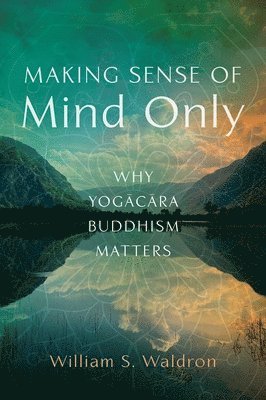
Through engaging, contemporary examples, Making Sense of Mind Only reveals the Yogacara school of Indian Buddhism as a coherent system of ideas and practices for the path to liberation, contextualizing its key texts and rendering them accessible and relevant.The Yogacara, or Yoga Practice, school is one of the two schools of Mahayana Buddhism that developed in the early centuries of the common era. Though it arose in India, Mahayana Buddhism now flourishes in China, Tibet, Korea, Vietnam, and Japan. While the other major Mahayana tradition, the Madhyamaka (Middle Way), focuses on the concept of emptiness—that all phenomena lack an intrinsic essence—the Yogacara school focuses on the cognitive processes whereby we impute such essences. Through everyday examples and analogues in cognitive science, author William Waldron makes Yogacara’s core teachings—on the three turnings of the Dharma wheel, the three natures, the storehouse consciousness, and mere perception—accessible to a broad audience. In contrast to the common characterization of Yogacara as philosophical idealism, Waldron presents Yogacara Buddhism on its own terms, as a coherent system of ideas and practices, with dependent arising its guiding principle. The first half of Making Sense of Mind Only explores the historical context for Yogacara’s development. Waldron examines early Buddhist texts that show how our affective and cognitive processes shape the way objects and worlds appear to us, and how we erroneously grasp onto them as essentially real—perpetuating the habits that bind us to samsara. He then analyzes the early Madhyamaka critique of essences. This context sets the stage for the book’s second half, an examination of how Yogacara texts such as the Samdhinirmocana Sutra and Asanga’s Stages of Yogic Practice (Yogacarabhumi) build upon these earlier ideas by arguing that our constructive processes also occur unconsciously. Not only do we collectively, yet mostly unknowingly, construct shared realities or cultures, our shared worlds are also mediated through the storehouse consciousness (alayavijñana) functioning as a cultural unconscious. Vasubandhu’s Twenty Verses argues that we can learn to recognize such objects and worlds as “mere perceptions” (vijñaptimatra) and thereby abandon our enchantment with the products of our own cognitive processes. Finally, Maitreya’s Distinguishing Phenomena from Their Ultimate Nature (Dharmadharmatavibhaga) elegantly lays out the Mahayana path to this transformation.